
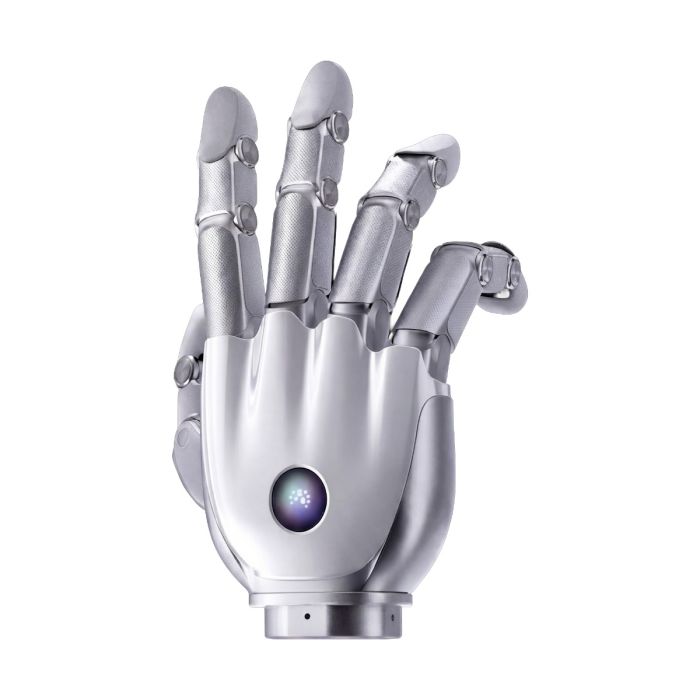
BrainCo Revo 3-21 Basic Robot Hand
In stock
- BRAND:
- BRAINCO
- MODEL:
- REVO 3-21 BASIC
- ORIGIN:
- China
- Warranty:
- 12 MONTHS
- AVAILABILITY:
- SUBJECT TO AVAILABILITY
- SKU:
- BrainCo-Revo-3
BrainCo Revo 3-21 Basic Robot Hand
Twenty-one motors in a single hand is not a feature list item; it is a statement about what a robot should be able to touch. The BrainCo Revo 3-21 Basic Robot Hand is built for teams that have outgrown open-and-close grippers and want fingers that can be commanded one joint at a time, for research, automation and advanced manipulation.
Robots USA sells the BrainCo Revo 3-21 Basic Robot Hand and supplies it to customers in the United States. Robots USA prepares your quotation, arranges delivery and supports the hand after the sale, so one team handles the order from first question to commissioning.
Background
BrainCo and the Revo lineage
BrainCo is a Hangzhou-based company that, per its published profile, was founded in 2015 and already offers three robotic products. The Revo name covers its dexterous hands. Revo 3 is described as the company's third-generation robot dexterous hand and was launched on 10 April 2026. Earlier generations remain in the catalog, including the Revo 1 and Revo 2 hands, so buyers can compare generations before they commit.
The Revo 3 family is reported under several model designations: Revo 3 U21, U21F, U21T and U21VT. Resellers use the shorter names Basic, Touch and Vision. Basic is a reseller name, and the manufacturer has not published a page for it, so the detailed differences between variants should be confirmed with us at quotation.
Positioning and key technology
According to the published description, the hand is designed for industrial automation, scientific research and advanced robotics manipulation. Its core technology is a drive architecture in which each of the 21 degrees of freedom has its own motor. The joints are direct-driven and backdrivable, which the source credits with rapid response and high control density across all finger segments. Backdrivable joints can also be moved by an outside force, a property that developers value when a hand has to interact with real objects and real people around it.
The motors are distributed as the published specification describes: five in the thumb and four in each of the index, middle, ring and pinky fingers. That layout gives the thumb the extra freedom it needs for opposition and in-hand work, the movements that separate a hand from a gripper.
Technical Specifications
| Specification | Value |
|---|---|
| Degrees of freedom | 21 fully active, each with an independently driven motor |
| DoF distribution | Five in the thumb; four in each of the index, middle, ring and pinky fingers |
| Joint drive | Direct-driven and backdrivable |
| Durability rating | Over 1,000,000 joint flex cycles |
| Qualification testing | Vibration, impact, payload, temperature extremes and salt spray |
| Software | C/C++ and Python SDKs for Linux and Windows |
| Recommended power supply | Stable 24V DC, at least 100W |
| Default RS485 IDs | Left hand 126, right hand 127, broadcast 0 |
| Weight | Not published |
| Operating temperature | Not published |
| IP rating | Not published |
| Operating noise | Not published |
| What is in the box | Not published |
Specifications as published; confirmed against the datasheet at quotation. The manufacturer has not published weight, operating temperature, IP rating, noise level or box contents, and we confirm each of them when we quote.
What makes the Revo 3-21 Basic different from a standard gripper?
A standard gripper gives you one or two axes: open and close. A hand with 21 active degrees of freedom lets you shape the grasp around the object. Fingers can curl at different rates, the thumb can oppose any fingertip, and the hand can adopt postures that a jaw mechanism cannot reach. For tasks such as handling small parts, using hand tools or building a grasp library for a learning system, that difference decides whether the project is possible at all.
The drive system matters as much as the count. With direct-driven, backdrivable joints, the published description points to fast response and dense control across every finger segment. Developers working on compliant behavior or learning from demonstration generally look for this combination, because the hand can yield to contact instead of fighting it.
Durability is the other half. The hand is rated for over 1,000,000 joint flex cycles, and the source says it was qualified through vibration, impact, payload, temperature extremes and salt spray testing. We treat this as a per-specification claim to be verified: the test limits and payload figures are not published, and we confirm them against the datasheet when we quote.
How do you power, connect and program the hand?
The published guidance recommends a stable 24V DC supply rated for at least 100W, chosen to reduce the risk of voltage drop when many motors move at once. Undersizing the supply is a common source of erratic behavior in multi-motor hands, so plan the power budget early.
On an RS485 bus, the default left hand ID is 126, the default right hand ID is 127 and the broadcast ID is 0. Those defaults, which the source states for both Revo 2 and Revo 3 hands, make a two-hand setup straightforward to address from the start.
On power-on, the hand runs a physical position calibration. It searches for the starting position of each finger, and all fingers open during this period. Keep the workspace clear of objects and cables at startup, and mount the hand so the fingers can open freely.
For software, BrainCo offers C/C++ and Python SDKs that work on Linux and Windows. That covers most research and integration stacks, whether your control code lives in a Python notebook or a compiled real-time application.
Who is the BrainCo Revo 3-21 Basic Robot Hand for?
Research labs are the clearest fit. Groups working on dexterous manipulation, grasp planning and learning-based control need a hand where each joint is individually commanded, and 21 independent motors give them that.
Automation engineers form the second group. Tasks that involve small, irregular or delicate parts, and that a jaw gripper handles poorly, may justify a multi-finger hand, provided the cycle time and environment fit the specification confirmed at quotation.
Robotics developers building humanoid or mobile manipulation platforms are a third group. The compact form and the cross-platform SDKs help here. Resellers also use the names Touch and Vision for other Revo 3 variants, but the fact sheet we hold does not detail the sensing differences, so we make no claim about what each adds. For teams that already know they need touch or vision sensing, review the BrainCo Revo 3-21 Touch Robot Hand and the BrainCo Revo 3-21 V-Touch Robot Hand, and ask us to confirm the differences in writing at quotation. The full range is listed in the BrainCo Revo 3 category. Buyers who want a previous-generation hand can look at the BrainCo Revo 2 Basic Right Dexterous Bionic Hand (XRR).
What is the BrainCo Revo 3-21 Basic Robot Hand used for?
- Dexterous manipulation research: Study grasping, in-hand motion and multi-finger coordination on real hardware.
- Industrial automation: Handle parts and tasks that two-jaw grippers cannot manage reliably.
- Humanoid and embodied AI platforms: Give a robot arm or humanoid a hand with human-like finger layout.
- Learning from demonstration: Map human hand motion onto a hand with a similar finger structure.
- Tool use experiments: Test how a robot picks up, holds and operates hand tools.
- Teaching and prototyping: Let students and engineers program a full-featured hand in C/C++ or Python.
Pricing and Availability
Pricing for the BrainCo Revo 3-21 Basic Robot Hand is handled by quotation, so send Robots USA your application, quantity and destination and we will respond with a proposal. Delivery, customs and support are arranged with the quotation. Everything we can state about the hand today is available on this page.
Frequently Asked Questions
How many degrees of freedom does the hand have?
It has 21 fully active degrees of freedom, each driven by its own motor. Five are in the thumb and four are in each of the other four fingers.
Is the hand backdrivable?
Yes. The published specification describes direct-driven and backdrivable joints across all finger segments.
What software can I use?
BrainCo provides C/C++ and Python SDKs that are compatible with Linux and Windows, per the published specification.
What power supply does it need?
The recommendation is a stable 24V DC supply rated at no less than 100W. Confirm your wiring and supply against the datasheet at quotation.
What happens when the hand powers on?
It runs a physical position calibration, searching for the starting position of each finger. All fingers open during that period, so keep the area around the hand clear.
How heavy is it, and what is its IP rating?
The manufacturer has not published the weight or the IP rating. We confirm both at quotation.
Where can I buy the BrainCo Revo 3-21 Basic Robot Hand and what does it cost?
You can buy it from Robots USA by requesting a quotation on this page. We do not list prices; the quotation covers the cost, delivery and support for your order.
Summary
The BrainCo Revo 3-21 Basic Robot Hand answers a simple question: what changes when every joint gets its own motor? The answer is a hand that can shape grasps, use direct-driven backdrivable joints, and run on common SDKs, all within the reported durability rating. Several specifications, including weight and IP rating, remain unpublished and are confirmed at quotation. If your work has moved beyond open-and-close, this page is the starting point.