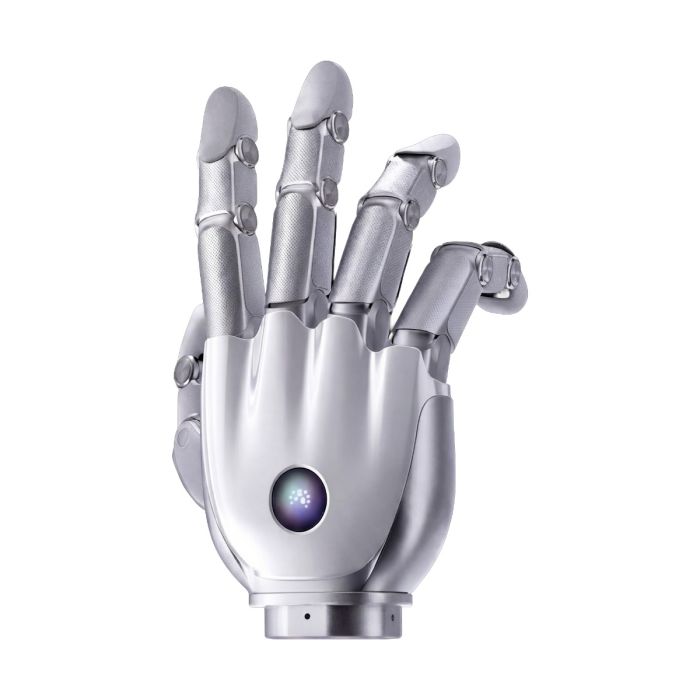
BrainCo Revo 3-21 V-Touch Robot Hand
In stock
- BRAND:
- BRAINCO
- MODEL:
- REVO 3-21 V-TOUCH
- ORIGIN:
- China
- Warranty:
- 12 MONTHS
- AVAILABILITY:
- SUBJECT TO AVAILABILITY
- SKU:
- BrainCo-Revo-3-V-Touch
BrainCo Revo 3-21 V-Touch Robot Hand
Most grippers know only two states, open and closed. The BrainCo Revo 3-21 V-Touch Robot Hand is built for the work in between: holding, adjusting, re-gripping and releasing while the hand reports what it feels. Its joints are direct-driven and backdrivable, and its tactile system combines a palm sensor array with vision-based touch at the fingertips. That makes it a tool for teams who want manipulation data, not just motion.
Robots USA sells the hand and quotes it for each project. We also arrange delivery and support with that quotation, and our team can walk you through which Revo 3 version fits your application.
Background
BrainCo and the Revo lineage
BrainCo is described in its own launch material as a Hangzhou-based brain-computer interface company, sometimes grouped among China's so-called "Six Little Dragons". The Revo 3 is billed as the company's third-generation robot dexterous hand. It follows earlier Revo hands that Robots USA also lists, including the Revo 1 and Revo 2 families, so the design has a visible line of development behind it.
The Revo 3 comes in several versions. This page covers the V-Touch version, and every figure below belongs to it. Please do not read them across to the other versions.
Positioning and key technology
The manufacturer positions the Revo 3 as a biomimetic dexterous hand for industrial automation, scientific research and advanced robotics manipulation. Three design choices define it. The first is a total of 21 degrees of freedom, with direct-driven and backdrivable joints. The second is a finger layout that gives each of the four fingers 4 DoF and the thumb 5 DoF. The third is a two-part tactile system: a piezoresistive array in the palm and vision-tactile sensing at the fingertips.
Direct-driven, backdrivable joints matter because an external force can move the finger. For a hand that works near people, fixtures or fragile parts, that behavior is useful to a control engineer. It is also the kind of architecture researchers look for when they teach a hand by demonstration.
Technical Specifications
| Specification | V-Touch version |
|---|---|
| Total degrees of freedom | 21 (direct-driven and backdrivable) |
| DoF distribution | Four fingers × 4 DoF, thumb × 5 DoF |
| Hand dimensions | 216 × 108 × 50 mm |
| Supply voltage | 16–85 V |
| Max current | 10 A (24 V) |
| Max active grip force | ≥100 N |
| Max fingertip pinch force | ≥25 N |
| Total hand payload | 20 kg |
| Four-finger payload | 5 kg |
| Repeatability | 0.1° |
| Joint open/close time | 0.33 s |
| Max grasping diameter | 150 mm |
| Communication interface | EtherCAT / CAN FD / RS-485 |
| Communication frequency | 500 Hz |
| Onboard sensors | IMU (mainboard), temperature (mainboard) |
| Tactile sensing | Palm piezoresistive array plus fingertip vision-tactile |
| Tactile points | 336 points (piezoresistive) plus 2000 markers (vision-tactile) |
| Motion capability | Full score on the Kapandji opposition test; covers 33 grasp types (Feix GRASP taxonomy) |
| Durability | Rated for over 1,000,000 joint flex cycles |
| Weight, IP rating, operating temperature, noise level, fingertip camera specifications | Not published by the manufacturer |
Specifications as published by the manufacturer; they are confirmed against the datasheet at quotation, and the unpublished items are confirmed at the same time.
What makes the V-Touch version different from a plain dexterous hand?
The difference is in what the hand can tell you. A hand with only joint feedback tells a controller where the fingers are. The V-Touch version also reports where and how the hand is being touched. According to the published specification, the palm carries a piezoresistive array of 336 points. The fingertips use vision-tactile sensing with 2000 markers. The palm array helps with the broad contact of a full-hand grasp. The fingertip sensing is aimed at fine contact.
The motion figures point the same way. The manufacturer reports a full score on the Kapandji opposition test, which checks how well the thumb reaches each finger. It also reports coverage of 33 grasp types from the Feix GRASP taxonomy. Repeatability is listed at 0.1°, and the joint open/close time at 0.33 s. Those are claims from a single published source, so we treat them as figures to be confirmed at quotation.
One gap is worth stating. The manufacturer has not published the specifications of the fingertip cameras themselves. If your vision pipeline depends on resolution or frame rate, raise it when you request a quotation and it will be clarified then.
How does the Revo 3 connect and get programmed?
The published interface list is EtherCAT, CAN FD and RS-485, with a communication frequency of 500 Hz. That gives integrators a choice between industrial fieldbus and lighter serial wiring. On the software side, the manufacturer describes complete cross-platform C/C++ and Python SDKs that work with Linux and Windows.
For power, the published supply range is 16–85 V, and the maximum current is given as 10 A at 24 V. The manufacturer recommends a stable 24V DC supply rated at no less than 100W to reduce the risk of voltage drop. Plan the supply with that in mind, because a sagging rail is a common reason a high-DoF hand misbehaves during a demonstration.
Who is the Revo 3-21 V-Touch for?
Research groups in embodied AI and tactile manipulation are the clearest fit. They need rich contact data to train and test policies, and a hand that exposes both palm and fingertip sensing gives them that. Humanoid developers form a second group. They need a hand with a human-like thumb and a broad grasp repertoire. Industrial automation teams can evaluate it for tasks where parts vary and a fixed gripper would need constant retooling.
Not every project needs the full sensing stack. If you want the dexterous hardware without the tactile layers, look at the BrainCo Revo 3-21 Basic Robot Hand. If palm-and-fingertip touch without vision-based sensing is enough, the BrainCo Revo 3-21 Touch Robot Hand may suit you. Both are separate listings, and their specifications are confirmed on their own pages and at quotation. Choosing the version that matches the task usually makes the project simpler to integrate.
What is the Revo 3-21 V-Touch used for?
- Embodied AI research. Collect contact and manipulation data for learning-based control.
- Humanoid robot platforms. Give a humanoid a hand with a five-DoF thumb and a wide grasp range.
- In-hand manipulation studies. Study re-grasping, rolling and adjusting objects using fingertip touch.
- Flexible industrial handling. Pick mixed parts without a custom gripper for each one.
- Teleoperation and demonstration. Use the backdrivable joints to capture human demonstrations.
- Grasp benchmarking. Test against the Kapandji opposition test and the Feix grasp taxonomy.
Pricing and Availability
Robots USA does not publish a price for this hand. Quotation is the next step: tell us your application, the version you need and the quantity, and we will prepare a quote. Delivery, customs and support are arranged with the quotation. Current terms for the BrainCo Revo 3-21 V-Touch Robot Hand are available on this page.
Frequently Asked Questions
How many degrees of freedom does the V-Touch version have?
The published specification lists 21 DoF, all direct-driven and backdrivable. Each of the four fingers has 4 DoF, and the thumb has 5 DoF.
Which communication interfaces does it support?
The published interfaces are EtherCAT, CAN FD and RS-485, with a communication frequency of 500 Hz. Confirm the interface for your controller at quotation.
What software can I use with it?
The manufacturer describes cross-platform C/C++ and Python SDKs compatible with Linux and Windows.
What power supply does it need?
The published supply voltage range is 16–85 V. The manufacturer recommends a stable 24V DC supply rated at no less than 100W.
How much does it weigh, and is it water- or dust-resistant?
The manufacturer has not published the weight or an IP rating. Both are confirmed at quotation.
How does it differ from the Basic and Touch versions?
The V-Touch version combines a palm piezoresistive array with fingertip vision-tactile sensing. The Basic and Touch versions are listed separately, and their specifications are confirmed on their own pages.
Where can I buy the BrainCo Revo 3-21 V-Touch Robot Hand and what does it cost?
Robots USA sells it by quotation. Send us your requirements and we will prepare an offer. We do not list a price on this page.
Summary
The Revo 3-21 V-Touch is for teams who need a hand that feels as well as grips. The published specification lists 21 backdrivable DoF, palm and fingertip tactile sensing, EtherCAT, CAN FD and RS-485 connectivity, and C/C++ and Python SDKs. The weight, protection rating, operating temperature and fingertip camera details are not published, so they are confirmed at quotation. If you want to evaluate the hand for your project, this page is the starting point.