Quadruped Robots
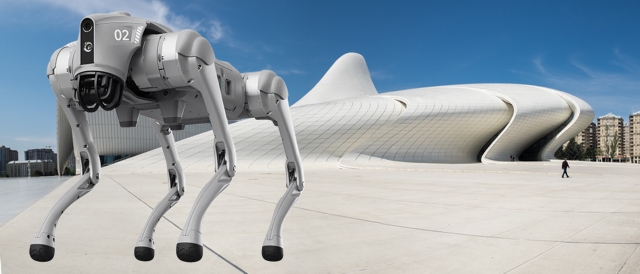
Quadruped robots — four-legged robot dogs — are the most field-proven category in mobile robotics, built to carry sensors and payloads across stairs, rubble, slopes and confined spaces that stop wheeled machines: today they run inspection rounds through power plants and tunnels, patrol perimeters, support police and fire operations, and anchor research and classroom programs nationwide. Robots USA carries America's largest robot-dog selection, from consumer-priced companions to industrial and emergency-response platforms, with FCC-compliant options, financing and support in all fifty states.
Quadruped Robots — Robot Dogs Built for Real Work
Before any robot walked into a factory on two legs, one trotted in on four. The quadruped is mobile robotics' proven veteran — the first legged form to leave the laboratory, survive commercial deployment and come down the cost curve — and the category has now matured into something the pioneers never offered: a genuine market. The 88 machines on this page run from consumer-priced companions to hazard-rated industrial platforms, in two mechanical philosophies — standard quadrupeds that walk everything, and wheeled quadrupeds whose powered wheels roll the smooth stretches and walk the rough ones — plus the robot dog companion class and even robot horses for ride-on and heavy-carry concepts. What they share is the reason the form factor won: four legs put sensors, cameras and payloads in places wheels, tracks and tripods simply cannot reach — up stairwells, across rubble, through 40-degree slopes, into crawl spaces — and they do it daily, on battery cycles, in weather, at costs that now undercut a single year of the labor they relieve. This guide covers how to choose between legs and wheels, which platform fits which mission, what the compliance picture looks like for American buyers, and where the honest limits of the category still sit in 2026.
Every quadruped robot in this category is sold by Robots USA with current pricing shown on each product page, checkout or formal quotation available on all models, financing for qualifying businesses and agencies, and delivery and after-sales support across all fifty states.
Why the Robot Dog Commercialized First
The mission is carrying, not walking
A quadruped earns nothing by walking; it earns by what walking delivers. The category's economics rest on a simple substitution: every inspection round, patrol loop and hazard entry a facility runs is a person's hours plus a person's risk, and a four-legged platform converts both into machine time. The modern robot dog is best understood as a self-propelled sensor mast — visual, thermal, acoustic, LiDAR and gas-detection payloads riding a chassis that goes wherever a technician's boots go — with robotic arms increasingly added for valve turns, door pulls and sample grabs. That is why adoption concentrated in inspection, security and emergency response: the missions where terrain is hostile, repetition is endless and the alternative is a human in the hazard radius.
From one famous dog to a working market
The category's early fame belonged to a single celebrated machine; its present belongs to competition. Volume manufacturing — led by Unitree, whose Go2 family turned the robot dog into an ordinary purchase — collapsed entry prices by an order of magnitude, while specialists pushed the industrial ceiling upward: Deep Robotics hardened the wheeled-legged formula for utilities and tunnels, Unitree's B2 line scaled into heavy payloads and dedicated fire-rescue configurations, and Faraday Future brought an American-certified family to market in its FX quadruped series. The result on this page is a ladder with no gaps: a classroom can start at companion pricing, a plant can field an IP-rated inspector, a fire department can quote a smoke-and-heat-rated responder — one seller, one support channel, live pricing throughout.
Legs or Wheels? Choosing a Quadruped Configuration
The category's most consequential fork is at the feet. A standard quadruped walks everything — the pure form, mechanically simpler at the foot, at home on the roughest share of terrain and the natural choice for research, education, outdoor patrol and sites that are mostly obstacle. A wheeled quadruped ends each leg in a powered wheel: on smooth floors it rolls at multiples of walking speed and a fraction of walking energy, then stands and steps the moment terrain demands legs — the hybrid that wins in facilities that are mostly corridor with occasional stairs, in large-perimeter patrol where transit time dominates, and in any mission where coverage per battery decides the fleet size. The grid's wheeled options span the ladder — from the Unitree Go2-W and Galileo C1-W to the industrial Deep Robotics LYNX M20S — and the practical rule is unglamorous: count your site's smooth meters against its rough ones, and buy the feet your ratio votes for.
The American Quadruped Range
Unitree anchors the market end to end: the Go2 in Air, Pro and Edu trims from consumer to research spec, the Go2-W on wheels, the athletic A2, the industrial B2 with its fire-rescue variant, the AS2, and the legacy Go1, B1 and AlienGo — with a full accessories tree of batteries and chargers behind them. Deep Robotics brings the utility-proven LYNX wheeled-legged series alongside its X-series industrial walkers and Lite research line. Faraday Future's FX dogs pair a certified professional patrol platform with America's first foundational education quadruped. Galileo fields the compact C1, wheeled C1-W and larger E1; MagicLab's MagicDog-W, AiMOGA's Argos and Genisom's industrial line round out a grid where every filter above — payload, speed, DOF, FCC approval, secondary development — cuts a real shortlist.
Compliance and Public-Sector Buying
Quadrupeds lead robotics into regulated territory — police, fire, critical infrastructure — so the paperwork matters as much as the payload. Radio certification comes first: every connected dog is an FCC-jurisdiction device, and the FCC-Compliant Robots category plus this page's FCC-approved filter isolate models with U.S. equipment authorization in one click — the practical baseline for agency procurement. Workplace deployment follows ordinary machine-safety practice: document a hazard analysis for shared-space operation, configure speed and standoff for occupied areas, and log operations — the data-recording most platforms build in makes the audit trail nearly free. For police, firefighting and government buyers, the proposed federal restrictions on foreign-made robots remain exactly that — proposed, and aimed at federal-agency procurement rather than state, local or private purchases — while data-governance review (where telemetry is stored, what reaches manufacturer clouds, how connectivity is firewalled) is simply good practice for sensitive sites, and our team advises on compliant configurations at quotation.
What can a robot dog honestly do in 2026?
The mature answer flatters the category. Proven, in daily commercial service: autonomous inspection routes with repeatable data capture across plants, substations and tunnels; perimeter and interior patrol with self-charging continuity on dock-equipped models; remote reconnaissance and hazard entry for public-safety teams; sensor carriage — thermal, acoustic, gas, LiDAR mapping — into places fixed instruments and wheeled robots cannot go; and research and teaching, where open SDKs and secondary development (a filter above) have made the quadruped the standard legged platform from high school to doctorate. Still frontier: fine manipulation from a moving base, long fully-autonomous missions in genuinely novel terrain, and crowded-public autonomy without an operator's eye. The buying logic follows: where the mission is a route, a round or a reach problem, the technology is ready and the payback is arithmetic; where it is dexterity or judgment, plan a supervised pilot. The line between the two is exactly what our team helps buyers draw at quotation.
Who are quadruped robots for?
For industrial operators — utilities, energy, manufacturing, mining — converting inspection rounds into autonomous, documented machine time; for security teams fielding tireless patrol across campuses, warehouses and perimeters; for police, fire and emergency agencies putting a machine into the smoke, the rubble or the unknown room ahead of a person; for universities and research groups, for whom the quadruped is legged robotics' reference platform; for schools building STEM programs on classroom-safe dogs with curricula attached; for venues, brands and creators staging the most charismatic machines in robotics; and for individuals and families, where the companion class starts at consumer pricing. Buyers whose missions need hands and human height will find the humanoid catalog one category over — and many programs run both.
What are quadruped robots used for?
- Industrial inspection: autonomous rounds through plants, substations, tunnels and construction sites with multi-sensor data capture.
- Security patrol: perimeter and interior monitoring, day-night cycles and dock-based self-charging continuity.
- Public safety and fire rescue: reconnaissance, hazard assessment and response support ahead of human entry.
- Research and development: locomotion, autonomy and perception work on SDK-open platforms.
- Education: robotics and AI curricula from classroom companions to university fleets.
- Entertainment and companionship: performances, exhibitions, content creation and personal ownership.
Pricing and Availability
Every quadruped robot in this category is available for purchase from Robots USA, with live pricing displayed on each listing above, checkout on stocked models and formal quotations on all — including specialist configurations such as fire-rescue and hazard-rated variants quoted to mission requirements. Because final cost moves with trim, sensor payloads, arms, docks, batteries and accessories, buyers comparing platforms should request a quotation against their site and mission profile; our team advises on legs-versus-wheels selection, FCC-compliant configurations and fleet planning at no charge. Qualifying businesses and agencies can spread acquisition through our financing program, with potential accelerated tax treatment for equipment placed in service this year detailed on the financing page. Delivery and after-sales support cover all fifty states, and all purchasing details are available on this page.
Frequently Asked Questions
What is a quadruped robot?
A four-legged mobile robot built to carry sensors, cameras and payloads across terrain that defeats wheeled machines — stairs, rubble, slopes and confined spaces — spanning standard walking and wheeled hybrid designs from companion to industrial class.
What's the difference between a quadruped robot and a robot dog?
"Robot dog" is the everyday name for the same machines — most naturally the compact, companion-style models — while "quadruped" covers the full category up through industrial and emergency-response platforms.
Should I buy a walking or a wheeled quadruped?
Count your terrain: mostly rough, outdoor or obstacle-dense sites favor pure legs; facilities that are mostly smooth floor with occasional stairs favor wheels-on-legs, which cover far more ground per charge and sprint between waypoints — models like the Go2-W and LYNX M20S exist for exactly that profile.
Which robot dog is best for beginners or education?
Start compact and open: the Unitree Go2 family is the default first dog from home use through university Edu trims, Faraday Future's FX education quadruped adds a full U.S. STEM curriculum, and the secondary-development filter above isolates every programmable model.
Can quadruped robots really work for police and fire departments?
Yes — reconnaissance, hazard entry and response support are among the category's most established public-safety roles, with dedicated configurations such as the Unitree B2 fire-rescue variant quoted to agency requirements alongside our police and firefighting ranges.
What do quadruped robots cost in the USA?
Current prices are shown live on every listing in this category — the range runs from consumer-priced companions to industrial platforms — and because payloads, arms, docks and trims move final cost substantially, serious buyers should request a formal quotation, with financing available for qualifying purchases.
Where can I buy a quadruped robot in the USA and what does it cost?
Right here: every robot dog in this category is sold by Robots USA with nationwide delivery and after-sales support, prices listed on each product page, quotations for configured and volume purchases, and financing available — all purchasing details are on this page.
Summary
The quadruped is where robotics stopped demonstrating and started clocking in: the four-legged platform proved itself on inspection routes, patrol loops and hazard entries years before any other legged machine earned a payroll line, and the market that grew around it now serves every buyer the form factor can help. On this page that market is complete — Unitree's ladder from companion to fire rescue, Deep Robotics' utility-hardened hybrids, Faraday Future's certified American dogs, Galileo, MagicLab and more — split cleanly between legs for the rough and wheels for the long, filtered by payload, openness and FCC status, priced live and financed on request. For the plant, the precinct, the lab, the classroom or the living room, the working dog of robotics is in stock — and this page is the starting point.