BrainCo Revo 1 Intelligent Dexterous Bionic Hand
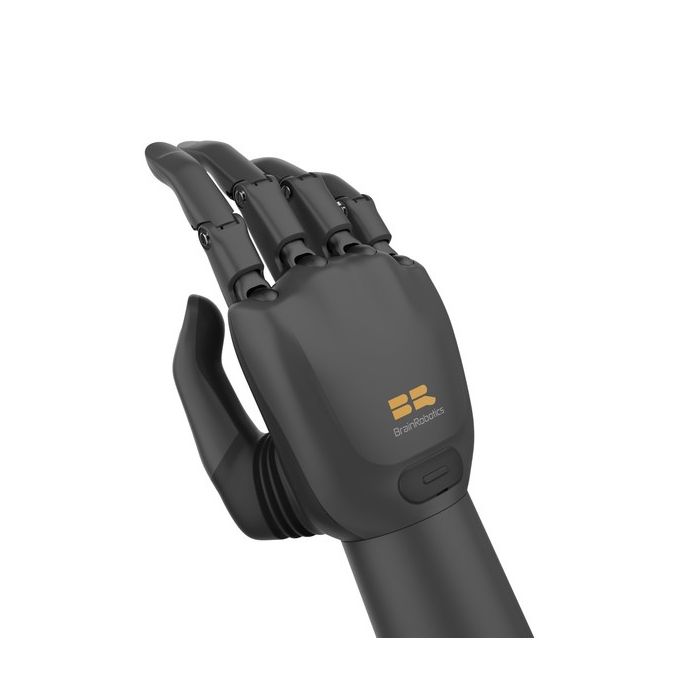
The BrainCo Revo 1 Intelligent Dexterous Bionic Hand is a robotic dexterous hand platform from BrainCo, a brain-computer-interface and human-machine-interface company that publicly lists “BrainCo Bionic Dexterous Hand Revo1” among its product lines on its official website. BrainCo positions itself as a company working across bionic hands, bionic knees, neurotechnology, and AI-oriented robotics solutions.
In stock
- BRAND:
- BRAINCO
- PART #:
- Intelligent Dexterous Bionic Hand
- ORIGIN:
- China
- Warranty:
- 12 MONTHS
- AVAILABILITY:
- SUBJECT TO AVAILABILITY
- SKU:
- BrainCo-Dexterous-Bionic-Hand
BrainCo Revo 1 Intelligent Dexterous Bionic Hand
A gripper closes on an object; a hand decides how to meet it. That gap is where the BrainCo Revo 1 Intelligent Dexterous Bionic Hand sits. It is a biomimetic hand with a thumb that works in two directions and four fingers that each combine a driven joint with a passive one. The aim is a hand that conforms to objects instead of clamping them.
Robots USA supplies the Revo 1 and quotes, delivers and supports it for buyers in the American market. Tell us your application and which Revo 1 configuration you need, and we prepare the quotation around it.
Background
BrainCo and its lineage
BrainCo was founded in 2015 and incubated by the Harvard Innovation Lab (i-Lab). It is based in Somerville, Mass. According to the published source, the company has focused on developing a non-invasive brain-computer interface (BCI). That background explains the Revo 1. A hand meant to be worn, commanded or studied alongside human signals has to be built differently from a hand meant only to pick parts off a conveyor.
The Revo 1 belongs to the family BrainCo lists under its bionic hand products. Later hands in the range appear elsewhere in our catalog, including the Brainco Revo 2 Touch Biomimetic Dexterous Right Hand (XTR) and the BrainCo Revo 3-21 Basic Robot Hand. The full Revo 1 range sits in the BrainCo Revo 1 category.
Positioning and key technology
The Revo 1 is described as a biomimetic dexterous hand with 6 active joints and 10 degrees of freedom (single-source, per the published specification). Ten degrees of freedom driven by six actuated joints means some motion is passive. The finger design makes this explicit. Each of the four fingers pairs one active flexion/extension degree of freedom with one passive flexion/extension degree of freedom. The thumb has two active degrees of freedom, for abduction/adduction and for flexion/extension.
The source also describes a turbo mode based on stall detection. When a finger stalls against an object, it pauses for the configured stall duration and then continues gripping at 500 ms intervals. The hand also runs a position calibration sweep automatically after power-on. For teams that integrate hands into larger systems, the published material lists a ROS 2 driver and Python and C/C++ SDK examples. These are useful starting points for software work.
Technical Specifications
| Specification | Value |
|---|---|
| Type | Biomimetic dexterous hand |
| Active joints | 6 |
| Degrees of freedom | 10 |
| Thumb | 2 active degrees of freedom (abduction/adduction, flexion/extension) |
| Other four fingers | Each 1 active and 1 passive flexion/extension degree of freedom |
| Maximum hand load | 30 kg |
| Five-finger grip force | 50 N |
| Control modes | Position and Speed |
| Turbo mode | Stall-detection based; continues gripping at 500 ms intervals after the configured stall duration |
| Power-on behavior | Automatic position calibration sweep |
| Interface | Under the wrist; connector model PAP-05V-S |
| Device ID | Default 1; configurable within 1 - 254 |
| LED | User-configurable colors and patterns |
| Hardware variants | Revo 1 Basic and Revo 1 Advanced; tactile sensing depends on the SKU |
| Software | ROS 2 driver; Python and C/C++ SDK examples |
| Weight, dimensions, IP rating | Not published by the manufacturer; confirmed at quotation |
Specifications as published by a single source; confirmed against the datasheet at quotation.
What makes the Revo 1 different from a standard gripper?
A parallel gripper has one motion and one job: open, close, hold. The Revo 1 spreads its motion across a thumb and four fingers. That lets it wrap around objects of different shapes instead of pinching them at two points. The thumb matters most here. With two active degrees of freedom, it can move across the palm as well as curl, which is what makes opposed grasps possible.
The published figures give a sense of scale. The maximum hand load is reported as 30 kg and the five-finger grip force as 50 N. The two are different measures, so read them separately and confirm both against the datasheet for your application.
Control is the other difference. The hand offers Position and Speed control modes, so software can either place a finger at a target or drive it at a set rate. Turbo mode adds a behavior for contact. When a finger meets resistance, it pauses for the configured stall duration and then keeps gripping at 500 ms intervals. That is closer to how a person adjusts a hold than a simple force cutoff.
Which Revo 1 configuration do I need?
The sources name Revo 1 Basic and Revo 1 Advanced as the public hardware variants, and also mention a Basic Touch SKU. Tactile sensing depends on the SKU. The fact sheet gives no separate figures for each version, so we do not assign any to one version or another. If your work depends on touch feedback, say so when you request a quotation and we will confirm which SKU carries it.
If you want to compare against a newer generation with tactile options, look at the BrainCo Revo 3-21 Touch Robot Hand. Its specifications differ from the Revo 1 and should be checked on its own page.
Who is the BrainCo Revo 1 for?
Research labs are the clearest fit. A hand with a documented ROS 2 driver and SDK examples in Python and C/C++ is easier to bring into an existing software stack than a hand that arrives with a closed controller. The SDK examples also cover the Control Glove and EMG Armband, which suits teams working on teleoperation or muscle-signal control.
Rehabilitation and prosthetics researchers form a second group. BrainCo's background in human-machine interfaces makes the Revo 1 a natural platform for studying hand function. Our Medical Robots category lists related equipment for that work.
Universities and training programs get a third use. A hand with a visible joint structure and configurable settings teaches kinematics, grasp planning and sensor integration well. Robotics integrators who need a human-scale end-effector for humanoid or manipulation prototypes make up the fourth group. They should check the unpublished items, such as weight and dimensions, before committing to a design.
What is the Revo 1 used for?
- Dexterous manipulation research: Test grasp strategies with a thumb and four fingers instead of a two-jaw gripper.
- Humanoid and arm prototypes: Fit a human-like end-effector to a robot arm or upper-body platform.
- Rehabilitation and prosthetic studies: Explore hand function and human-machine control in a lab setting.
- Teleoperation experiments: Drive the hand from a Control Glove or EMG Armband using the SDK examples.
- Teaching and training: Show students how joints, passive degrees of freedom and control modes combine in a real hand.
- Software integration: Build and test ROS 2 control pipelines against hardware.
Pricing and Availability
We do not list prices on this page. Robots USA prepares a quotation for the Revo 1 configuration you specify. Delivery, customs and support are arranged together with that quotation. Submit your request and the application behind it, and the quotation request is available on this page.
Frequently Asked Questions
How many joints and degrees of freedom does the Revo 1 have?
The published specification lists 6 active joints and 10 degrees of freedom. The difference comes from the passive flexion/extension joints in the four fingers.
How is the thumb built?
The thumb has two active degrees of freedom, abduction/adduction and flexion/extension. Each of the other four fingers has one active and one passive flexion/extension degree of freedom.
What are the load and grip figures?
The source reports a maximum hand load of 30 kg and a five-finger grip force of 50 N. Both come from a single source and are confirmed against the datasheet at quotation.
Which control modes and software are supported?
The hand supports Position and Speed control modes. A ROS 2 driver and Python and C/C++ SDK examples are listed, including examples for the Control Glove and EMG Armband.
Does the Revo 1 have tactile sensing?
It depends on the SKU. Revo 1 Basic and Revo 1 Advanced are the public variants, and a Basic Touch SKU is also named. Tell us your requirement and we confirm the right one.
What is not published?
The manufacturer has not published the hand weight, dimensions, IP rating, box contents or certifications beyond warranty. These are confirmed at quotation.
Where can I buy the Revo 1 and what does it cost?
Robots USA sells the BrainCo Revo 1 and supplies it to American buyers. Pricing is given only in a written quotation, which you can request on this page.
Summary
The Revo 1 is for work where a gripper is not enough. It offers a two-axis thumb, four fingers with active and passive joints, Position and Speed control, a stall-based turbo mode, and software support through ROS 2 and SDK examples. Several details, such as weight, dimensions and IP rating, remain unpublished, so they are confirmed at quotation. If you want a hand that adapts to the object, this page is the starting point.