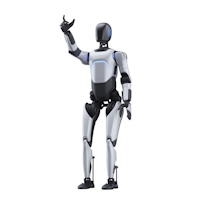
Agibot A2 & A3 USA
The AgiBot A Series (also marketed under the Yuanzheng brand name in China) is the flagship line of full-size bipedal humanoid robots developed by AGIBOT Innovation Shanghai Technology Co., Ltd., known internationally as AgiBot or Zhiyuan Robotics. The A Series spans multiple distinct models covering a range of applications from general-purpose customer service and exhibition work to heavy-duty industrial material handling and high-agility performance robotics.
AgiBot A Series USA: The World's Most Deployed Humanoid Robot Family
The series began with the RAISE A1, launched in August 2023, and has since expanded into the A2 family, which includes the A2 Lite, A2 Ultra, A2 Max, and A2-W variants, and the Expedition A3, unveiled in February 2026. As of March 2026, AgiBot had rolled out its 10,000th humanoid robot overall, with the A Series constituting a substantial share of that total. According to analyst firm Omdia, AgiBot shipped more than 5,100 humanoid robots in 2025, capturing approximately 39 percent of the global humanoid market.
The A2 Ultra, widely considered the reference configuration within the A Series, was the first humanoid robot to hold concurrent top-tier safety certifications in China, the United States, and Europe, having received CR, CE-MD, CE-RED, and FCC certifications as of May 2025. It set a Guinness World Record in November 2025 for the longest distance ever walked by a humanoid robot, completing a cross-provincial journey of 106.286 kilometers from Suzhou to Shanghai under its own power over three days. The same model earned the 2025 iF Design Award and the 2025 Red Dot Award for its industrial design.
The A Series Models
RAISE A1: The Founding Platform
The RAISE A1 was AgiBot's first commercially deployed humanoid robot, launched in August 2023 and aimed primarily at industrial applications. It stands 1.75 meters tall, weighs 53 kilograms, and features 49 degrees of freedom. The A1 is capable of walking at speeds up to 7 km/h and handling loads up to 80 kilograms. Its sensor suite includes an RGBD camera and LiDAR sensors, and its modular component design allowed it to be configured for a range of industrial scenarios including bolt tightening, vehicle inspections, and laboratory experiments.
The A1 served as AgiBot's proof-of-concept platform and helped establish the supply chain, manufacturing processes, and software foundations that made the A2's faster commercial ramp possible. It demonstrated that AgiBot could build and ship a complete bipedal humanoid in its first year of operation.
A2 Lite: The Accessible Entry Point
The A2 Lite is the entry-level configuration within the A2 family, designed to make the platform's core bipedal capabilities available to buyers with more cost-sensitive requirements. It features seven degrees of freedom per arm and six degrees of freedom per leg, with a dedicated six-degree-of-freedom dexterous hand system and two degrees of freedom in the head. Its battery supports approximately 1.5 hours of continuous walking or up to three hours of standing with voice interaction.
The A2 Lite's joint range of motion is published in detail: shoulder pitch at plus or minus 170 degrees, shoulder roll from negative 30 to 95 degrees, shoulder yaw at plus or minus 170 degrees, elbow pitch from negative 1 to 118 degrees, wrist roll at plus or minus 170 degrees, wrist pitch at plus or minus 45 degrees, and wrist yaw at plus or minus 30 degrees. Hip roll ranges from negative 37 to 40 degrees, hip yaw at plus or minus 75 degrees, hip pitch from negative 50 to 110 degrees, knee pitch from negative 5 to 140 degrees, ankle pitch from negative 30 to 52 degrees, and ankle roll at plus or minus 28 degrees.
The A2 Lite supports hot-swappable batteries, allowing battery replacement while powered on for uninterrupted operation. It is manufactured to automotive-grade production standards, with 92 comprehensive inspection checkpoints per unit and multiple aging and endurance tests before shipment.
A2 Ultra: The Flagship Reference Model
The A2 Ultra is the most widely deployed and recognized configuration within the A Series and serves as the technical and commercial benchmark of the family. It stands 169 centimeters tall (175 cm in some published specifications) and weighs approximately 69 kilograms, with dimensions of 169 by 75 by 30 centimeters. It features more than 40 degrees of freedom in total, including six-degree-of-freedom dexterous hands and seven degrees of freedom per arm, with 19 total hand degrees of freedom enabling precision manipulation tasks.
The A2 Ultra's sensor array includes 3D LiDAR for 360-degree spatial awareness, RGB-D cameras for depth perception, fisheye cameras for wide-angle environmental coverage, a microphone array, a speaker, and force and torque sensors on the hands. Its AI computing system delivers 200 TOPS of onboard processing power, enabling real-time execution of large language model-driven interaction, visual recognition, and autonomous navigation planning. The WorkGPT interaction system achieves 96 percent multimodal accuracy and a 99 percent face wake-up rate. The HIMUS 3D-SLAM and VectorFlux planning algorithms provide L4-level autonomous navigation capability.
The A2 Ultra has been validated through up to 2,000 hours of walking tests, including 360 hours of continuous operation without anomalies, equivalent to approximately 18 months of typical usage with zero falls. Continuous over-the-air software updates are issued every two to three months, allowing deployed units to gain new capabilities without hardware changes. The platform's appearance, walking speed, expression behaviors, and action sequences are fully configurable by operators.
The A2 Ultra holds the Guinness World Record for the longest distance walked by a humanoid robot, set in November 2025. It was also the first humanoid robot to complete a 24-hour outdoor walking livestream, demonstrating sustained autonomous stability in high-temperature outdoor conditions. At the 2025 World Humanoid Robot Games, an A2 Ultra configured as a "Terracotta Warrior" won the gold medal in group dance performance.
The A2 Ultra carries PLd-level safety certification and features a three-layer protection architecture operating at the business, system, and hardware levels simultaneously.
A2 Max: The Heavy-Duty Industrial Variant
The A2 Max, also referred to as the Expedition A2 Max, is designed specifically for industrial material handling and palletizing applications where load capacity is the primary requirement. It stands 175 centimeters tall, weighs 85 kilograms, and features 67 total degrees of freedom, the highest of any configuration in the A2 family.
The A2 Max's dual arms use dual-ratio reduction joint modules to deliver a peak joint torque of 450 Newton-meters, enabling a maximum payload of 40 kilograms. The leg joints use linear actuator thigh motors providing 8,800 Newtons of thrust, giving the robot the structural strength needed to maintain bipedal stability while carrying substantial loads. A three-degree-of-freedom waist allows squatting and bending, enabling it to access loads across the full vertical working range from floor level upward.
The A2 Max was demonstrated publicly at AgiBot's August 2024 product launch event, where it moved a 40-kilogram aviation box using its dual-arm system. As of April 2026, the A2 Max is listed as "Coming Soon" on AgiBot's product page, with enterprise buyers encouraged to register interest through AgiBot's official channels.
A2-W: The Wheeled Industrial Humanoid
The A2-W is a wheeled variant of the A2 platform designed for sustained factory and warehouse operation. Rather than bipedal locomotion, it uses a four-wheel-drive mobile base that provides greater stability and energy efficiency during continuous industrial deployment. It features two seven-degree-of-freedom force-controlled arms capable of carrying up to five kilograms per arm, and its batteries are hot-swappable for uninterrupted 24-hour operation cycles.
The A2-W's published dimensions are approximately 770 by 620 by 1,630 millimeters with a weight of approximately 230 kilograms. Its battery capacity of roughly 2 kWh supports approximately five hours of runtime on a charge of about two hours. The A2-W's force-controlled manipulation system provides sub-millimeter precision for assembly and industrial tasks. Fulin Precision, a Chinese manufacturing company, placed an order for nearly 100 A2-W units for deployment at its factories, representing one of the largest single orders for AgiBot humanoid hardware from a single industrial customer.
Expedition A3: The High-Agility Performance Platform
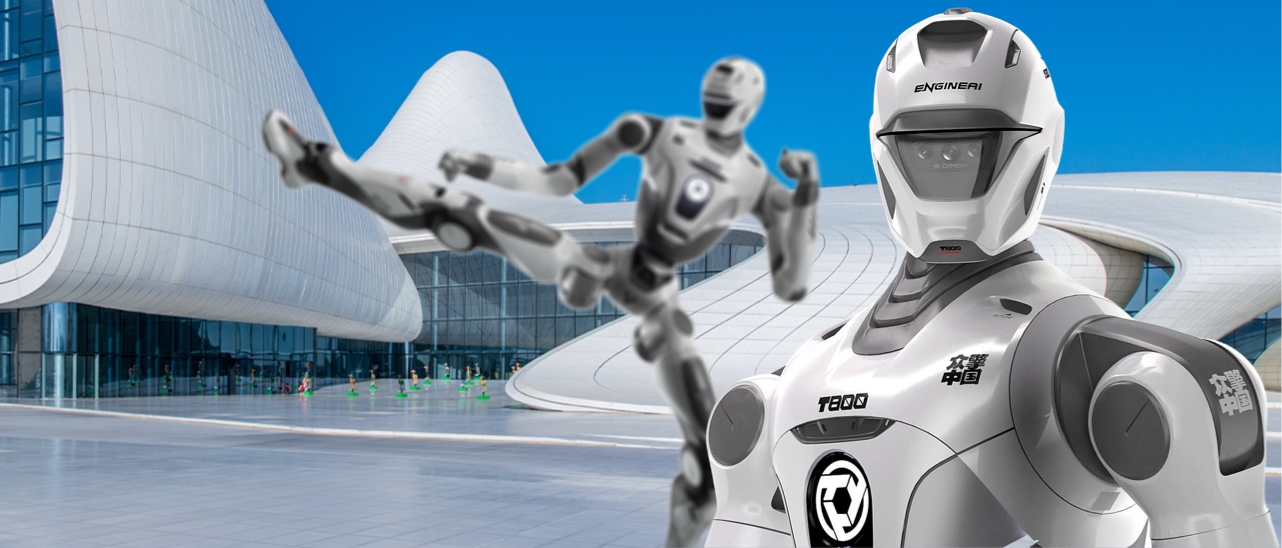
The Expedition A3 was unveiled in February 2026 and represents a different design philosophy within the A Series, prioritizing dynamic performance and audience-facing engagement over service AI and industrial utility. The A3 gained global attention through demonstrations showing it execute aerial flying kicks, consecutive mid-air strikes, cyclone spinning movements, and backflips, all filmed in real-world conditions without computer-generated imagery. These demonstrations led to the robot being informally called "the kung fu robot" in international technology media.
The A3 incorporates a flexible waist joint designed to mirror the rotational and lateral range of the human torso. This waist articulation allows the robot to generate the rotational momentum needed for spinning kicks and mid-air transitions that earlier humanoid platforms with rigid torsos could not execute. Its legs use lightweight exoskeleton construction optimized for explosive jumping and impact absorption. A real-time balance correction algorithm maintains stable posture through airborne phases.
The A3 also features a dual-battery design that enables eight-hour continuous operation, specifically supporting its use in sustained live performance scenarios. Its debut at the AGIBOT Night event in Shanghai on February 7 and 8, 2026, saw more than 200 AgiBot robots perform a 60-minute live gala featuring music, dance, comedy, and martial arts sequences.
Technology and Specifications
AI Architecture
All A Series robots are powered by AgiBot's GO-1 (Genie Operator-1) generalist embodied foundation model, introduced in March 2025. GO-1 uses a Vision-Language-Latent-Action (ViLLA) architecture that combines a Vision-Language Model with a Mixture of Experts framework, enabling robots to learn from human demonstration videos, generalize to zero-shot tasks, and adapt across different embodiments. Pre-trained on the AgiBot World dataset of over one million real-world trajectories, GO-1 achieves over 60 percent success rates on complex tasks and outperforms previous state-of-the-art approaches by 32 percent.
The A Series also incorporates ActionGPT, which generates natural movement sequences from voice commands, and HIMUS 3D-SLAM navigation with VectorFlux path planning for L4-level autonomous mobility in dynamic environments. The integration of WorkGPT provides the conversational and facial interaction layer, with 96 percent multimodal accuracy and a 99 percent face wake-up rate.
At AgiBot's 2026 Partner Conference, the company announced a second-generation AI stack adding the GO-2 (ViLLA) manipulation model with Action Chain-of-Thought reasoning, the Behavioral Foundation Model for learning human-like movements from short videos, and the WITA Omni model for unified multimodal interaction. These updates apply to A Series platforms through over-the-air software updates.
Safety and Certification
The A2 Ultra was the first humanoid robot to hold concurrent top-tier certifications in China (CR), the United States (FCC), and Europe (CE-MD and CE-RED). This triple-certification milestone, achieved in May 2025, removes a significant procurement barrier for enterprise buyers in regulated industries. The A2's safety architecture operates at three simultaneous layers: business-level policy constraints, system-level software safeguards, and hardware-level protection mechanisms.
Applications and Use Cases
The A Series robots collectively address eight core commercial application domains as defined by AgiBot.
Customer service and reception: The A2 Ultra and A2 Lite are deployed as front-desk receptionists, guided tour hosts, and exhibition presenters in hotels, corporate lobbies, shopping centers, museums, and cultural venues. The robot's facial recognition, natural language processing, and autonomous navigation combine to handle visitor greeting, appointment verification, wayfinding, and information delivery.
Manufacturing and industrial assembly: The A2-W is operational on factory production lines for tasks including electronics component handling, seatbelt cylinder assembly, and automotive parts work. The A2 Max is designed for palletizing and material handling where its 40-kilogram payload and 450 Newton-meter arm torque are required.
Live entertainment and performance: The A3's martial arts demonstrations and group performance capability at AGIBOT Night established a new category for the platform. The A2 Ultra also performs in entertainment contexts, having appeared at the 2025 CMG Science and Innovation Gala and Hunan TV's 2026 New Year's Eve Gala.
Brand promotion and marketing: PepsiCo deployed a customized A2 humanoid named Fizzbot as its first robotic brand ambassador, launched at a presentation featuring David Beckham, and used Pepsi-branded AgiBot robots to serve beverages at events including the 2025 World Artificial Intelligence Conference in Shanghai.
Research and education: The open AgiBot World dataset and the A Series' developer SDK and API access make the platform a research tool for universities, engineering programs, and robotics labs studying embodied AI, locomotion, and manipulation.
Logistics and data collection: A Series robots are deployed in warehousing and logistics environments for sorting and navigation tasks, and G2-platform robots collect large-scale embodied AI training data that feeds back into the GO-1 model's continuous improvement.
Advantages and Benefits
Production-scale proven: With more than 5,000 units shipped in 2025, the A Series is backed by a manufacturing track record that no comparable full-size humanoid platform anywhere in the world has matched. Buyers can source multiple units on realistic lead times rather than joining a waitlist for prototypes.
Triple-market safety certification: FCC (USA), CE (Europe), and CR (China) certifications on the A2 Ultra remove regulatory uncertainty for enterprise buyers in all three major markets.
Guinness World Record endurance: The 106.286-kilometer autonomous walk from Suzhou to Shanghai is not merely a marketing achievement; it validates the platform's navigation robustness, power management, and mechanical durability under extended real-world operating conditions.
Design award recognition: The 2025 iF Design Award and 2025 Red Dot Award reflect the A2 Ultra's quality not only as a technical system but as an ergonomically and aesthetically well-considered product, important for customer-facing deployments where appearance matters.
Continuous OTA improvement: Software updates every two to three months mean that deployed units gain new capabilities over time. Organizations that purchase A Series robots today will benefit from the AI improvements that AgiBot's research team releases across the platform's operational lifetime.
Breadth within a single family: The A Series covers customer service (A2 Lite, A2 Ultra), heavy industrial work (A2 Max), wheeled factory deployment (A2-W), and high-agility performance (A3) within a single product family on a common software stack, reducing integration complexity for organizations deploying robots across multiple use cases.
Comparison with Other Humanoid Robots
AgiBot A2 vs. Tesla Optimus
Tesla's Optimus is frequently cited as the future benchmark for affordable humanoid robots, with Tesla targeting a retail price of $20,000 to $30,000 for eventual high-volume production. However, as of early 2026, Optimus remained in a pre-commercial phase with no broad enterprise availability. The A2 Ultra, at $100,000 to $190,000, is more expensive than Tesla's stated long-term pricing target, but is commercially available and production-validated now. For organizations that need a deployable humanoid robot in 2026 rather than a future product, the A2 Series represents one of the very few options with documented production scale and real-world deployment evidence.
AgiBot A2 vs. Agility Robotics Digit
Agility Robotics' Digit, an American humanoid designed for warehouse logistics at Amazon, is priced at approximately $250,000 and focuses on a narrower set of logistics tasks rather than the broad service and industrial range of the A2. The A2 Ultra's lower price point, broader application portfolio, and superior conversational AI make it a more versatile option for organizations not primarily focused on warehouse logistics.
AgiBot A2 vs. Unitree H1
Unitree's H1, priced at approximately $90,000, is a research-oriented bipedal humanoid with a focus on athletic performance and developer accessibility. The A2 Ultra offers more sophisticated service AI, a richer sensor package, a higher degree-of-freedom hand system, and PLd-level safety certification, but at a higher price and with less established US distribution infrastructure than Unitree. For organizations prioritizing ready deployment in customer-facing environments, the A2 Ultra's interaction capabilities and certifications offer meaningful advantages over the H1.
Summary
The AgiBot A Series represents the most commercially validated family of full-size humanoid robots available to US buyers in 2026. From the RAISE A1's initial industrial deployment in 2023 through the A2 Lite and A2 Ultra's broad commercial rollout, the A2 Max's heavy-duty industrial positioning, the A2-W's factory floor deployment at scale, and the Expedition A3's demonstration of a new category in agile performance robotics, the A Series has systematically expanded both the capabilities and the market reach of AgiBot's humanoid platform. The A2 Ultra's Guinness World Record, triple-market safety certifications, iF Design Award, Red Dot Award, and participation in major global events from CES 2026 to national television broadcasts collectively establish it as the most independently validated humanoid robot in large-scale commercial deployment today. For US enterprises in manufacturing, hospitality, retail, entertainment, and research seeking a full-size humanoid robot with proven production scale and real-world deployment evidence, the AgiBot A Series is the definitive reference platform.
Frequently Asked Questions (FAQ)
What is the AgiBot A Series?
The AgiBot A Series is the flagship line of full-size bipedal humanoid robots developed by AgiBot (AGIBOT Innovation Shanghai Technology Co., Ltd., also known as Zhiyuan Robotics). The series includes the RAISE A1 (launched August 2023), the A2 Lite (entry-level service humanoid), the A2 Ultra (the flagship model and Guinness World Record holder), the A2 Max (heavy-duty industrial variant with a 40-kg payload), the A2-W (wheeled factory deployment variant), and the Expedition A3 (high-agility performance platform). Together, the A Series is the most commercially deployed family of full-size humanoid robots in the world by units shipped.
How does the AgiBot A2 Ultra work?
The A2 Ultra uses bipedal locomotion controlled by an AI system that integrates the GO-1 generalist foundation model, HIMUS 3D-SLAM navigation, and VectorFlux path planning. Its 40-plus degrees of freedom across arms, legs, hands, and head enable natural movement and fine-grained manipulation. Six HD cameras, 360-degree LiDAR, RGB-D sensors, and force-torque sensors on the hands provide the robot with comprehensive environmental awareness. WorkGPT handles natural language conversation and facial recognition with 96 percent multimodal accuracy. The entire system runs on 200 TOPS of onboard AI computing, requiring no cloud connection for core operational functions.
Why is the AgiBot A Series important for the humanoid robotics industry?
The A Series is significant because it is the first family of full-size humanoid robots to be mass-produced and commercially deployed at scale, establishing that humanoid robots can move beyond laboratory demonstrations into real enterprise operations. The A2 Ultra's triple-market certification (China, USA, EU), Guinness World Record for autonomous walking, and over-the-air software update system represent the kind of production-grade engineering maturity that distinguishes commercial robots from research prototypes. The A Series is also the primary hardware platform driving AgiBot's position as the world's number-one humanoid robot manufacturer by volume according to analyst firm Omdia.
What are the benefits of the AgiBot A2 for businesses?
The A2 offers several documented benefits for enterprise customers. Its PLd-level three-layer safety architecture enables safe deployment in environments shared with people. Its FCC, CE, and CR certifications reduce regulatory barriers in the US, European, and Chinese markets. Its WorkGPT interaction system, with 96 percent multimodal accuracy, delivers customer-facing conversational quality comparable to leading AI assistants. Its 19-degree-of-freedom dexterous hands enable precision manipulation tasks including threading needles. Its HIMUS 3D-SLAM autonomous navigation and continuous OTA updates ensure the platform improves over time. And its production-scale availability, with more than 5,000 units shipped in 2025, means organizations can procure multiple units on reliable timelines rather than waiting for prototype availability.
What is the difference between the AgiBot A2 Lite and A2 Ultra?
The A2 Lite and A2 Ultra share the same chassis dimensions but differ in degrees of freedom and perception hardware. The A2 Lite uses a 23-DOF configuration with simpler sensing suited to entry-level service and education deployments. The A2 Ultra features 40-plus degrees of freedom with six-DOF dexterous hands, adds 3D LiDAR and RGB-D cameras to the sensor suite, and supports the full WorkGPT interaction stack. The Ultra is the appropriate choice for perception-rich human-robot interaction, contact-aware demonstrations, and customer-facing deployments where sensing fidelity and conversation quality are priorities. The Lite is more cost-efficient for applications where those advanced capabilities are not required.
What Guinness World Record did the AgiBot A2 set?
The AgiBot A2 Ultra set the Guinness World Record for the longest distance walked by a humanoid robot, completing a cross-provincial autonomous walk of 106.286 kilometers from Suzhou to Shanghai over three days in November 2025. This record validates the platform's navigation robustness, power management, and mechanical durability under sustained real-world outdoor conditions, demonstrating capabilities that go well beyond the controlled demonstration environments typical of most humanoid robot testing.
What is the AgiBot A Series? The AgiBot A Series is the flagship humanoid robot product line from AgiBot (Zhiyuan Robotics), a Shanghai-based robotics company. It includes four generations: the RAISE A1 (2023), the Expedition A2 and its variants A2-Max, A2-W, and A2 Ultra (2024-2025), and the Expedition A3 (2026). Each model is a full-size, bipedal or wheeled general-purpose humanoid robot powered by AgiBot's proprietary AI software stack, including the GO-1 foundation model and the WorkGPT multimodal engine.
How does the AgiBot A2 robot work? The AgiBot A2 processes sensory input from onboard cameras, LiDAR, and microphones through its WorkGPT AI engine, which runs at 200 TOPS on local hardware without requiring cloud connectivity. The GO-1 foundation model interprets the robot's environment, understands natural-language instructions, plans multi-step actions, and sends commands to the robot's PowerFlow joint motors and SkillHand dexterous hands. The system supports voice commands, face recognition, obstacle avoidance, and fine-manipulation tasks like threading a needle — all through onboard edge inference.
What are the differences between the AgiBot A2, A2-Max, A2-W, and A2 Ultra? The standard A2 is a general-purpose bipedal humanoid for commercial and industrial use. The A2-Max is a heavy-duty variant with a 40-kilogram payload and 67 degrees of freedom for demanding industrial work. The A2-W is a wheeled version with dual force-controlled arms for repeatable factory assembly tasks at sub-millimeter accuracy. The A2 Ultra is a refined service-oriented model with 40 degrees of freedom, triple-market certification (China, US, EU), up to 1,300 hours of validated continuous walking endurance, and software customization tools for commercial deployments.
What is the AgiBot Expedition A3 robot? The Expedition A3 is AgiBot's third-generation full-size humanoid, unveiled in February 2026. It is designed for high-interaction environments like retail, entertainment, and live events. The A3 features a flexible waist with human-like range of motion, lightweight exoskeleton legs for agility, an eight-hour battery life via a dual-battery torso system, fast battery-swapping, and an end-to-end AI model for wake-word-free conversation. It gained widespread attention for performing aerial flying kicks, consecutive airborne strikes, and cyclone kicks in demonstrations filmed without CGI.
What industries use the AgiBot A Series? The A Series is deployed across automotive manufacturing, electronics assembly, logistics and warehousing, commercial reception and guided tour services, retail and brand activation, research and education, entertainment and live events, and trade show exhibitions. AgiBot has identified industrial manufacturing as the primary near-term revenue driver, with commercial service and household applications projected to grow over the next five to eight years.
How does the AgiBot A2 compare to Tesla Optimus? Both are full-size bipedal humanoid robots designed for general-purpose industrial and commercial tasks. The A2 is available for enterprise purchase today at $100,000 to $190,000, with over 5,000 units shipped in 2025 and triple-market certification. Tesla Optimus was still in limited production as of early 2026 with no public purchase availability, though Tesla has projected an eventual retail price of approximately $20,000 to $30,000 once scale is reached. The competitive dynamics between the two programs will become clearer as Optimus moves toward broader deployment in 2026 and beyond.