
BrainCo Revo 2 Pro Dexterous Right Hand (XER)
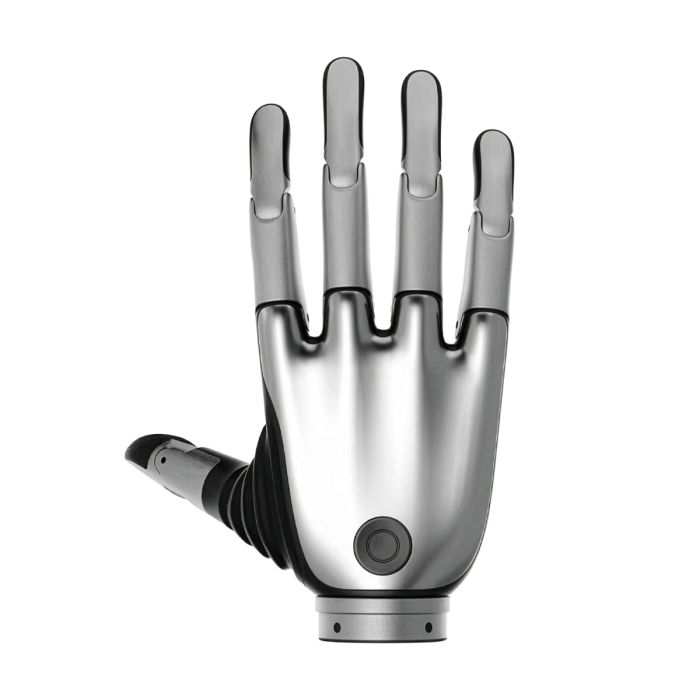
In stock
- BRAND:
- BRAINCO
- MODEL:
- REVO 2 PRO
- PART #:
- XER
- ORIGIN:
- China
- Warranty:
- 12 MONTHS
- AVAILABILITY:
- SUBJECT TO AVAILABILITY
- SKU:
- BrainCo-Revo-2-Pro
BrainCo Revo 2 Pro Dexterous Right Hand (XER)
Bolting a hand onto a robot is the easy part. Getting it to talk to the controller, survive a long test day and stay predictable under load is where projects stall. The BrainCo Revo 2 Pro Dexterous Right Hand (XER) is built around that second problem: a bionic hand for robot integration and research, with three communication interfaces and software support for the main development environments.
Robots USA sells the XER and supplies it to robotics teams, labs and integrators. Robots USA prepares the quotation, arranges delivery and handles support questions after the sale, so one contact covers the process from the first inquiry onward.
Background
The Revo 2 family and its three versions
The Revo 2 line comes in three versions, each offered as a left and a right hand. The Basic version carries the codes XRL and XRR, the Pro version XEL and XER, and the Touch version XTL and XTR. The sources describe the whole line as a bionic dexterous hand for robot integration and research. The XER is the right-hand model of the Pro version, and the XEL is its left-hand counterpart.
The family sits within the broader BrainCo Revo 2 range. Buyers comparing it with other end-effectors can also browse the Hands category.
Where the Pro version sits
The Pro version is the middle step. According to the published specification, it adds EtherCAT to the RS485 and CAN FD interfaces of the Basic version, and it widens the supply voltage range to 12-64V, where the Basic version is listed at 12-28V. The Touch version is listed with the same communication, voltage and current figures as the Pro version. The Pro hand is therefore the choice when bus flexibility and a wide power window matter. The Touch version is the one to look at if tactile capability is on your list.
Its core mechanical layout is 6 active joints and 11 degrees of freedom, as reported in the published specification. It supports Python and C SDK work on Linux, Windows and ROS, and it accepts OTA online upgrades.
Technical Specifications
| Specification | Value (Pro version, XER) |
|---|---|
| Version code | XEL/XER (XER is the right hand) |
| Active joints | 6 |
| Degrees of freedom | 11 |
| Weight | 383 g |
| Height (palm base to middle fingertip) | 160 mm |
| Full fist grip force | ≥50N |
| Pinch force | ≥15N |
| Max payload | ≥20kg |
| Operating noise (at 50cm) | ≤50dB |
| Flexion/extension speed | ≤0.65s |
| Maximum opening and closing distance | 100mm (from thumb to index finger) |
| Communication interface | 485, CANfd, EtherCAT |
| Supply voltage | 12-64V |
| Static current | 115 mA @24V |
| Maximum current | 4.65A @24V |
| Repetitive control precision | 0.1° |
| Operating temperature | -10 - 40℃ / 90%RH |
| Smart protection | Current, stall, high-temperature and anti-collision protection |
| SDK | Python/C; Linux, Windows and ROS |
| Online upgrade | OTA supported |
| Standard colors | Space Gray, Silver (bulk color customization supported) |
| In the box | One dexterous hand, one 485/CANFD communication cable, one power cable, one EtherCAT communication cable |
| Tactile sensing specification | Not published |
| IP rating | Not published |
| Wrist flange dimensions | Not published |
| Service life | Not published |
Specifications as published; confirmed against the datasheet at quotation. The manufacturer has not published a tactile sensing specification, an IP rating, wrist flange dimensions or a service life, so these are confirmed at quotation. The 383 g weight is listed without a left or right distinction, and a right-hand-specific weight has not been published.
What makes the Pro version different from the Basic version?
The differences the sources document are electrical. The Basic hand is listed with RS485 and CAN FD only, a 12-28V supply, a static current of 65 mA @24V and a maximum current of 4.6 A @24V. The Pro hand is listed with RS485, CAN FD and EtherCAT, a 12-64V supply, a static current of 115 mA @24V and a maximum current of 4.65A @24V. The repetitive control precision is listed as 0.1° on all three versions.
For an integrator, EtherCAT is the practical difference. Many industrial and humanoid control stacks already run on it, and a hand that joins the same bus avoids a separate gateway. The wider voltage window also gives more freedom when the hand shares a power rail with other equipment. If your controller only speaks RS485 or CAN FD and your supply sits at or below 28V, the BrainCo Revo 2 Basic Right Dexterous Bionic Hand (XRR) may be enough.
Does the XER need a matching left hand?
Not necessarily. The XER is the right-hand model and works as a single end-effector on one arm. Teams building bimanual systems often want both sides, and the BrainCo Revo 2 Pro Dexterous Left Hand (XEL) is the Pro-version counterpart. The sources list the Pro figures for both codes together, so a pair shares the same published specification. Confirm the mounting arrangement for each side at quotation, since the wrist flange dimensions have not been published.
Who is the BrainCo Revo 2 Pro Dexterous Right Hand (XER) for?
Research labs are the clearest fit. The Python and C SDK, ROS support and OTA upgrades suit teams that iterate on manipulation policies and need to update firmware without opening the hand. Robot integrators building humanoid or arm-mounted platforms will value the EtherCAT option and the 12-64V supply range.
University programs and training centers can use it to teach manipulation, control and human-robot interaction on real hardware. Prototype teams in industrial automation can use it to test light handling tasks before committing to a design. Buyers who need tactile feedback should look at the Brainco Revo 2 Touch Biomimetic Dexterous Right Hand (XTR) instead. Buyers who only need a simpler interface set should consider the Basic version.
What is the BrainCo Revo 2 Pro Dexterous Right Hand (XER) used for?
- Humanoid robot integration. It serves as the right-hand end-effector on a bipedal or upper-body humanoid platform.
- Manipulation research. Labs use the 11 degrees of freedom to study grasping, in-hand motion and policy learning.
- Bimanual experiments. Paired with the left hand, it supports handover and two-handed task studies.
- Arm-mounted prototyping. Integrators test pick-and-place and light handling on a robot arm.
- Teaching and training. Universities use it to show students real dexterous control over RS485, CAN FD or EtherCAT.
- Human-robot interaction studies. Its low published operating noise and protection features suit work around people, subject to your own safety assessment.
Pricing and Availability
Robots USA quotes the XER on request, and the quotation is the starting point for any purchase. Delivery, customs and support are arranged together with the quotation. Send us your platform, interface and quantity requirements, and we will confirm the details against the manufacturer's datasheet. Everything we can state about this hand is available on this page.
Frequently Asked Questions
What communication interfaces does the XER support?
The published specification lists RS485, CAN FD and EtherCAT for the Pro version. The Basic version is listed without EtherCAT.
Which software environments are supported?
The SDK supports Python and C and is compatible with Linux, Windows and ROS systems, per the published specification. OTA online upgrades are also listed.
What protections does the hand include?
The specification lists current protection, stall protection, high-temperature protection and anti-collision protection. Confirm the details against the datasheet at quotation.
What is included in the box?
The Pro package is reported to include one dexterous hand, one 485/CANFD communication cable, one power cable and one EtherCAT communication cable.
Does it have an IP rating or tactile sensing?
The manufacturer has not published an IP rating or a tactile sensing specification for this version. Both are confirmed at quotation. For tactile capability, ask about the Touch version.
What colors are available?
Standard colors are Space Gray and Silver, and bulk color customization is reported as supported.
Where can I buy the BrainCo Revo 2 Pro Dexterous Right Hand (XER) and what does it cost?
Robots USA supplies it on a quotation basis. Pricing is provided with the quotation, and delivery, customs and support are arranged at the same time.
Summary
Integration, not raw motion, is where a dexterous hand succeeds or fails, and the XER is aimed squarely at it. It offers three communication interfaces, a 12-64V supply window, Python and C SDK support for Linux, Windows and ROS, and published grip, pinch and payload figures. Gaps remain, including tactile sensing, IP rating, flange dimensions and service life, and these are confirmed at quotation. For a right-hand Pro end-effector in your next robot, this page is the starting point.
Specifications
General
Physical
Mobility
Performance
Connectivity
Software
Hand
Feature
1. High quality and stability – five years of product iteration and professional production lines.
2. Lightweight (383 grams), with 5 kg active grip force, 20 kg single-hand load capacity, and a grip-to-weight ratio of 53.
3. Ergonomic Bionic Design – supports curved surface grasping with anti- collision finger design.
4. Multi-dimensional tactile perception – pressure, friction, direction, proximity, and surface texture.
5. High Sensitivity Tactile Perception – max resolution of 0.01N.
6. Wide voltage support – 64V.
7. Universal Interfaces – RS485 & CAN-FD, and EtherCAT.
8. Standard Protocols and SDKs – Modbus & Protobuf protocols, SDKs for Python / C / ROS.