
Industrial Robots
Industrial robots carry out production, handling, inspection and logistics work across manufacturing and heavy industry. This category spans articulated, SCARA and collaborative arms, autonomous mobile robots and forklifts, inspection quadrupeds, specialty robots for hazardous sites and a new generation of industrial humanoids.
Robot arms, cobots, AMRs, autonomous forklifts, inspection quadrupeds and industrial humanoids for US operations, with live pricing, quotes, financing and setup support from Robots USA.
The United States installed 38,400 new industrial robots in 2025, a 12% jump that pushed it past Japan to become the second-largest robot market in the world. Most of that growth didn't come from car plants. It came from food producers, warehouses, logistics operators and medical manufacturers. The category itself has grown just as fast: today's industrial robots include caged welding arms, autonomous forklifts working mixed aisles, quadrupeds patrolling substations and humanoids working stations built for people. This page covers every type, how they work, what they cost to own, and how to buy and deploy them in the US through Robots USA.
What Makes a Robot an Industrial Robot?
The international standard ISO 8373 defines an industrial robot as an automatically controlled, reprogrammable, multipurpose manipulator, programmable in three or more axes, used in industrial automation. Reprogrammable means its motions can change in software without rebuilding the machine. Multipurpose means it can be adapted to a different job by changing the tooling. That flexibility is what separates a robot from single-purpose "hard" automation such as a dedicated press or transfer line.
In practice, buyers now use "industrial robots" for every robot built for factories, plants and industrial sites, including mobile platforms and humanoids. Robots that work in hotels, restaurants, hospitals and homes are classified as service robots instead.
The US Industrial Robot Market
According to the International Federation of Robotics (IFR) World Robotics 2026 report, factories worldwide installed a record 603,000 industrial robots in 2025, up 11%, and the global fleet in operation passed 5 million units. The US share grew 12% to 38,400 units, led by food, warehousing, logistics and medical customers, with automotive holding steady as the largest single buyer. The Association for Advancing Automation (A3) reports that North American companies ordered 36,766 robots worth $2.25 billion in 2025, with collaborative robots accounting for nearly one in five units. Labor shortages, reshoring and pressure to hold quality and lead times are the reasons US companies most often give for investing.
Types of Industrial Robots
Industrial Robot Arms
Robot arms are grouped by mechanical structure. Each design trades flexibility, speed, reach and footprint differently.
| Arm type | How it moves | Best for |
|---|---|---|
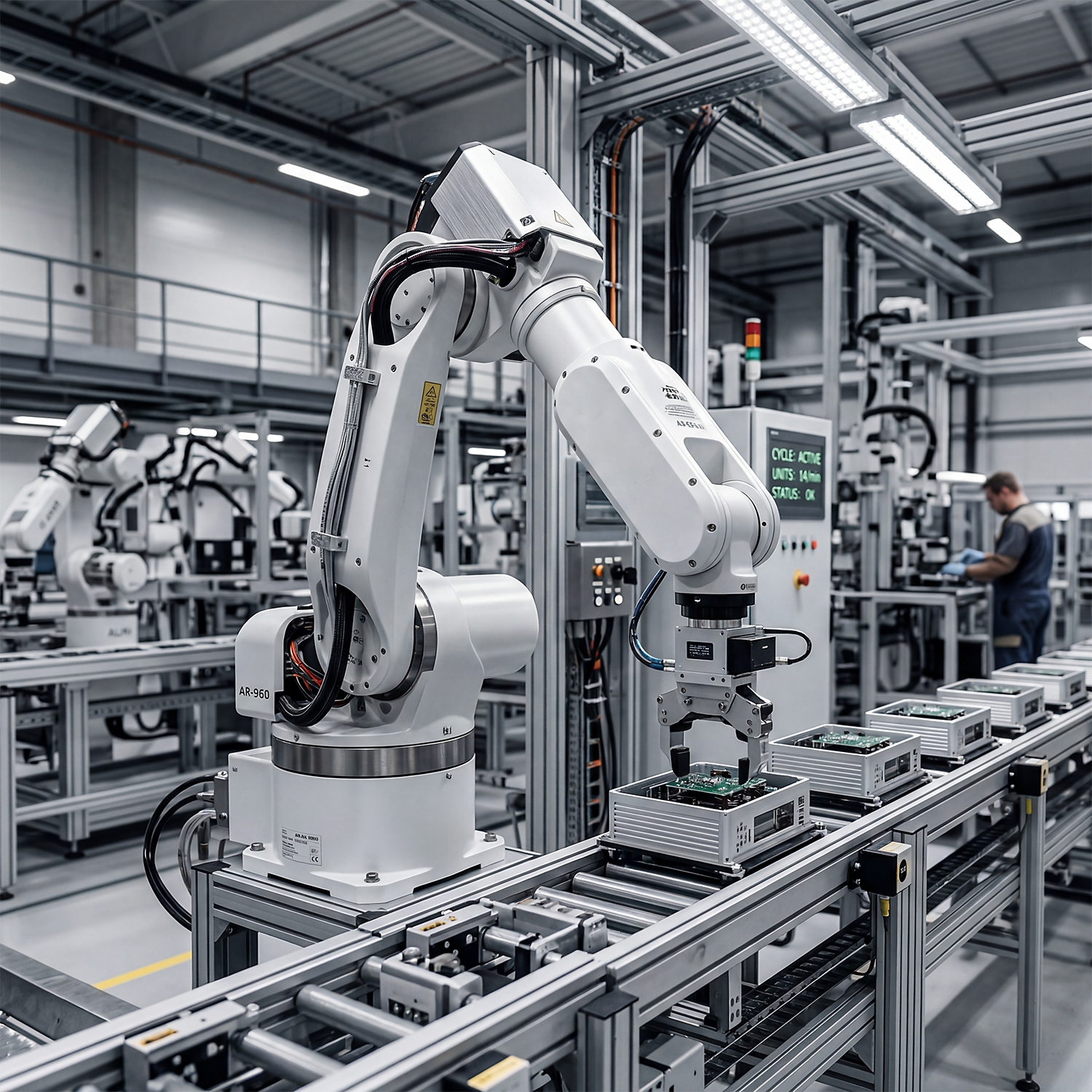
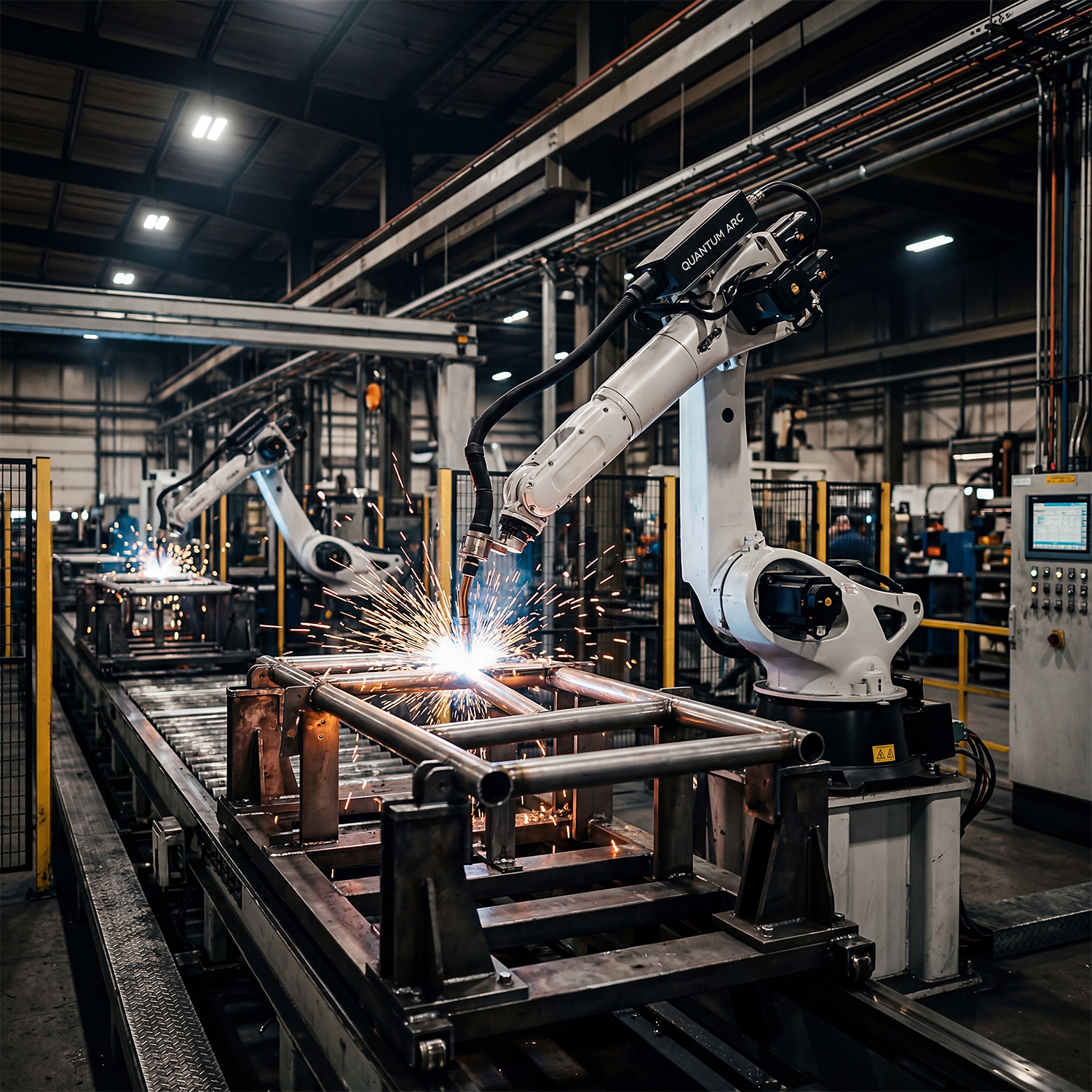
| Articulated | Three or more rotary joints, usually six | Welding, machine tending, palletizing, painting, heavy handling |
| SCARA | Two parallel rotary joints, rigid vertically and flexible horizontally | High-speed assembly and pick-and-place |
| Cartesian / gantry | Three linear axes (X, Y, Z) | Large parts, CNC loading, dispensing, long transfers |
| Delta / parallel | Linked arms forming a closed loop | Very fast light picking in food, pharma and packaging |
| Cylindrical | A rotary base with a linear lift and reach | Compact machine tending and assembly |
| Polar (spherical) | Two rotary joints and one linear axis | Die casting, forging and older welding cells |
| Collaborative (cobot) | Usually six rotary joints, with force and speed limiting | Tending, packing, screwdriving and inspection close to people |
Robots USA carries the SIASUN range from SCARA robots to small payload, large payload and ultra-high payload arms, plus special process robots. Collaborative options include SIASUN GCR cobots, Fairino FR series, Elephant Robotics, Realman and Dobot, all in the cobots category.
Autonomous Mobile Robots and AGVs
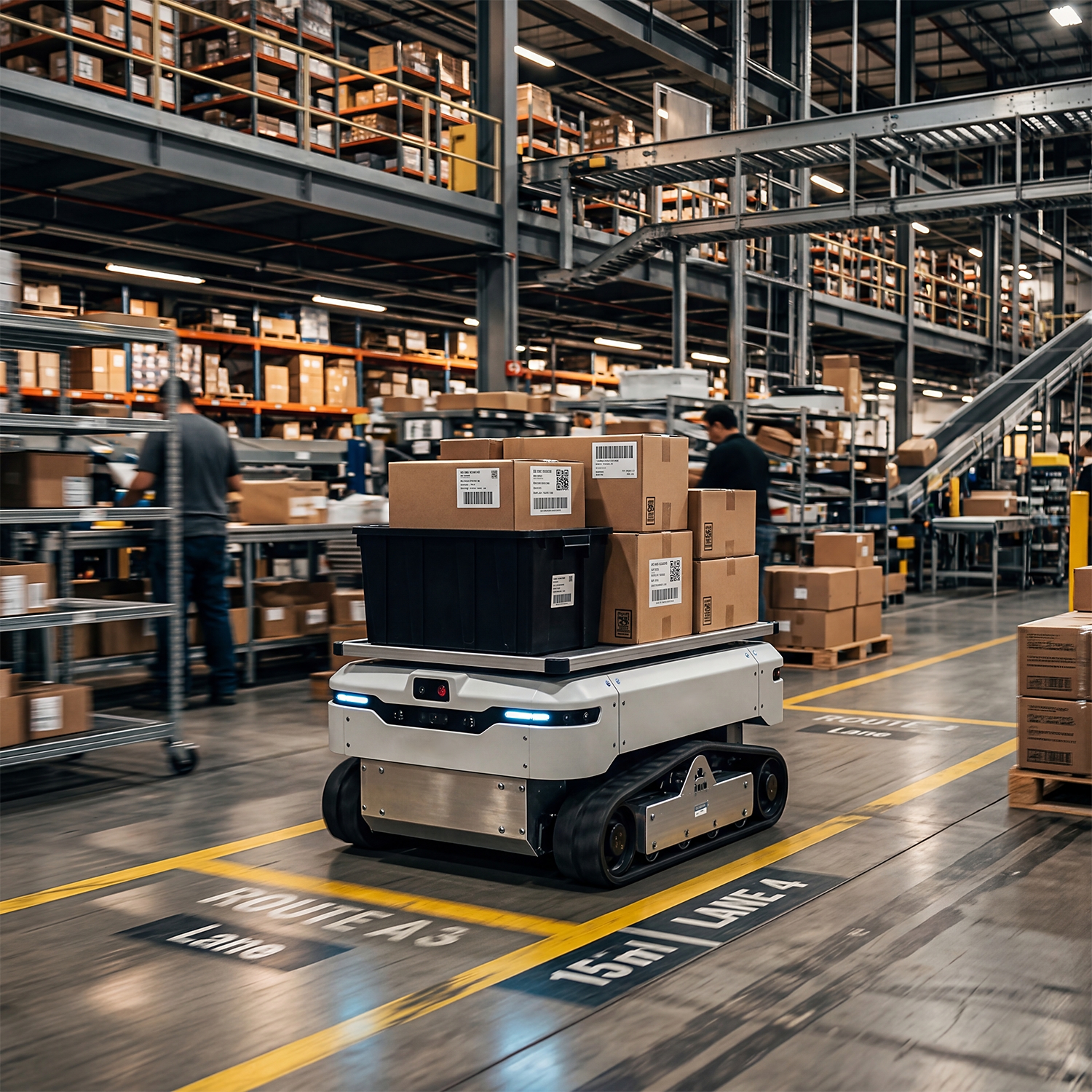
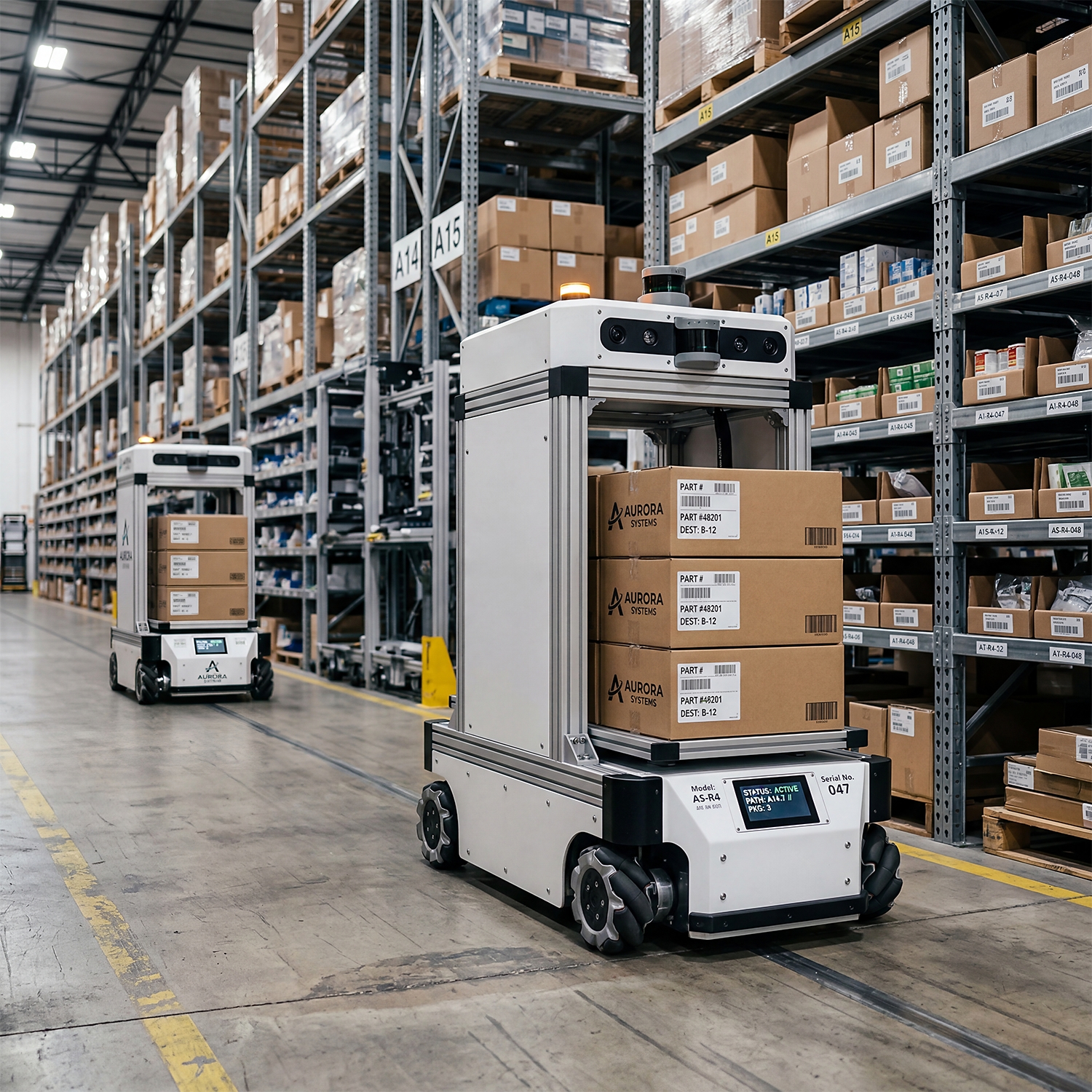
Mobile robots carry parts, totes, carts and racks between processes. Automated guided vehicles (AGVs) follow fixed routes, while autonomous mobile robots (AMRs) map the building with lidar and cameras and plan their own paths around people and obstacles. Browse AMRs, the SIASUN mobile robot range including heavy-duty and under-ride lift models, the ZLINK Q7-1500 and ZLINK under-run 1000 kg AGVs, the KEENON S100 heavy-load courier and Pudu industrial robots.
Autonomous Forklifts and Pallet Handling
Forklifts are one of the most accident-prone vehicles in industry, and pallet moves are highly repetitive, which makes them a natural fit for automation. Driverless pallet trucks, stackers and counterbalanced forklifts pick up, transport and rack pallets around the clock. See autonomous forklifts, Seer Robotics, SIASUN mobile forklifts, the ZLINK forklift AGV, the Richtech Robotics pallet jack, the PUDU MP2000 and lifting robots.
Industrial Humanoid Robots
Industrial humanoids are built for stations, carts and tools designed around human reach and two hands, so a plant can automate without redesigning the floor. Wheeled designs dominate early deployments because they are stable and easy to power; bipedal models can handle steps and tighter spaces. Current options include the AgiBot G2 industrial grade wheeled humanoid, the Galbot S1 heavy-duty wheeled humanoid, the RobotEra L7 bipedal humanoid and the Dex humanoid from Las Vegas-based Richtech Robotics, available as Dex Mobile and Dex Stationary. For how humanoids fit into production lines, see factory robots.
Inspection Robots and Industrial Quadrupeds
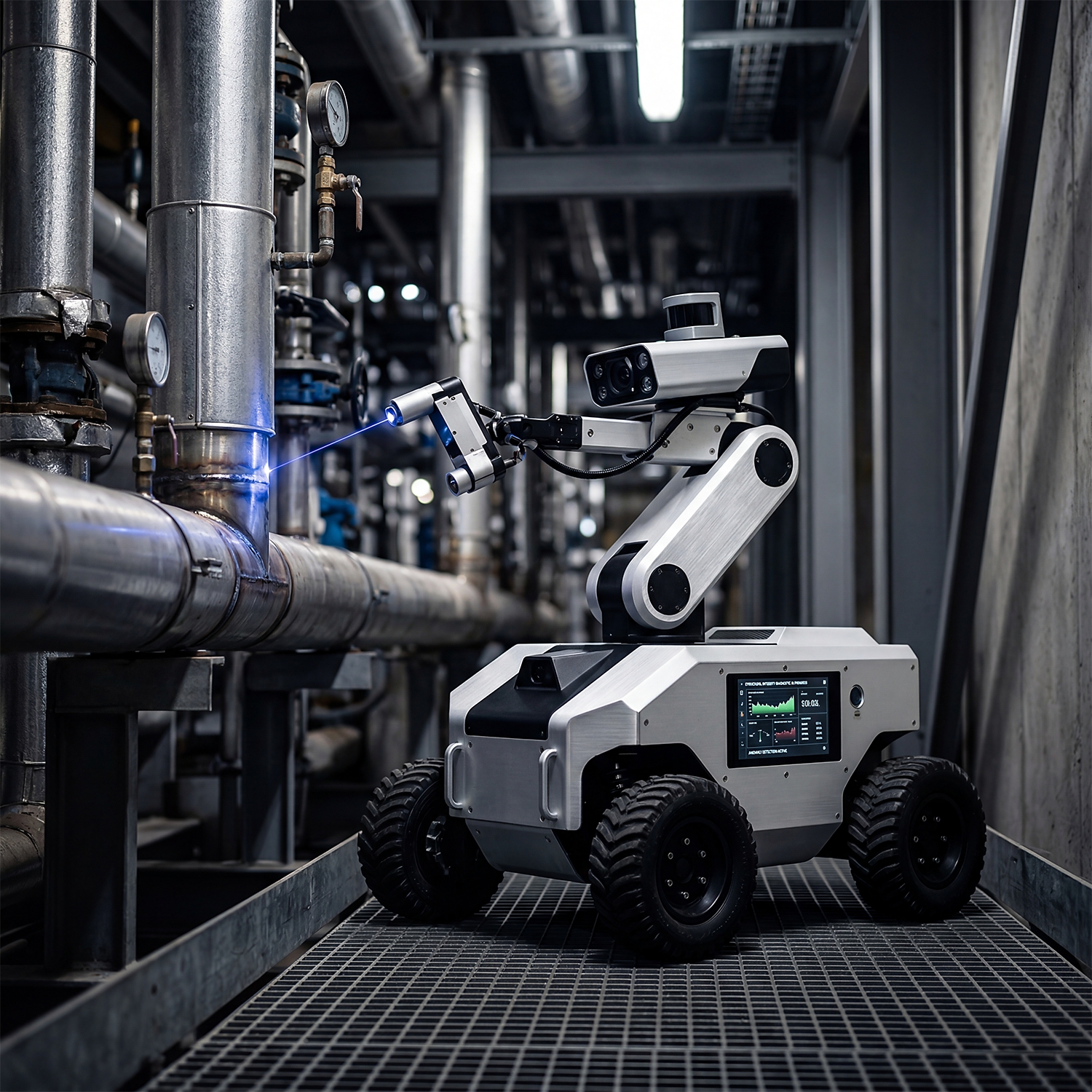
Four-legged robots carry thermal cameras, gas sensors, acoustic sensors and gauge-reading vision through plants, substations, tunnels and pipelines, including stairs and rough ground wheeled robots cannot cross. Options include the Deep Robotics X series, the LYNX M20S wheeled quadruped, the Unitree B2 and the AgiBot D1 Ultra, along with the full inspection robots category.
Specialty Industrial Robots
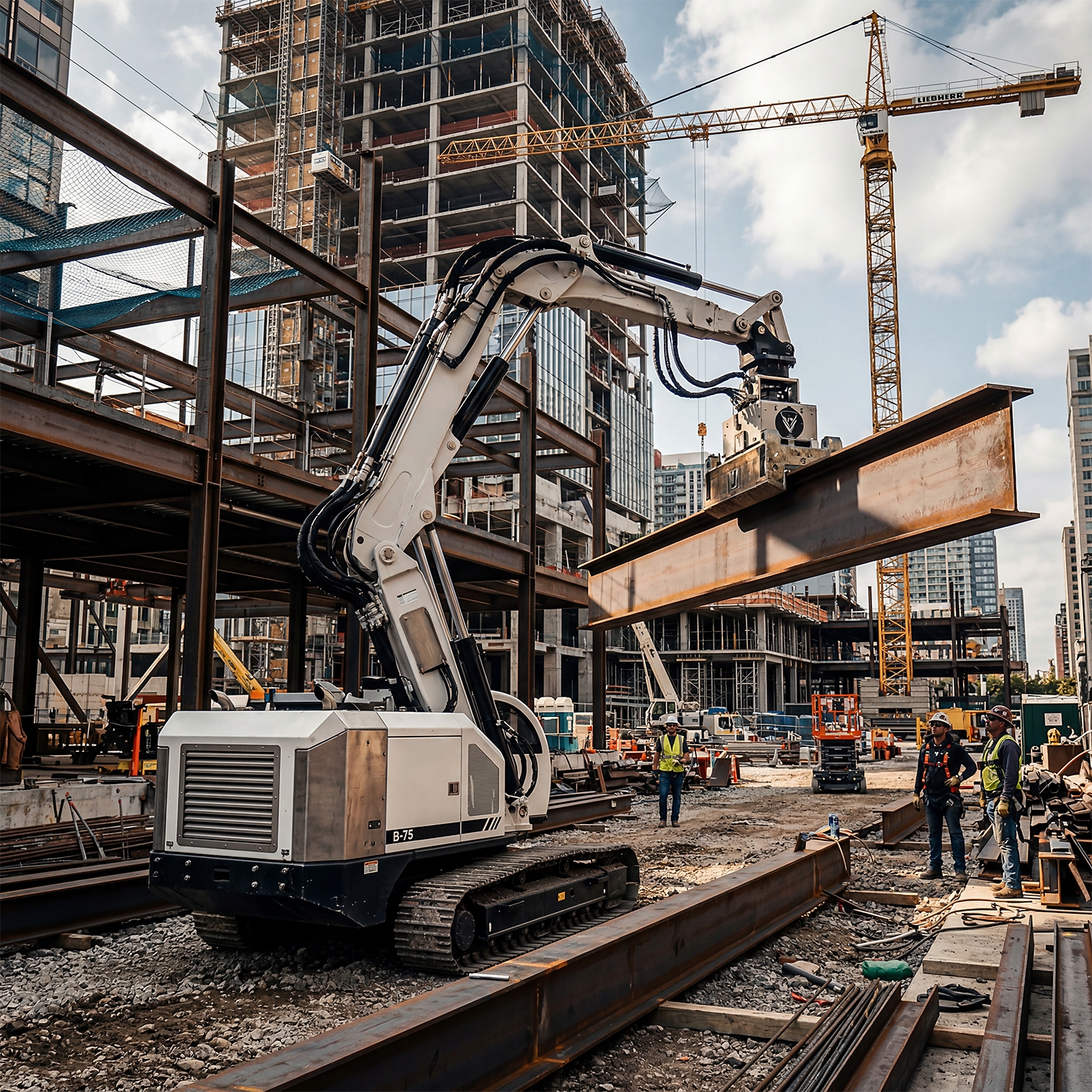
Some robots are built for one demanding environment. Explosion-proof units such as the Guo Xing RXR-MC80BD firefighting and reconnaissance robot enter chemical and fuel-handling sites. Welding robots help with the shortage of skilled welders, construction robots handle concrete, flooring and interior work, and industrial cleaning robots maintain plant floors and logistics yards.
How Industrial Robots Work
- Mechanics: joints driven by servo motors through precision gearboxes give the robot its payload, speed and repeatability.
- Controller: the robot's computer calculates each motion, coordinates the axes and runs the safety functions.
- Sensors: joint encoders track position, force and torque sensors add touch, vision systems locate parts and check quality, and lidar lets mobile robots navigate.
- Tooling: grippers, vacuum cups, welding torches, spray guns, screwdrivers or dexterous hands define the actual job.
- Programming: traditional teach pendants, offline programming and simulation, hand guiding on cobots, and increasingly AI training from demonstration, teleoperation and simulation.
- Integration: robots connect to PLCs, conveyors, MES and warehouse systems, while fleet software manages traffic, task assignment and charging. Digital twins let engineers test changes virtually before touching the line. See robot software.
Industries That Use Industrial Robots
- Automotive and transportation: body welding, painting, assembly and parts feeding, still the largest customer industry.
- Electronics and semiconductors: SCARA and small arms for fast, precise assembly, plus inspection.
- Metals and heavy machinery: large and ultra-high payload arms for castings, plate and machine components.
- Food, beverage and consumer goods: hygienic arms, delta pickers, case packing and palletizing.
- Pharmaceuticals and medical devices: cleanroom handling, packaging and inspection with full traceability.
- Warehousing and logistics: AMRs, forklifts, lifting robots and humanoids linking production to shipping. See warehouse robots and logistics robots.
- Energy, utilities and infrastructure: quadruped inspection of substations, plants and pipelines.
Benefits and Limitations of Industrial Robots
Benefits
- Consistent quality and repeatability, cycle after cycle.
- Higher output with extra shifts and fewer stoppages.
- Safer work, as robots take over heat, fumes, heavy lifting and forklift traffic.
- Coverage for roles that are hard to hire, such as welders, forklift drivers and line operators.
- Flexibility to reprogram for new products and smaller batches.
- Less scrap, less work in progress and better use of floor space.
Limitations
- Upfront investment includes tooling, safety equipment and integration, not just the robot.
- Traditional arms need consistent part presentation; highly variable parts may need vision or AI picking.
- Programming and maintenance skills must be built in-house or bought in.
- High-speed arms still need guarding and a documented risk assessment.
- Low-volume, constantly changing tasks may not pay back without a flexible robot such as a cobot or humanoid.
Industrial Robot Safety Standards in the US
Robot arms and robot cells follow ANSI/A3 R15.06-2025, the US adoption of ISO 10218 Parts 1 and 2. The 2025 revision clarifies functional safety requirements, folds collaborative robot guidance into the main standard and adds cybersecurity requirements. Driverless forklifts and mobile robots are covered by ANSI/ITSDF B56.5 and ISO 3691-4, which set rules for obstacle detection, speed zones and operation in shared aisles. OSHA has no robot-specific standard, but it enforces machine guarding and the General Duty Clause, and treats these consensus standards as the benchmark. Robots with wireless radios must also meet FCC rules; see FCC compliant robots.
How to Choose an Industrial Robot
- Start with the task. Fast small-part assembly suits SCARA, heavy handling needs large payload arms, material flow suits AMRs and forklifts, human-sized stations suit humanoids and hazardous patrol suits quadrupeds.
- Size the robot. Match payload (including tooling), reach, repeatability and cycle time to the real part, with margin.
- Check the environment. Consider dust, washdown, cleanroom, temperature, explosion risk, floor condition and ceiling height.
- Plan the safety concept. Decide on fencing, scanners, collaborative operation or aisle rules before you buy.
- Confirm integration. Check controller compatibility, PLC and MES links, fleet software and network requirements.
- Look at support. Check US availability of spares, documentation, training and warranty handling.
Industrial Robot Price and Cost of Ownership
Industrial robot prices range widely: from entry-level cobots and single AMRs to multi-robot production systems. Cost depends on robot type, payload class, precision, fleet size and how much integration the job needs. Beyond the robot, budget for end-of-arm tooling, fixtures, safety equipment, installation, programming, training and maintenance. Payback usually comes from extra shifts without overtime, lower scrap, fewer injuries and capacity you could not otherwise staff.
- Live pricing: many robots in the listing above show current prices, while larger systems are available by quote.
- Financing: Robots USA partners with ElmBlue to finance equipment over $2,000 with no upper limit, through leases and loans for a wide range of credit profiles, with rates from 7% for well-qualified businesses. See robot financing.
- Section 179: for 2026, businesses can expense up to $2,560,000 of qualifying equipment placed in service by December 31, phasing out above $4,090,000 in purchases, with 100% bonus depreciation also available. Confirm with your tax advisor.
Pre-Sale, Setup, Deployment and Ongoing Support
- Pre-sale: help choosing the robot type, payload and configuration for your process, comparing models and building a quote with tooling and accessories.
- Setup: manufacturer documentation and software with every robot, plus guidance on commissioning, network setup, site mapping for mobile robots and first programs.
- Deployment: help integrating into your line or facility, safety planning, operator training and scaling from a pilot to a fleet.
- Ongoing support: software updates, troubleshooting, spare parts and warranty coordination through the Robots USA support center.
Buy Industrial Robots in the USA
Robots USA sells industrial robots to manufacturers, warehouses, utilities and integrators across the United States, with free US delivery on selected models. Use the filters above to sort by robot type, brand, payload and use, add quote-only systems to your quote request, or contact Robots USA to discuss your application. For focused ranges, browse factory robots, welding robots, warehouse robots, the SIASUN catalog and the full robot catalog.
Frequently Asked Questions
What are industrial robots?
Industrial robots are automatically controlled, reprogrammable machines that perform production, handling, inspection and logistics tasks in industrial settings. The category includes robot arms, cobots, autonomous mobile robots, driverless forklifts, inspection quadrupeds and industrial humanoids.
What are the main types of industrial robots?
By arm design, the main types are articulated, SCARA, Cartesian, delta, cylindrical, polar and collaborative robots. Beyond fixed arms, the category also includes AMRs and AGVs, autonomous forklifts, inspection quadrupeds and industrial humanoids.
How much does an industrial robot cost?
Price depends on robot type, payload, precision and integration scope, and total cost also includes tooling, safety and installation. Live prices are shown in the listing above, larger systems are quoted per project, and financing and Section 179 can reduce the upfront cost.
How do industrial robots work?
A controller drives servo motors at each joint along programmed or learned paths, using encoders, force sensors and vision to position the tool accurately. Mobile robots add lidar mapping and fleet software that coordinates traffic and charging.
What are the disadvantages of industrial robots?
The main drawbacks are the upfront investment including integration, the need for programming and maintenance skills, the need for consistent part presentation on traditional arms, and safeguarding requirements for high-speed robots.
What is the difference between an industrial robot and a cobot?
A cobot is a type of industrial robot designed to share space with people, using force and speed limiting. Traditional industrial robots are usually faster and stronger but work behind fencing or other safeguards.
Which country uses the most industrial robots?
China installs the most industrial robots by far. In 2025 the United States became the second-largest market for new installations, ahead of Japan.
Where can I buy industrial robots in the USA?
You can buy industrial robots directly on this page from Robots USA, with live pricing, quotes for larger systems, financing and support from pre-sale through deployment.