
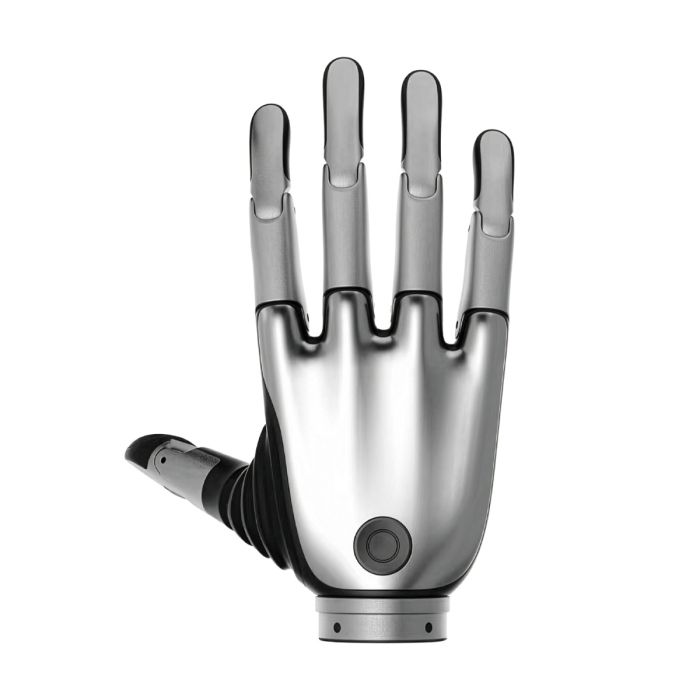
BrainCo Revo 2 Basic Right Dexterous Bionic Hand (XRR)
In stock
- BRAND:
- BRAINCO
- MODEL:
- REVO 2 BASIC
- PART #:
- XRL/XRR
- ORIGIN:
- China
- Warranty:
- 12 MONTHS
- AVAILABILITY:
- SUBJECT TO AVAILABILITY
- SKU:
- BrainCo-Revo-2-Basic
BrainCo Revo 2 Basic Right Dexterous Bionic Hand (XRR)
A robot arm can place its wrist almost anywhere, yet the part that touches the work is often a two-jaw gripper that was never meant to handle varied objects. The BrainCo Revo 2 Basic Right Dexterous Bionic Hand (XRR) goes after that weak point. It is a five-finger, right-handed hand that the source describes as a bionic dexterous hand for robot integration and research.
Robots USA sells this hand and supplies it to robotics teams, laboratories and integrators across the United States. We quote it, arrange delivery and stand behind support for it, so one contact covers the whole purchase.
Background
BrainCo and the Revo line
BrainCo is the maker of the Revo family of dexterous hands. The store also carries an earlier model, the Revo 1 Intelligent Dexterous Bionic Hand, so buyers who follow the line can compare generations. Revo 2 is the current family. The sources name three configurations within it: Basic, Pro and Touch. Each comes in a left and a right version, and each has its own version code.
For the Basic configuration the published codes are XRL for the left hand and XRR for the right. This page covers the right hand, XRR. The Pro configuration is listed under XEL and XER, and the Touch configuration under XTL and XTR. Keep those codes in mind when you order, because the letters tell you which hand you are specifying. A mix-up between a left and a right hand is expensive to discover after delivery.
Positioning of the Basic version
The Basic version is the base configuration of the Revo 2 family. It is aimed at integration and research work, in line with the manufacturer's own description of the hand. Nothing in the sources we hold ranks the three configurations in detail. We therefore do not claim which one is stronger. We only state what is published for the hand on this page, and we flag what is not.
Two practical details come from the published material. The communication interface is located under the wrist. Its connector model is BM05B-PASS-TFT(LF)(SN), per the published specification. Knowing the connector in advance lets an integrator plan cabling and mating parts before the hand arrives.
Technical Specifications
| Specification | Value |
|---|---|
| Product type | Bionic dexterous hand for robot integration and research |
| Version | Basic, right hand |
| Version code | XRR (the Basic left hand is XRL) |
| Degrees of freedom | 11 (6 active), as published for Revo 2 |
| Communication interface connector | BM05B-PASS-TFT(LF)(SN), located under the wrist |
| Default device ID | 127 for the right hand (126 for the left hand) |
| IP rating | Not published by the manufacturer |
| Dimensions with wrist | Not published by the manufacturer |
| Flexion/extension lifespan | Not published by the manufacturer |
| Battery | Not published by the manufacturer |
Specifications as published; confirmed against the datasheet at quotation. The manufacturer has not published the IP rating, the dimensions with wrist, the flexion/extension lifespan or any battery information, so each of these is confirmed at quotation.
What does 11 degrees of freedom with 6 active joints mean?
The published figure is 11 degrees of freedom, of which 6 are active. In plain terms, the hand has eleven independent ways to move, but only six of them are driven directly. The remaining motions are generally coupled to the driven ones. This is a common design choice in dexterous hands. It keeps the mechanism compact and the control problem manageable, while still letting the fingers close around an object in a natural way.
For a buyer, the consequence is that the hand is meant to be commanded through a small set of active joints, not through eleven separate actuators. That simplifies the software side. We do not have a published breakdown of which joints are active, so confirm the exact joint layout with the datasheet if your control design depends on it.
How do you identify and address this hand on a network?
Integration starts with identification. According to the published information, the default device ID for Revo 2 is 126 for the left hand and 127 for the right hand. The hand on this page is the right hand, so its default ID is 127. The practical benefit shows up in a two-handed build. A humanoid or a dual-arm cell can carry a left and a right hand on one system, and the different default IDs let each hand answer to its own address from the start.
The connector is the other half of the story. It sits under the wrist and is identified as BM05B-PASS-TFT(LF)(SN). Because it is a specific, named part, your electrical team can order the matching harness without guessing. The sources we hold do not describe the pin assignment or the supply requirements, so those details are confirmed against the datasheet at quotation. Treat them as open items in your design review until you have the document in hand.
Who is the BrainCo Revo 2 Basic Right Dexterous Bionic Hand (XRR) for?
Humanoid robot developers are the clearest audience. A humanoid needs hands that look and behave like hands, and a five-finger design is the obvious route. Research laboratories are the second group. Manipulation, grasp planning and teleoperation studies all need a hand with enough joints to produce interesting behavior, and the maker positions this hand for exactly that kind of research.
Systems integrators form a third group. They need a hand that arrives with a named connector, a documented device ID scheme and a clear version code, because those details shorten commissioning. Universities building teaching platforms will also find the Basic configuration a sensible starting point.
If your project needs the left hand, choose the BrainCo Revo 2 Basic Left Dexterous Bionic Hand (XRL). If you want a different configuration of the family, look at the BrainCo Revo 2 Pro Dexterous Right Hand (XER) or the Brainco Revo 2 Touch Biomimetic Dexterous Right Hand (XTR). The sources we hold do not detail what those versions add, so ask us for a comparison when you request your quotation. You can also browse the full BrainCo Revo 2 range or the wider Hands category.
What is the BrainCo Revo 2 Basic Right Dexterous Bionic Hand (XRR) used for?
- Humanoid robot hands: gives a humanoid platform a right hand with several independent joints.
- Manipulation research: supports studies of grasping and in-hand handling on a laboratory arm.
- Teleoperation experiments: lets an operator control a robotic hand that mimics human finger motion.
- Robot integration projects: serves as the end effector in prototype cells built by integrators.
- Dual-hand systems: pairs with the left-hand version, which has its own default ID, on one platform.
- Teaching and training: offers students a real dexterous hand for robotics coursework.
Pricing and Availability
We publish no price for this hand. Robots USA prepares a quotation for each request, and the quotation is the next step. Delivery, customs and support are arranged together with the quotation, so you receive a single plan. Send us your application, the number of hands you need and your control setup, and we will respond with the details. Everything you need to start that request is available on this page.
Frequently Asked Questions
Is this the left or the right hand?
It is the right hand, version code XRR. The matching Basic left hand carries the code XRL.
How many degrees of freedom does it have?
The published figure for Revo 2 is 11 degrees of freedom, with 6 of them active. This comes from a single source and is confirmed against the datasheet at quotation.
What is the default device ID?
Per the published information, the default ID for the right hand is 127, and the left hand uses 126. This allows two hands to coexist on one system.
What connector does the hand use?
The communication interface is under the wrist, and the connector model is reported as BM05B-PASS-TFT(LF)(SN). Confirm it against the datasheet before ordering cabling.
Is the IP rating published?
No. The manufacturer has not published an IP rating, so any protection claim is confirmed at quotation. The same applies to the dimensions with wrist, the flexion/extension lifespan and battery information.
Does this version suit research use?
The source describes Revo 2 as a bionic dexterous hand for robot integration and research. The Basic version is therefore a reasonable fit for those uses.
Where can I buy the BrainCo Revo 2 Basic Right Dexterous Bionic Hand (XRR) and what does it cost?
You can buy it from Robots USA, which supplies, quotes, delivers and supports it. The cost is given in a personal quotation after you send your requirements, so no price is shown on this page.
Summary
Most robot arms stop at a simple gripper, and that is the gap this hand is meant to close. The BrainCo Revo 2 Basic Right Dexterous Bionic Hand (XRR) offers a right-hand, multi-joint design with 11 degrees of freedom as published, a named connector under the wrist, and a clear default ID of 127. Several figures remain unpublished, including the IP rating, dimensions with wrist, lifespan and battery details, and we say so openly. If you want to bring a real hand to your robot, this page is the starting point.