
BrainCo Revo 2 Pro Dexterous Left Hand (XEL)
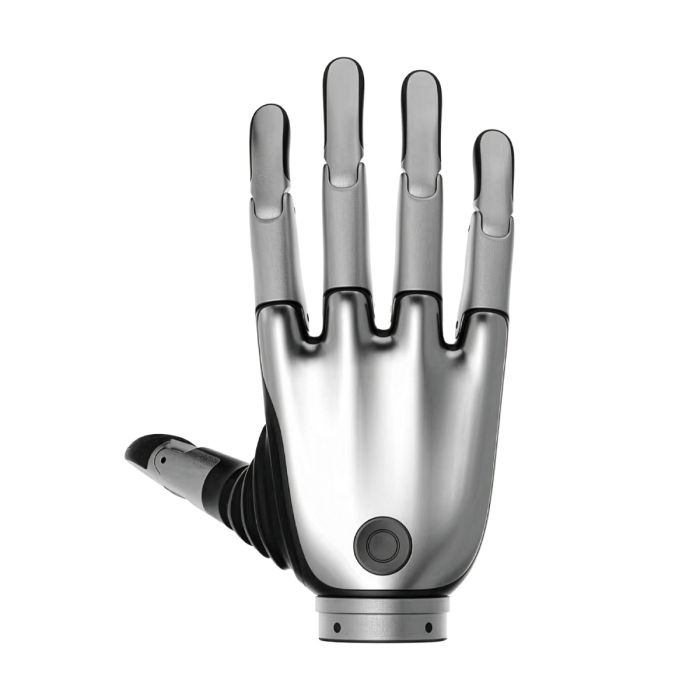
In stock
- BRAND:
- BRAINCO
- MODEL:
- REVO 2 PRO
- PART #:
- XEL
- ORIGIN:
- China
- AVAILABILITY:
- SUBJECT TO AVAILABILITY
- SKU:
- BrainCo-Revo-2-Pro-Left
BrainCo Revo 2 Pro Dexterous Left Hand (XEL)
The last stretch of a robot arm decides whether the machine can actually do anything. The BrainCo Revo 2 Pro Dexterous Left Hand (XEL) is a left-hand unit aimed at that stretch: a human-scaled hand that, per the published specification, reports 11 degrees of freedom driven by 6 active joints, and it adds fieldbus options that suit serious integration work.
Robots USA sells and supplies the BrainCo Revo 2 Pro Dexterous Left Hand (XEL) to robotics labs, integrators and humanoid developers. Robots USA prepares your quotation, arranges delivery and supports the product after the sale.
Background
BrainCo and the Revo 2 lineage
BrainCo markets the Revo 2 as a family of dexterous hands in three versions. The Basic version carries the codes XRL (left) and XRR (right). The Pro version carries XEL (left) and XER (right). The Touch version carries XTL (left) and XTR (right). The XEL covered on this page is the left-hand Pro. An earlier generation, the Revo 1, is also in the catalog for teams comparing generations.
All three Revo 2 tiers share a common mechanical basis. Per the published specification, that includes 11 degrees of freedom with 6 active joints, a weight of 383 g and a height of 160 mm from the base of the palm to the tip of the middle finger. What separates the tiers is mainly electrical and communication capability, plus tactile features on the Touch version.
Where the Pro sits in the range
The Pro version sits between Basic and Touch. Compared with the Basic, the published table lists a wider supply voltage range of 12-64V (the Basic is listed at 12-28V) and an added EtherCAT interface alongside 485 and CANfd. The listed static current is 115 mA at 24V and the maximum current is 4.65A at 24V. Those are the figures an integrator checks first when sizing a power supply and picking a bus.
The manufacturer has not published tactile sensing detail for the Pro version. If touch feedback is central to your application, compare it against the Touch version before you decide.
Technical Specifications
| Specification | Value (Pro, XEL) |
|---|---|
| Version code | XEL (left) / XER (right) |
| Degrees of freedom | 11 (6 active) |
| Weight | 383 g |
| Height (palm base to middle fingertip) | 160 mm |
| Full fist grip force | ≥50N |
| Pinch force | ≥15N |
| Max payload | ≥20kg |
| Operating noise (at 50cm) | ≤50dB |
| Flexion/extension speed | ≤0.65s |
| Maximum opening and closing distance | 100mm (from thumb to index finger) |
| Communication interface | 485, CANfd, EtherCAT |
| Supply voltage | 12-64V |
| Static current | 115 mA @24V |
| Maximum current | 4.65A @24V |
| Repetitive control precision | 0.1° |
| Operating temperature | -10 - 40℃ / 90%RH |
| Smart control | Position, velocity and current feedback control; cascaded control; compliance control |
| Smart protection | Current, stall, high-temperature and anti-collision protection |
| SDK integration | Python/C; Linux, Windows and ROS systems |
| Online upgrade | OTA online upgrades supported |
| Standard colors | Space Gray, Silver (bulk color customization supported) |
Specifications as published; confirmed against the datasheet at quotation. The manufacturer has not published hand width, materials, an IP or ingress protection rating, cable length or box contents, so these are confirmed at quotation.
What makes the Revo 2 Pro different from the Basic?
The mechanical envelope is the same across the series as published: the same weight, height, grip figures and degrees of freedom. The difference is in the electronics and the interface. The Pro lists EtherCAT in addition to 485 and CANfd, and it accepts a supply from 12 to 64V where the BrainCo Revo 2 Basic Left Dexterous Bionic Hand (XRL) is listed at 12 to 28V.
That matters in practice. EtherCAT is a common choice for deterministic, real-time control in industrial and research cells. A wider voltage window lets the hand run from higher-voltage battery or bus systems without a separate step-down stage. If your controller speaks EtherCAT, or your arm platform distributes power above 28V, the Pro removes work that the Basic would leave to you.
The Pro also lists a higher static current (115 mA at 24V against 65 mA for the Basic) and a slightly higher maximum current (4.65A against 4.6A). Plan your power budget from the datasheet confirmed at quotation, not from the headline weight alone.
How is the Pro controlled and protected?
Per the published specification, the hand supports position, velocity and current feedback control, cascaded control and compliance control. Compliance control is the useful one for contact tasks, since it lets the hand yield rather than fight an object or a person. Repetitive control precision is listed at 0.1°.
Protection is layered: current protection, stall protection, high-temperature protection and anti-collision protection are all listed. For a lab where the hand will see many prototype iterations and the occasional bad command, those safeguards reduce the risk of burning out an actuator.
On the software side, the SDK is reported to support Python and C and to work with Linux, Windows and ROS systems. OTA online upgrades are supported, so firmware can be updated without sending the hand back. The default device ID for the left hand is listed as 126; the right hand uses 127. Set the IDs correctly when you run both hands on one bus.
Who is the BrainCo Revo 2 Pro Left Hand for?
Humanoid developers are the clearest fit. A hand of this published weight and size is meant for the arms of compact and mid-size humanoid platforms, where a heavier hand would burden the wrist and the shoulder joints. Pair it with the matching BrainCo Revo 2 Pro Dexterous Right Hand (XER) when the robot needs both hands.
Research labs working on manipulation, imitation learning and teleoperation are the second group. The Python and C SDK, ROS compatibility and EtherCAT support fit the way those labs already work. Integrators who build demonstration cells or light-assembly prototypes will value the fieldbus options and the wide voltage range.
If your budget or bus is simpler, the Basic version covers the same mechanical basics. If your work depends on tactile feedback, look at the Brainco Revo 2 Touch Biomimetic Dexterous Left Hand (XTL). You can also browse the full BrainCo Revo 2 range, or the wider Hands category, to compare.
What is the BrainCo Revo 2 Pro Left Hand used for?
- Humanoid robot manipulation. It serves as the left end effector on a humanoid arm for grasping and handling everyday objects.
- Teleoperation. An operator drives the hand remotely, using the position and compliance control modes.
- Manipulation research. Labs use it to collect data and test grasping policies through the Python or C SDK.
- Bimanual systems. Paired with the right-hand version, it completes a two-handed setup for tasks that need both sides.
- Fieldbus-based automation cells. The EtherCAT and CANfd interfaces let it join industrial control networks.
- Demonstrations and education. Its human-scaled form and low listed noise make it practical for classrooms and trade-show booths.
Pricing and Availability
Robots USA does not publish prices on this page. Request a quotation for the BrainCo Revo 2 Pro Dexterous Left Hand (XEL), stating your quantity, your intended bus and your power supply. Delivery, customs and support are arranged with the quotation. Everything we can confirm about the product is available on this page.
Frequently Asked Questions
What is the difference between XEL and XER?
XEL is the left-hand Pro version and XER is the right-hand Pro version. The published specifications are the same apart from the side, and the default device IDs are 126 for the left and 127 for the right.
How many joints does the hand have?
The published specification lists 11 degrees of freedom, driven by 6 active joints. Confirm the details against the datasheet at quotation.
Which communication interfaces does the Pro support?
The Pro is listed with 485, CANfd and EtherCAT. The Basic version is listed without EtherCAT.
What software can I use to control it?
The SDK is reported to support Python and C and to be compatible with Linux, Windows and ROS systems. OTA online upgrades are also listed.
Does the Pro version include tactile sensing?
The manufacturer has not published tactile sensing detail for the Pro version, so confirm it at quotation. The Touch version is the one built around tactile features.
Is an ingress protection rating available?
No IP or ingress protection rating has been published, and neither have the materials, the cable length or the box contents. These are confirmed at quotation.
Where can I buy the BrainCo Revo 2 Pro Left Hand and what does it cost?
You can buy it from Robots USA, which quotes, delivers and supports the hand. No price is shown on this page; send a quotation request and we will respond with the terms for your order.
Summary
The final stretch of a robot arm is where the work happens, and the BrainCo Revo 2 Pro Dexterous Left Hand (XEL) is built for that stretch. Per the published specification, it combines 11 degrees of freedom, a weight of 383 g, a grip of at least 50N and a payload of at least 20kg. On top of the shared Revo 2 basis, the Pro adds EtherCAT and a 12-64V supply range. For a left hand that fits compact humanoid arms and fieldbus-driven cells, this page is the starting point.
Specifications
General
Physical
Mobility
Performance
Connectivity
Software
Hand
Feature
1. High quality and stability – five years of product iteration and professional production lines.
2. Lightweight (383 grams), with 5 kg active grip force, 20 kg single-hand load capacity, and a grip-to-weight ratio of 53.
3. Ergonomic Bionic Design – supports curved surface grasping with anti- collision finger design.
4. Multi-dimensional tactile perception – pressure, friction, direction, proximity, and surface texture.
5. High Sensitivity Tactile Perception – max resolution of 0.01N.
6. Wide voltage support – 64V.
7. Universal Interfaces – RS485 & CAN-FD, and EtherCAT.
8. Standard Protocols and SDKs – Modbus & Protobuf protocols, SDKs for Python / C / ROS.