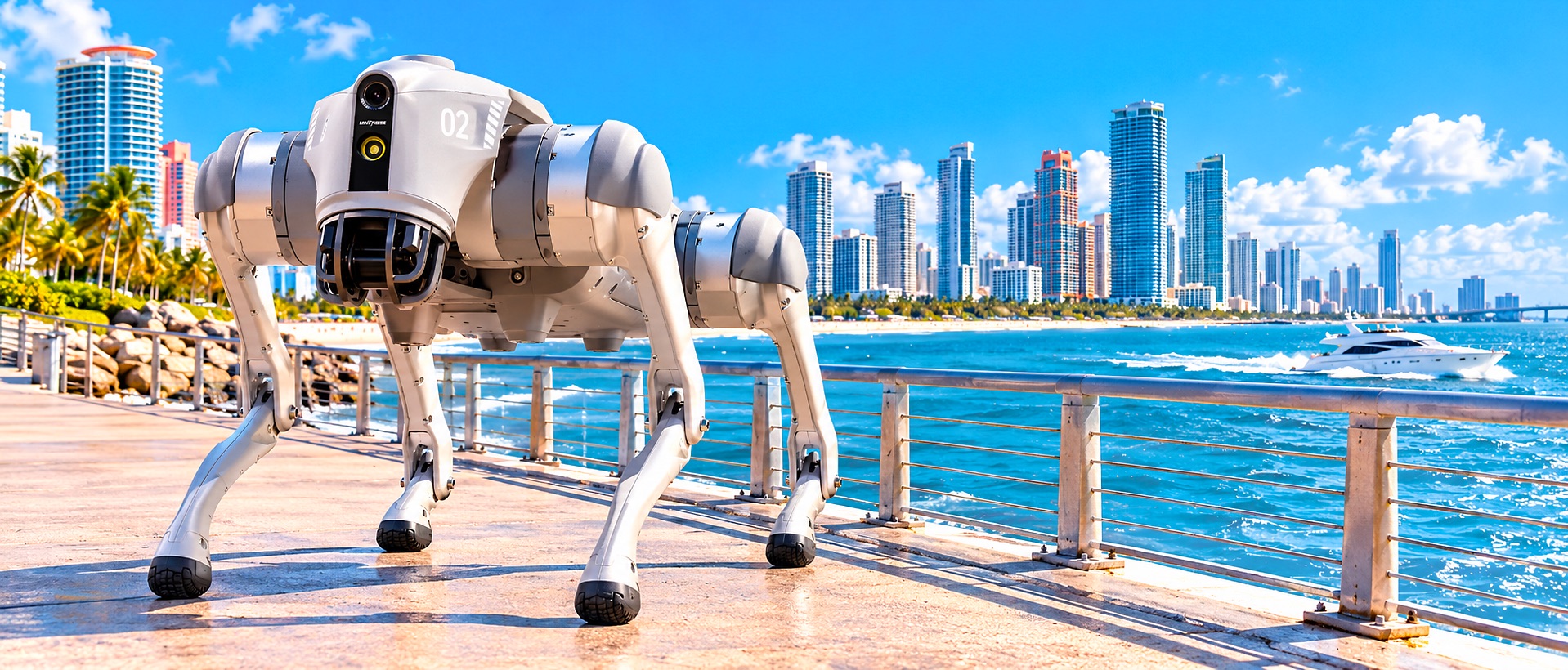
Keenon DINERBOT T8 with 5 Year Warranty

In stock
- BRAND:
- KEENON
- MODEL:
- T8
- ORIGIN:
- China
- Warranty:
- 60 MONTHS
- AVAILABILITY:
- ALLOW 2-4 WEEKS FOR DELIVERY
- SKU:
- KEENON-T8
Keenon DINERBOT T8 with 5 Year Warranty
In a busy dining room, the hardest automation problem is often not distance but space: chairs shift, people pause in aisles, and a tray must arrive without turning service into a spectacle. Keenon DINERBOT T8 with 5 Year Warranty is positioned for that kind of compact, guest-facing environment. Per the published specification, it combines a 55 cm (21.65″) minimum passage width with a 20 kg total load capacity, while source material reports a 300° open tray and guidance through tray sensors, voice prompts, and visual cues on a 10.1″ touch screen.
Robots USA sells the Keenon DINERBOT T8 with 5 Year Warranty for U.S. restaurant, hospitality, and commercial service projects. Robots USA quotes the configuration, arranges delivery and support, and confirms the final specification against the applicable datasheet at quotation so that the robot supplied matches the operating environment and the version selected.
Background
KEENON and the DINERBOT family
KEENON is the brand behind the DINERBOT line of service robots, a family aimed at moving items through public, staff, and customer-facing spaces. Restaurant delivery robots are typically used to reduce repetitive walking, support table service, and keep staff focused on guest interaction rather than repeated tray transport. The published source for this model reports CE certification, and also reports that the DINERBOT T8 received Japan's 2023 Good Design Award for design and usability.
The version names in the source material matter. The T8 is identified as the visual SLAM version, while T8 LS is named as the laser mapping version and T8 LB is also named. The fact sheet does not publish separate dimensional, capacity, or battery figures for T8 LS or T8 LB, so any project comparing those trims should have the selected version confirmed by Robots USA at quotation.
Compact service as the core idea
The T8 is presented around a narrow footprint and approachable self-pickup workflow rather than around heavy industrial payloads. Per the published specification, the robot measures 38.4×46.8×111.1cm (15.12″x18.43″x43.74″) and weighs 34kg (74.96lbs). Those figures describe a robot intended to move among people, furniture, and service stations, rather than a machine reserved for back-of-house logistics.
Source material reports 3 stereo vision sensors for detecting common high obstacles and those under 5cm. In practical terms, buyers should read that as a published obstacle-detection feature for service environments, while still validating the route, floor surface, lighting, and venue layout before deployment. The manufacturer has not published the IP rating, operating temperature, noise level, connectivity, battery capacity, or box contents in the supplied fact sheet; those items are confirmed at quotation.
Technical Specifications
| Specification | Value |
|---|---|
| Versions named by sources | T8 (visual SLAM); T8 LS (laser mapping version); T8 LB |
| Dimensions (WxDxH) | 38.4×46.8×111.1cm (15.12″x18.43″x43.74″), per published specification |
| Weight | 34kg (74.96lbs), per published specification |
| Max. moving speed | 1.0m/s (3.28ft/s), per published specification |
| Battery life | Up to 15h, per published specification |
| Charging time | 4h, per published specification |
| Slope angle | 5°, per published specification |
| Minimum passage width | 55 cm (21.65″), per published specification |
| Total load capacity | 20 kg, per published specification |
| Obstacle detection sensors | 3 stereo vision sensors, detecting common high obstacles and those under 5cm, as reported by source material |
| Self-pickup guidance | Tray sensors, a 300° open tray, and voice and visual guidance on the 10.1″ touch screen, as reported by source material |
| Multi-robot coordination | Patented algorithms schedule tasks and coordinate with other KEENON robots, as reported by source material |
| Design award | Japan's 2023 Good Design Award, as reported by source material |
| Certification | CE, as reported by source material |
| IP rating | Not published; confirmed at quotation |
| Battery capacity | Not published; confirmed at quotation |
| Box contents | Not published; confirmed at quotation |
| Connectivity | Not published; confirmed at quotation |
| Noise level | Not published; confirmed at quotation |
| Operating temperature | Not published; confirmed at quotation |
Specifications are as published by the source material and are confirmed against the datasheet at quotation.
What makes the DINERBOT T8 suitable for narrow restaurant layouts?
The published minimum passage width of 55 cm (21.65″) is the key figure for venues where larger service robots may be difficult to route. Restaurants often have service corridors that change during the day as chairs move, guests gather, or staff stage carts and bins. A compact delivery robot does not remove the need for operational planning, but it can make automation more realistic in spaces where a wide platform would force route compromises.
The published dimensions of 38.4×46.8×111.1cm (15.12″x18.43″x43.74″) support that narrow-layout argument. The 20 kg total load capacity, per the published specification, keeps the T8 in the category of tray and item movement for dining rooms, cafes, hotels, food courts, and similar service spaces. Buyers should still confirm tray size, route width, turning areas, and pickup points at quotation, because the fact sheet does not publish box contents or optional accessories.
How does guidance and coordination work in service?
Source material reports a self-pickup process using tray sensors, a 300° open tray, and voice and visual guidance on the 10.1″ touch screen. That combination is important because a delivery robot in a dining room must communicate with staff and guests, not only navigate. Clear prompts can help users understand when to remove an item and when the robot is ready to continue its task.
The source also reports multi-robot coordination using patented algorithms to schedule tasks and coordinate with other KEENON robots without collision or waiting times. That statement should be confirmed in the project context, especially when a buyer is planning several robots in one venue. Route density, docking positions, staff workflows, and the mix of KEENON models all affect how coordination is implemented in practice.
Who is the DINERBOT T8 for?
The DINERBOT T8 is for operators who want a compact, guest-facing delivery robot for repetitive tray movement in commercial service spaces. Typical buyer segments include restaurants with narrow aisles, cafes that need back-and-forth item delivery, hospitality venues that want a visible service assistant, and multi-zone dining spaces where staff spend time walking between kitchen, counter, and table areas.
The T8 is the version to consider when the source-named visual SLAM version is the target configuration. Where a buyer specifically requires the source-named laser mapping version, Robots USA should quote the T8 LS rather than assuming the same configuration. The T8 LB is named in the source list, but the supplied fact sheet does not publish its distinguishing specifications, so buyers interested in that version should request confirmation before comparison.
What is the DINERBOT T8 used for?
- Restaurant table delivery: The robot can support repetitive movement of prepared items between service points and guest areas, subject to route validation.
- Tray return support: Staff can use a service robot workflow to move cleared items from dining areas toward a collection point where the venue design allows it.
- Cafe counter service: Compact routing can help in cafes where staff alternate between preparation areas, counters, and seating zones.
- Hotel food and beverage service: Hospitality teams can use a guest-facing robot to assist movement within approved restaurant, lounge, or event areas.
- Food court operations: Shared commercial spaces may use robots for repeated point-to-point delivery when the route is controlled and suitable.
- Multi-robot service projects: Source material reports coordination with other KEENON robots, so larger deployments can be reviewed as a coordinated workflow at quotation.
Pricing and Availability
Robots USA provides pricing by quotation for the Keenon DINERBOT T8 with 5 Year Warranty because the final configuration, version, deployment requirements, and support scope must be confirmed before supply. Delivery, customs and support are arranged with the quotation. To start the process, submit the Robots USA quotation request available on this page.
Frequently Asked Questions
Is the Keenon DINERBOT T8 certified?
Yes, source material reports CE certification for the KEENON DinerBot T8 Delivery Robot. Robots USA confirms certification documentation against the applicable datasheet at quotation.
What is the load capacity of the DINERBOT T8?
The published specification reports a total load capacity of 20 kg. The distribution of that load by tray or accessory is not published in the supplied fact sheet and should be confirmed at quotation.
How wide a passage does the DINERBOT T8 need?
Per the published specification, the minimum passage width is 55 cm (21.65″). Actual deployment should still be checked against turns, guest traffic, furniture placement, and service-station access.
How long does the battery last?
The published specification reports battery life of up to 15h and a charging time of 4h. The battery capacity itself is not published in the supplied fact sheet and is confirmed at quotation.
Does the DINERBOT T8 detect obstacles?
Source material reports 3 stereo vision sensors for detecting common high obstacles and those under 5cm. Venue testing remains important because lighting, routes, floor conditions, and operating procedures can affect real-world performance.
What is the difference between T8 and T8 LS?
The source list identifies T8 as the visual SLAM version and T8 LS as the laser mapping version. The supplied fact sheet does not publish separate figures for T8 LS, so Robots USA should confirm the selected version at quotation.
Where can I buy the Keenon DINERBOT T8 with 5 Year Warranty and what does it cost?
You can buy it through Robots USA by requesting a formal quotation. Robots USA provides the cost after confirming the version, project requirements, delivery arrangements, and support scope.
Summary
The DINERBOT T8 is best understood through the practical pressure of a service aisle: the robot must carry useful loads, communicate clearly, and fit into a room that was designed for people first. Per the published specification, its 55 cm (21.65″) minimum passage width, 20 kg total load capacity, up to 15h battery life, and 4h charging time give buyers concrete figures to evaluate. Source material also reports 3 stereo vision sensors, self-pickup guidance through the 10.1″ touch screen, multi-robot coordination with other KEENON robots, CE certification, and recognition from Japan's 2023 Good Design Award.
Important project details remain unpublished in the supplied fact sheet, including IP rating, battery capacity, box contents, connectivity, noise level, and operating temperature. That makes quotation more than a price step; it is the point where Robots USA confirms the exact version, documentation, route assumptions, and support plan. For buyers assessing compact service automation for a real dining room rather than a theoretical floor plan, this page is the starting point.