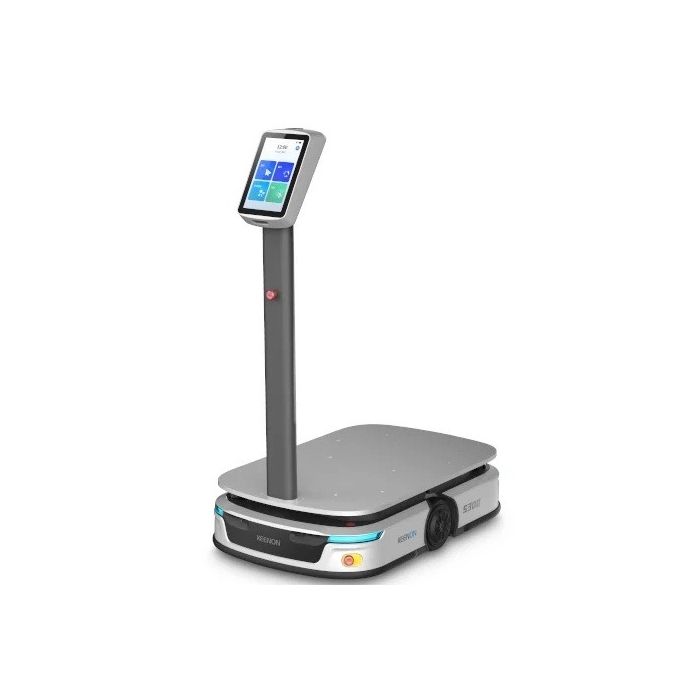
KEENON S300 Heavy-Load Intelligent Warehouse Delivery Robot with 5 Year Warranty
In stock
- BRAND:
- KEENON
- MODEL:
- S300
- ORIGIN:
- China
- Warranty:
- 60 MONTHS
- AVAILABILITY:
- ALLOW 2-4 WEEKS FOR DELIVERY
- SKU:
- KEENON-S300
KEENON S300 Heavy-Load Intelligent Warehouse Delivery Robot with 5 Year Warranty
Between a manual trolley and a fixed conveyor line, many warehouses have a difficult middle ground: loads are too repetitive for people to move all day, but routes change too often to justify permanent automation. KEENON S300 Heavy-Load Intelligent Warehouse Delivery Robot with 5 Year Warranty is presented in the published information as a transport robot for that space, with reported 300 kg load handling, VSLAM navigation, offline operation and a 360° safety system. Rather than asking a facility to rebuild every aisle around a single track, the S300 is reported to plan routes, make task decisions autonomously and support material movement between shelves, boxes, rack frames and transfer points.
Robots USA sells the KEENON-S300 for customers in the United States who need a quoted warehouse delivery robot for industrial, commercial and logistics environments. Robots USA provides quotation, delivery coordination and support for the product, with configuration details, documentation checks, customs requirements and site support arranged during the quotation process.
Background
KEENON and mobile service robotics
KEENON is the brand named for the S300, and the product sits in the broader class of autonomous mobile robots used to move goods through human workspaces. In this category, the buying decision is rarely about a single headline figure. A warehouse team normally checks load handling, floor layout, docking precision, charging strategy, user interface and the way a robot can work alongside existing access control, elevators and IoT systems. The published S300 information reports several of those elements, including VSLAM navigation, LiDAR, stereo vision, emergency stop buttons and integration with building systems.
How the S300 is positioned
The S300 is reported as a heavy-load intelligent warehouse delivery robot, not a table-service robot or a small parcel shuttle. Per the published specification, it handles 300 kg loads and uses a low chassis with lifting function to drive under, lift and lower rack frames, boxes and similar structures. That positioning matters for facilities where the transfer point is as important as the journey: the robot must approach a rack, align accurately, lift the load and move it to another point without depending on a human to push or steer the load.
Technical Specifications
| Specification | S300 |
|---|---|
| Product overview | Reported as a transport robot handling 300 kg loads with VSLAM navigation, 360° safety system and offline operation |
| Dimensions (L×W×H) | Per published specification: 925 × 620 × 1282 mm |
| Chassis and lifting function | Reported as a 23 cm low chassis with lifting function, adapting to shelves up to 120×120 cm |
| Speed, unloaded | Per published specification: 0,2-1 m/s |
| Speed, loaded | Per published specification: 0,2-0,8 m/s |
| Battery runtime, charging time and battery swap | Reported as 6h full-load runtime, 3,5h fast charging and 15-second battery swap |
| Battery type | Per published specification: Ternäre Lithium 48V 15Ah |
| Display | Per published specification: 10,1 Zoll Touchscreen (1280×800) |
| Sensors and safety | Reported as 3 stereo vision cameras, 2 LiDAR, 1 VSLAM sensor and 3 emergency stop buttons |
| Offline operation | Reported to plan routes and make task decisions autonomously, including in basements and areas without network coverage |
| Delivery modes | Reported as direct delivery, multi-point delivery, cycle mode and handling, selectable by terminal or display |
| Multi-robot coordination and integrations | Reported as up to 10 devices working together, with integration with elevators, access control and IoT systems |
| Docking accuracy | Per published specification: 2-3 cm |
| Setup time | Published information states VSLAM creates centimetre-accurate maps in one day |
| Lifting function | Reported to drive under, lift and lower rack frames and boxes for transport |
| IP rating | Not published; confirmed at quotation |
| Noise level | Not published; confirmed at quotation |
| Operating system | Not published; confirmed at quotation |
| Charging station power rating | Not published; confirmed at quotation |
| Maximum payload volume | Not published; confirmed at quotation |
| Warranty-independent service life | Not published; confirmed at quotation |
These specifications are as published and are confirmed against the datasheet at quotation.
What makes the KEENON S300 different from a conventional trolley or cart?
A trolley depends on a person to move it, while the S300 is reported to process data in real time, plan routes and make task decisions autonomously. That difference is important where material movement repeats across shifts, floors or departments, because the labour problem is not only the weight of a single trip but the accumulation of many routine transfers.
The published S300 information also describes a lifting function that allows the robot to drive under, lift and lower rack frames and boxes. In practical terms, that reported function places the robot closer to an autonomous material transfer platform than a simple powered cart. Per the published specification, docking accuracy is 2-3 cm, which is a key figure to verify for any site where racks, charging points or special transfer points must be reached consistently in tight spaces.
How does offline operation help in warehouse deployment?
Warehouses often include mezzanines, basements, service corridors and areas where wireless coverage is incomplete or interrupted. The S300 is reported to work in basements and areas without network coverage, while planning routes and making task decisions autonomously. That does not remove the need for a careful site survey, but it does address a common concern: whether every useful route has to depend on constant connectivity.
The published information also reports delivery modes including direct delivery, multi-point delivery, cycle mode and handling, selectable by terminal or display. For a buyer, those modes suggest the S300 can be considered for point-to-point transfers, scheduled circulation and task-based handling flows, subject to confirmation of the final workflow, rack dimensions, route width and safety requirements at quotation.
Who is KEENON S300 for?
The KEENON-S300 is for warehouse, manufacturing, commercial storage and internal logistics teams that need to move heavier goods than a light delivery robot would normally carry. Per the published information, the S300 is positioned around 300 kg load handling, a 23 cm low chassis with lifting function and adaptation to shelves up to 120×120 cm, so it is most relevant where the load carrier can match that type of under-run and lift operation.
Operations managers may consider it for repetitive material movement between receiving areas, staging locations, production cells, storage rooms or service zones. Facilities teams may focus on the reported offline operation and integration with elevators, access control and IoT systems, particularly where goods must cross between secured zones or floors. Safety and compliance reviewers should examine the reported 3 stereo vision cameras, 2 LiDAR, 1 VSLAM sensor and 3 emergency stop buttons, then confirm the complete site safety case before deployment.
The fact sheet supplied for this page names only the S300 version, so this article does not steer buyers toward a sibling trim with different specifications. If a project requires a published IP rating, noise level, operating system, charging station power rating, maximum payload volume or warranty-independent service life, those details should be requested and confirmed during quotation because they were not published in the supplied sources.
What is KEENON S300 used for?
- Rack-frame movement: The published information reports that the S300 can drive under, lift and lower rack frames for transport.
- Box transport: The lifting function is reported for boxes and similar load carriers where the site layout supports the operation.
- Warehouse point-to-point delivery: Direct delivery is reported as a selectable mode by terminal or display.
- Multi-stop internal logistics: Multi-point delivery is reported for routes that require more than one destination in a task flow.
- Repeated circulation tasks: Cycle mode is reported for operations that need recurring movement along planned routes.
- Coordinated fleet work: The published information reports that up to 10 devices can work together with task distribution and global route optimization.
Pricing and Availability
Robots USA provides KEENON-S300 pricing by quotation because configuration, deployment scope and support requirements must be confirmed for each site. No price is stated on this page, and the appropriate commercial offer should be requested with the intended routes, load carriers, operating environment and integration requirements.
Delivery, customs and support are arranged with the quotation. To request current commercial terms for the KEENON S300 Heavy-Load Intelligent Warehouse Delivery Robot with 5 Year Warranty, use the quotation option available on this page.
Frequently Asked Questions
What load does the KEENON S300 handle?
The published information reports that the S300 handles 300 kg loads. The exact load carrier, shelf arrangement and payload distribution should be confirmed at quotation for the intended site.
What are the dimensions of the S300?
Per the published specification, the S300 dimensions are 925 × 620 × 1282 mm. Any clearance assessment should also account for aisles, turning areas, rack geometry and transfer points.
What navigation system does the S300 use?
The S300 is reported to use VSLAM navigation. The published information also states that VSLAM creates centimetre-accurate maps in one day, to be confirmed against the datasheet at quotation.
Can the S300 operate without network coverage?
The published information reports offline operation, including use in basements and areas without network coverage. Site-specific behaviour should still be reviewed during deployment planning.
What sensors and safety hardware are reported?
The source reports 3 stereo vision cameras, 2 LiDAR, 1 VSLAM sensor and 3 emergency stop buttons. A complete safety assessment should be completed for the actual working environment.
Are IP rating, noise level and operating system published?
No. The manufacturer has not published the IP rating, noise level or operating system in the supplied sources; these are confirmed at quotation.
Where can I buy KEENON S300 and what does it cost?
You can request the KEENON-S300 from Robots USA. Pricing is provided by quotation, with delivery, customs and support details arranged as part of the quoted offer.
Summary
The S300 is best understood as a way to automate the middle ground between hand-pushed movement and fixed infrastructure. The published information reports 300 kg load handling, VSLAM navigation, a 23 cm low chassis with lifting function, 2-3 cm docking accuracy, 6h full-load runtime and 3,5h fast charging, while also identifying practical deployment factors such as offline operation, delivery modes and multi-robot coordination.
For buyers, the next step is not to assume that every warehouse problem is solved by a robot, but to test whether the reported S300 capabilities match the loads, routes, racks and integrations in the facility. Robots USA can quote, deliver and support the KEENON-S300 for suitable projects, and for that evaluation this page is the starting point.