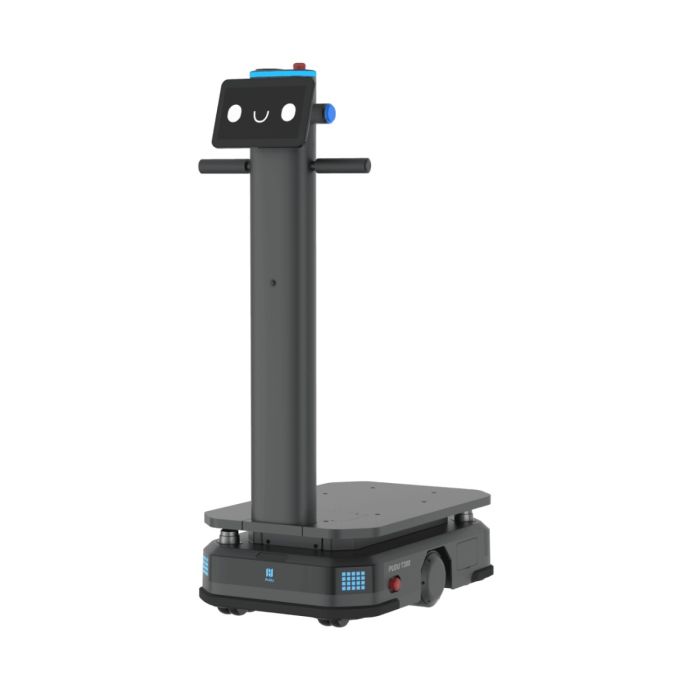
PUDU T150 Light-Payload Industrial Delivery Robot
In stock
- BRAND:
- PUDU ROBOTICS
- MODEL:
- T150
- ORIGIN:
- China
- AVAILABILITY:
- SUBJECT TO AVAILABILITY
- SKU:
- PUDU-T150
PUDU T150 Light-Payload Industrial Delivery Robot
A conveyor decides the route once and keeps it forever. That works until the production line moves, a new cell is added or the warehouse layout changes for the season, and then the steel that once saved time becomes an obstacle. The PUDU T150 Light-Payload Industrial Delivery Robot takes the opposite approach: it carries parts, totes and materials between stations along routes that live in software, so the path changes when the floor changes. It builds its map onboard, coordinates with other units without a local server and fits through aisles a pallet truck would never attempt. For operations that need flexible, repeatable material flow rather than a fixed line, it is a direct and practical answer.
Robots USA sells the PUDU T150 in both its Standard and Lifting configurations and supplies it to manufacturers, warehouse operators and intralogistics teams. Robots USA prepares each quotation against the buyer's application, coordinates delivery and provides after-sales support, so technical questions, configuration choices and commissioning are handled by one team from first contact onward.
Background
PUDU ROBOTICS: from service floors to factory floors
PUDU ROBOTICS built its reputation on service robots for restaurants, hotels and other commercial spaces, where a machine has to share busy floors with people, react to unpredictable movement and be run by staff with no robotics background. That experience shapes its industrial line. The T150 brings the same emphasis on simple operation, with an onboard touchscreen running a proprietary operating system, while adding what industrial buyers expect: compliance with ISO 3691-4 standards and industrial-specific CE certification. The result is a robot designed to be dispatched by line workers, not just by engineers.
Navigation and deployment technology
The core of the T150 is its perception stack. Dual RGBD cameras and 360° dual LiDAR feed AI-driven multi-level navigation and obstacle avoidance, and the Standard version combines VSLAM + LiDAR SLAM for positioning. Fusing visual and laser-based localization gives the robot more than one way to know where it is, which matters in facilities where racks get restocked, carts get parked in odd places and lighting varies across a shift. Deployment is equally lean: mapping is done onboard and multiple robots self-network, with no local servers or network deployment required. Power is handled three ways, with rapid battery swapping, auto-charging and wired power options that the manufacturer positions as enabling 24/7 uptime.
Technical Specifications
| Specification | PUDU T150 Standard | PUDU T150 Lifting |
|---|---|---|
| Machine dimensions | 835mm×500mm×1350mm(32.8 in × 19.7 in × 53.1 in) | Not published; confirmed at quotation |
| Machine weight | 65KG(143.4lbs) | 81KG(178.57lbs) |
| Maximum payload | 150KG(330.7 lbs) | Not published; confirmed at quotation |
| Lifting height | Not applicable | 60mm(2.36 in) |
| Maximum operating speed | 0.2~1.2 m/s (0.66~3.94 ft/s) | Not published; confirmed at quotation |
| Minimum passable width | 60cm (23.6 in) | Not published; confirmed at quotation |
| Navigation method | VSLAM + LiDAR SLAM | Not published; confirmed at quotation |
| Sensors | Dual RGBD cameras, 360° dual LiDAR | Dual RGBD cameras, 360° dual LiDAR |
| Charging time | 2h(0%-90%) | 2h(0%-90%) |
| Operating time | 12h (no-load) | 12h (no-load) |
| Step-climbing capability | 20 mm (0.79 in) | 20 mm (0.79 in) |
| Gap-crossing capability | 35 mm (1.38 in) | 35 mm (1.38 in) |
| Operating environment | 0 ℃~ 40 ℃ (32°F ~ 104°F) | 0 ℃~ 40 ℃ (32°F ~ 104°F) |
| Power options | Rapid battery swapping, auto-charging, wired power | Rapid battery swapping, auto-charging, wired power |
| IoT integration | E-gate Control, Elevator Control, Call with pager, PUDU Link | E-gate Control, Elevator Control, Call with pager, PUDU Link |
| Safety certification | ISO 3691-4 standards, industrial-specific CE certification | ISO 3691-4 standards, industrial-specific CE certification |
| Ingress protection, noise level, battery type and voltage, cargo deck dimensions, Wi-Fi / network connectivity, maximum slope, package contents | Not published; confirmed at quotation | Not published; confirmed at quotation |
Specifications are shown as published by PUDU ROBOTICS for the T150 and are confirmed against the current datasheet at quotation.
What does the PUDU T150 Lifting add over the Standard?
The two builds share the same perception system, software, power options and safety credentials, so the decision comes down to how material is handed off. The Standard version is the delivery workhorse: per the manufacturer's description, it is optimized for cost-effective, point-to-point material delivery, and it is the version with a published maximum payload of 150KG(330.7 lbs). Someone loads it, the robot drives, someone unloads it.
The Lifting version adds a lifting mechanism with a maximum lifting height of 60mm(2.36 in), designed for material lifting and transport tasks in industrial and warehouse environments. That small vertical stroke changes the workflow: instead of waiting for a person at each end, the robot can raise a load, carry it and set it down. PUDU positions this build for automated integration and more advanced workflows. The added hardware shows in the weight, 81KG(178.57lbs) against 65KG(143.4lbs) for the Standard. The manufacturer has not published a payload figure for the Lifting version; it is confirmed at quotation, and buyers should not assume it matches the Standard.
How does the PUDU T150 fit into an existing facility?
Most automation projects stall on infrastructure, not on the robot. The T150 is built to sidestep that. Because mapping happens onboard and robots self-network, a facility does not need to install local servers or plan a dedicated network deployment before the first run. Integration with the building is handled through IoT functions for E-gate Control and Elevator Control, which let the robot pass through access gates and ride elevators between floors, along with Call with pager and PUDU Link.
Day-to-day operation is meant for the people already on the floor. The onboard touchscreen handles direct task dispatching, mode switching and configuration, while button pagers let a workstation call the robot with a single press. For plants running their own systems, API integration provides a path to connect the T150 to existing software. Physically, the Standard version passes through openings as narrow as 60cm (23.6 in), and the robot handles steps of 20 mm (0.79 in) and gaps of 35 mm (1.38 in), the kind of thresholds, ramps and elevator edges found in real buildings. Maximum slope has not been published and should be confirmed at quotation if ramps are on the route.
Who is the PUDU T150 for?
The T150 suits operations where materials move often, in moderate quantities, between fixed points. Electronics and component manufacturers feeding assembly lines, warehouses shuttling totes between picking and packing, and facilities spread over several floors with elevators all fit the profile. Teams that want to start small benefit from the no-server deployment, since a single robot can prove the concept before more units are added to the self-networked fleet.
Within the T150 family, buyers who simply need loads carried from point A to point B, with people loading and unloading, are best served by the Standard version. Operations aiming to remove the manual hand-off, or to connect the robot to racks, carts and automated stations, should look at the Lifting version. Loads beyond the T150's rating call for a larger machine; Robots USA carries heavier PUDU platforms in its Industrial Robots category, and broader production automation is collected under Factory Robots.
What is the PUDU T150 used for?
- Line-side parts delivery: keeping assembly stations supplied with components without pulling operators off the line.
- Inter-line handling: moving work-in-progress between production cells on routes that can be changed in software.
- Warehouse picking and distribution: shuttling totes between pick zones, packing benches and dispatch areas.
- Replenishment and retrieval: returning empty containers and bringing stock back to the point of use on call.
- Multi-floor transport: using Elevator Control and E-gate Control to deliver between floors and secured areas.
- Automated load hand-off: with the Lifting version, raising and setting down loads to cut out manual transfer.
Pricing and Availability
Robots USA prices the PUDU T150 by quotation, because the right configuration depends on your loads, routes, building integration and fleet size. Share your application and the version you are considering, and the team will confirm the specifications that matter to your site, including those not yet published. Delivery, customs and support are arranged together with the quotation. To start the process, the quotation request is available on this page.
Frequently Asked Questions
What payload does the PUDU T150 carry?
The Standard version has a maximum payload of 150KG(330.7 lbs). The manufacturer has not published a payload for the Lifting version; it is confirmed at quotation.
How long does the T150 run on a charge?
The published operating time is 12h (no-load), and charging takes 2h(0%-90%). Rapid battery swapping, auto-charging and wired power are available for continuous operation.
Does the T150 need servers or a dedicated network?
No. Mapping is done onboard and multiple robots self-network, with no local servers or network deployment required.
Can the T150 use elevators and access gates?
Yes. Its IoT integration includes Elevator Control and E-gate Control, along with Call with pager and PUDU Link.
What safety standards does it meet?
The T150 meets ISO 3691-4 standards and holds industrial-specific CE certification.
What is its ingress protection rating?
The manufacturer has not published an ingress protection rating. If your environment involves dust or moisture, it is confirmed at quotation; the published operating range is 0 ℃~ 40 ℃ (32°F ~ 104°F).
Where can I buy the PUDU T150 and what does it cost?
You can buy the PUDU T150 from Robots USA, which supplies both the Standard and Lifting versions. Cost depends on configuration and project scope, so it is provided through a personalized quotation requested on this page.
Summary
Fixed automation locks a route in place; the PUDU T150 keeps the route flexible. With dual RGBD cameras, 360° dual LiDAR, onboard mapping and self-networking, it moves materials through factories and warehouses without servers, rebuilt aisles or a new network. The Standard version handles point-to-point delivery with a published maximum payload of 150KG(330.7 lbs), while the Lifting version raises loads up to 60mm(2.36 in) for workflows that remove the manual hand-off. ISO 3691-4 compliance, industrial-specific CE certification and elevator and gate integration round out a robot built for real buildings. For a quotation from Robots USA tailored to your site, this page is the starting point.