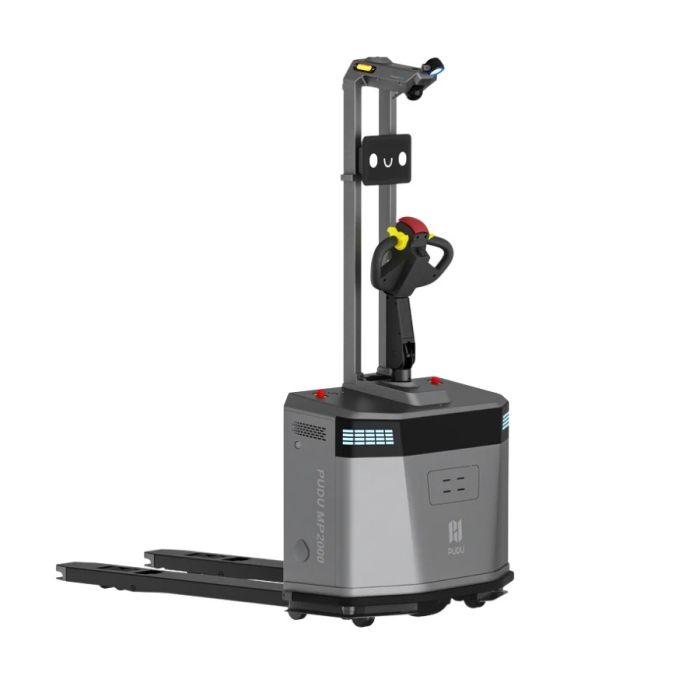
PUDU MP2000 AI-Native Pallet Handling Robot
In stock
- BRAND:
- PUDU ROBOTICS
- MODEL:
- MP2000
- ORIGIN:
- China
- Warranty:
- 12 MONTHS
- AVAILABILITY:
- SUBJECT TO AVAILABILITY
- SKU:
- PUDU-MP2000
PUDU MP2000 AI-Native Pallet Handling Robot
Spend an hour on almost any loading dock and count the trips: an operator steps onto a pallet truck, carries a load from the staging lane to the rack aisle, drops it, and rides back empty to do it again. None of it is difficult work, but it eats skilled labor hours that could go to picking, checking, or loading trucks. The PUDU MP2000 AI-Native Pallet Handling Robot is designed to take those repetitive horizontal moves off the operator's shift. It finds pallets on its own, engages them even when they were set down crooked, and moves them through the facility with 3D LiDAR-SLAM and VSLAM navigation, while a person can still take manual control whenever a job calls for it.
Robots USA is the seller of the PUDU MP2000 in both published versions, the MP2000 Standard version (MPID01-M) and the MP2000 Narrow Fork (MPID01-N). Robots USA prepares the quotation for your site, supplies the robot to your facility, and stays your contact for delivery, commissioning questions, and after-sales support once the fleet is running.
Background
PUDU ROBOTICS moves from service floors to the warehouse
PUDU ROBOTICS built its reputation on autonomous robots that work among people: delivery robots in restaurants and hotels, and industrial delivery robots in factories and commercial buildings. That background matters for pallet handling. A robot that has to share aisles with forklift drivers, pickers, and visitors needs the same habits a service robot needs in a crowded dining room: constant awareness of who is around it, predictable behavior, and the ability to recover without a technician. The MP2000 applies that experience to heavier loads and to the pallet as the unit of work. Buyers already familiar with PUDU's lighter industrial carts will find the MP2000 extends the same family into true pallet transport.
Multi-sensor navigation and edge intelligence
The MP2000 navigates with 3D LiDAR-SLAM and VSLAM, so it builds and follows its own map of the building rather than relying on magnetic tape, reflectors, or QR codes on the floor. According to PUDU ROBOTICS, this multi-sensor navigation, combined with edge intelligence on the robot, means the MP2000 requires no site modifications, platform integration, or complex deployment. Fleet coordination is distributed: the robots orchestrate their work among themselves, and the fleet keeps operating in sync even when the network goes offline. Tasks can be dispatched through PUDU Link, through APIs, by voice command, or with physical task buttons, and optional integration is available with elevator controls, automatic doors, and other IoT devices.
Technical Specifications
| Specification | MP2000 Standard version (MPID01-M) | MP2000 Narrow Fork (MPID01-N) |
|---|---|---|
| Overall dimensions | 1585 x 910 x 1870 mm(62.40 x 35.83 x 73.62 inches) | Not published; confirmed at quotation |
| Max. load | 2000 kg(4409.25 lbs) | Not published; confirmed at quotation |
| Max. lift height | 200±5 mm(7.87±0.20 inches) | Not published; confirmed at quotation |
| Fork outer width | 620 mm (24.41 inches) | 550 mm (21.65 inches) |
| Navigation method | 3D LiDAR-SLAM, VSLAM | 3D LiDAR-SLAM, VSLAM |
| Travel speed | Up to 1.6 m/s unloaded, 1.2 m/s loaded | Up to 1.6 m/s unloaded, 1.2 m/s loaded |
| Fork insertion | Completed in 20 seconds | Completed in 20 seconds |
| Gradeability | 3°/ 8° (Full Load/Unloaded) | 3°/ 8° (Full Load/Unloaded) |
| Battery life | 12 h (None load), 6 h (Max. load) | 12 h (None load), 6 h (Max. load) |
| Charging time | About 2 h at 200V~240Vac; about 3.2h at 100V~120Vac | About 2 h at 200V~240Vac; about 3.2h at 100V~120Vac |
| Narrow-aisle pickup | 90° pallet pickup in aisles as narrow as 2 m, pallet spacing down to 15 cm | 90° pallet pickup in aisles as narrow as 2 m, pallet spacing down to 15 cm |
| Pallet pickup tolerance | Offset up to 15 cm, angle up to 15° | Offset up to 15 cm, angle up to 15° |
| Thresholds and gaps | Thresholds up to 10 mm, gaps up to 35 mm | Thresholds up to 10 mm, gaps up to 35 mm |
| Compatible load carriers | Standard three-runner pallet, perimeter-base pallet; learns non-standard carriers | Standard three-runner pallet, perimeter-base pallet; learns non-standard carriers |
| Product weight | Not published; confirmed at quotation | Not published; confirmed at quotation |
| Battery type and capacity | Not published; confirmed at quotation | Not published; confirmed at quotation |
| Ingress protection rating | Not published; confirmed at quotation | Not published; confirmed at quotation |
| Operating temperature range | Not published; confirmed at quotation | Not published; confirmed at quotation |
| Wireless connectivity | Not published; confirmed at quotation | Not published; confirmed at quotation |
| Safety certifications | Not published; confirmed at quotation | Not published; confirmed at quotation |
| Contents of the box | Not published; confirmed at quotation | Not published; confirmed at quotation |
Specifications are as published by PUDU ROBOTICS; rows not tied to a version are published for the MP2000 as a whole, and every figure is confirmed against the datasheet at quotation.
What does the MP2000 Narrow Fork version change?
The published difference between the two versions is the fork outer width: 620 mm (24.41 inches) on the MP2000 Standard version (MPID01-M) and 550 mm (21.65 inches) on the MP2000 Narrow Fork (MPID01-N). That single dimension decides which pallets each version can enter cleanly, so the right choice depends on the fork-pocket geometry of the carriers you actually move. Load capacity, lift height, and overall dimensions are published only for the Standard version; PUDU ROBOTICS has not published those figures for the Narrow Fork, so they are confirmed at quotation rather than assumed. If your site runs a mix of pallet types, Robots USA can review your carriers before recommending one version or a combination of both.
How does the MP2000 cope with real pallets and real floors?
Many automated pallet movers expect loads to sit exactly where the system put them. The MP2000 is specified to adapt automatically to manually placed pallets offset by up to 15 cm and angled by up to 15°, which reduces how often someone has to walk over and square a pallet before the robot will touch it. It supports standard three-runner and perimeter-base pallets and automatically learns to recognize non-standard load carriers for precise fork engagement.
Space and floor conditions are addressed as well. The robot handles 90° pallet pickup in aisles as narrow as 2 m, with pallet spacing down to 15 cm, and it rolls over thresholds up to 10 mm and gaps up to 35 mm. Gradeability is 3° at full load and 8° unloaded, which is worth checking against any ramps on your planned routes. Around people, depth cameras, 3D LiDAR, and other sensors form a multi-layer safety system that detects people, equipment, and obstacles in real time. Safety certifications have not been published by the manufacturer, so they are confirmed at quotation for your jurisdiction.
Who is the PUDU MP2000 AI-Native Pallet Handling Robot for?
The clearest fit is a distribution center or third-party logistics operation where pallets shuttle constantly between receiving, staging, and storage, and where operators spend too much of their shift on short repetitive moves. Manufacturers are a second group: line-side replenishment and finished-goods transfer to the warehouse are steady, predictable flows that suit an autonomous robot with task-button or API dispatch. Facilities spread across several floors can benefit from the optional elevator and automatic-door integration.
Sites that handle pallets with narrower fork entries should look at the MP2000 Narrow Fork (MPID01-N), while the MP2000 Standard version (MPID01-M) is the version with published load, lift, and dimension figures. Operations that move totes, carts, or smaller loads rather than full pallets may find a better match among PUDU's delivery platforms in our Industrial Robots category, and broader production-floor automation is gathered under Factory Robots.
What is the PUDU MP2000 used for?
- Inbound receiving: moving pallets from the dock to staging lanes as trucks are unloaded.
- Putaway support: carrying staged pallets to the rack aisle for storage.
- Line-side replenishment: delivering raw materials to production lines on a schedule or on demand.
- Finished-goods transfer: taking completed pallets from end of line to the warehouse.
- Outbound staging: assembling pallets near shipping doors ahead of truck loading.
- Multi-floor transport: moving pallets between levels with optional elevator integration.
Pricing and Availability
Robots USA sells the MP2000 by quotation, so the configuration, version, and quantity match your facility rather than a generic catalog listing. Delivery, customs, and support are arranged together with the quotation. Tell us about your pallet types, aisle widths, ramps, and the moves you want to automate, and we will confirm the published figures and the unpublished items against the datasheet. To start, a quotation request is available on this page.
Frequently Asked Questions
How much can the MP2000 carry?
The MP2000 Standard version (MPID01-M) has a maximum load of 2000 kg(4409.25 lbs). PUDU ROBOTICS has not published the maximum load for the Narrow Fork version, so it is confirmed at quotation.
Does the robot need tape, reflectors, or markers on the floor?
No. It navigates with 3D LiDAR-SLAM and VSLAM, and the manufacturer states it requires no site modifications, platform integration, or complex deployment.
How long does the battery last and how fast does it charge?
Battery life is 12 h with no load and 6 h at maximum load. Charging takes about 2 h at 200V~240Vac or about 3.2h at 100V~120Vac; battery type and capacity are not published and are confirmed at quotation.
Can an operator take over manually?
Yes. The MP2000 switches between autonomous and manual modes, handling routine tasks on its own while allowing operator assistance when needed.
What happens if the network goes down?
Fleet orchestration is distributed, and according to PUDU ROBOTICS the fleet continues operating in sync even offline.
Is the MP2000 rated for outdoor or cold-storage use?
The ingress protection rating and operating temperature range have not been published. Both are confirmed at quotation before any outdoor or temperature-controlled deployment is planned.
Where can I buy the PUDU MP2000 AI-Native Pallet Handling Robot and what does it cost?
You can buy it from Robots USA, which supplies both the Standard and Narrow Fork versions. Cost depends on version, quantity, and integration needs, so it is set in a quotation prepared for your site.
Summary
Those empty return trips on the pallet truck are where the MP2000 earns its place. It takes over short, repetitive pallet moves, picks up loads that were set down imperfectly, works in tight aisles, and coordinates as a fleet that keeps running even without a network connection, all without reworking the building. Choose the Standard or Narrow Fork version to match your pallets, confirm the unpublished details at quotation, and let Robots USA handle supply and support. For freeing your operators from the dock-to-rack shuttle, this page is the starting point.