
Topsky Small Fire Reconnaissance Robot
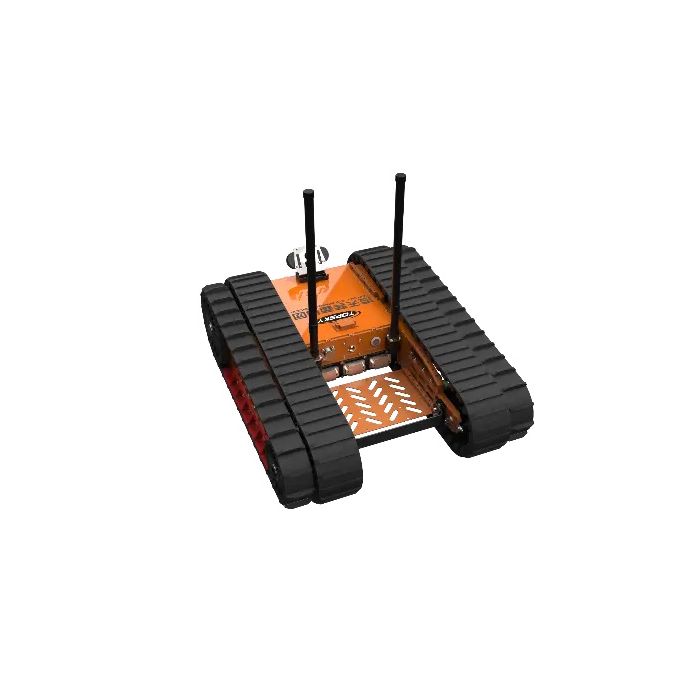
In stock
- BRAND:
- TOPSKY
- MODEL:
- RXR-C10D
- PART #:
- RXR-C10D
- ORIGIN:
- China
- Warranty:
- 12 MONTHS
- AVAILABILITY:
- SUBJECT TO AVAILABILITY
- SKU:
- Topsky-RXR-C10D
Buy now, pay later
Topsky Small Fire Reconnaissance Robot
Small robots usually pay for their size at the first stairwell. Shrink a tracked platform until it rolls under a parked car, and it tends to lose the reach to climb a step, cross a gap or get over a fallen beam, which is exactly the terrain an emergency scene throws at it. The Topsky Small fire reconnaissance robot refuses that trade. At no more than 200mm high without its antenna, it fits beneath vehicle bodies and storage shelves, yet its crawler and front double swing arms carry it up 40 degree stairs and over 280mm vertical obstacles. It goes into flammable, explosive and otherwise harsh environments for reconnaissance and gas detection, so your people do not have to.
Robots USA supplies the RXR-C10D to fire departments, industrial emergency teams, hazmat units and system integrators across the United States. We prepare the quotation and help you choose the expansion modules your mission calls for. We arrange delivery and remain your point of contact for training questions and support once the robot is in service.
Background
TOPSKY and its firefighting robot line
TOPSKY builds a family of firefighting robots that runs from heavy suppression machines to dedicated scouts, and several of them appear in our Firefighting Robots category. The RXR-C10D sits at the light, reconnaissance end of that range. Its larger siblings are built around extinguishing agents or smoke-exhaust equipment. This robot is built around sensing and video. Its job is to arrive first, look and measure, and send that information back to the people deciding what happens next. It belongs to the broader class of UGVs, unmanned ground vehicles that put a machine in the place of a person wherever the ground is too dangerous or too confined to enter.
Crawler plus double swing arm
The chassis pairs a crawler track with a front double swing arm structure. The tracks give steady traction on rubble, wet floors and uneven ground. The swing arms reach forward and lever the body up onto an edge, letting a low machine climb a 360mm platform, cross 41 cm wide trenches and take on 45 degree slopes. The two swing arms detach freely, so the robot can run without them where the clearance is tightest or the terrain is flat. The track itself is made of flame-retardant, anti-static, high-temperature resistant rubber with Kevlar inside, and a derailment protection design helps keep it seated on the drive while the robot climbs and turns over obstacles.
Technical Specifications
| Specification | Value |
|---|---|
| Version | RXR-C10D small fire reconnaissance robot (B) |
| Chassis | Crawler + front double swing arm structure, detachable swing arms |
| Maximum vertical obstacle | 280mm (28 cm) |
| Platform climbing | 360mm |
| Slope climbing | 45 degree |
| Stair climbing | 40 degree |
| Trench crossing | 41 cm wide |
| Protection level | IP67 (whole robot) |
| Power | Electric, ternary lithium battery |
| Size | ≤length 610mm×width 490mm×height 200mm (without antenna) |
| Weight | ≤25kg |
| Wireless video transmission distance | 500m (open) two-point communication; 800m (open) three-point communication (optional) |
| Wired remote control distance | 100m |
| Crawler | Flame-retardant, anti-static, high-temperature resistant rubber with Kevlar inside; derailment protection design |
| Expansion modules | Lidar module, gas detection module, reconnaissance gimbal module, robotic arm module |
| Expansion interfaces | Four extended aviation plug ports; reserved RS232, RS485, CAN, network port, 24V, 12V (normally closed) |
| Remote control terminal display | No less than 10 inches high-brightness LCD screen, 4 channels of video signal switching |
| Remote control terminal weight | 2.5kg |
Specifications are as published by the manufacturer and are confirmed against the datasheet at quotation.
The manufacturer has not published the battery capacity, charging time, camera resolution, operating temperature range, payload capacity or the specifications of the gas detection module; Robots USA confirms these with you at quotation.
How does the RXR-C10D keep working when the radio link fails?
Radio is often the first thing to fail inside a structure. Concrete, steel shelving, tank walls and the bulk of a parked vehicle all absorb or reflect a wireless signal, and an industrial site can add interference of its own. The RXR-C10D answers this in two ways.
First, its wireless video link reaches 500m in open conditions with two-point communication. Where the line of sight is broken, an optional three-point configuration extends that to 800m in open conditions and is designed for occluded scenes, placing a relay between the operator and the robot.
Second, the robot carries wired control. When signal interference makes wireless operation unreliable, the operator can drive it remotely over a tether out to 100m. That shorter reach is a deliberate trade: the tether keeps command of the robot when the radio cannot, which matters most in exactly the places a reconnaissance robot is sent, such as basements, plant rooms and storage aisles.
At the operator end, the remote control terminal weighs 2.5kg and uses a high-brightness LCD screen of no less than 10 inches, so it stays readable outdoors. It switches between four channels of video, letting the operator move between views without losing the picture.
What can be mounted on the RXR-C10D?
The robot is a carrier first, and its payload defines the mission. TOPSKY lists four expansion modules: a lidar module, a gas detection module, a reconnaissance gimbal module and a robotic arm module. Gas detection matches the robot's core purpose of reading the atmosphere in a hazard zone before anyone enters it. The gimbal points cameras where the crew needs to look. Lidar adds spatial sensing, and the robotic arm gives the robot a way to interact with what it finds.
For teams that build their own sensor packages, the expansion interfaces matter as much as the modules. Four extended aviation plug ports sit alongside reserved RS232, RS485, CAN and network connections, with 24V and 12V (normally closed) power outputs. That gives an integrator standard serial, fieldbus and Ethernet paths into the platform without custom wiring. Robots USA can discuss module combinations as part of your quotation.
Who is the Topsky Small fire reconnaissance robot for?
Municipal and county fire departments are the natural first buyers. They need a scout that a small crew can carry off a truck, deploy quickly and send ahead into a structure, a parking garage or a vehicle fire, where the danger sits low and out of sight.
Industrial emergency response teams at refineries, chemical plants, fuel depots and large warehouses form the second group. Their sites combine flammable inventory, dense racking and heavy steel that blocks radio, which is the setting where low clearance, gas detection and wired control work together.
Hazmat and special operations units will value the robot as a way to assess a scene before committing personnel in protective gear. System integrators and research groups, for their part, will look at the reserved RS232, RS485, CAN and network interfaces as a base for their own payloads.
The RXR-C10D is a reconnaissance robot, not an extinguishing one. Teams whose priority is putting agent on a fire should compare the Topsky All-terrain fire fighting robot and the rest of the suppression line. Where the task centers on building a model of the scene, the Topsky Firefighting reconnaissance modeling robot is the sibling to look at. Robots USA can help you weigh the options against your mission.
What is the Topsky Small fire reconnaissance robot used for?
- Gas detection ahead of entry: it carries a gas detection module into flammable or explosive atmospheres so the crew learns what the air holds before going in.
- Under-vehicle inspection: its low body reaches beneath car bodies to check for fire spread, leaks or hazards that cannot be seen from a standing position.
- Warehouse and shelving reconnaissance: it searches beneath storage shelves and along racking where smoke and stacked goods hide the source.
- Multi-level structure surveys: it climbs stairs and platforms to scout upper floors, mezzanines and raised plant areas.
- Operations in radio-denied areas: it switches to wired control in basements, tunnels and steel-heavy rooms where wireless signals fail.
- Custom sensor deployments: it serves as a rugged mobile carrier for lidar, a gimbal, a robotic arm or an integrator's own payload through its expansion interfaces.
Pricing and Availability
Robots USA prices the Topsky Small fire reconnaissance robot by quotation, because the final configuration depends on the communication setup and expansion modules you select. Tell us about your mission, your sites and the sensors you need, and we will prepare a quotation that reflects your actual configuration. Delivery, customs and support are arranged together with the quotation. To begin, use the quotation request available on this page.
Frequently Asked Questions
How low can the robot go?
The RXR-C10D measures no more than 200mm high without its antenna, low enough to reconnoiter beneath car bodies and storage shelves.
Can it climb stairs?
Yes. It climbs 40 degree stairs and 45 degree slopes, crosses 280mm vertical obstacles, climbs a 360mm platform and spans 41 cm wide trenches.
Is the robot waterproof?
The whole robot is rated IP67.
What happens if the wireless signal is lost?
The robot carries wired control, so the operator can keep driving it over a tether out to 100m when signal interference blocks the wireless link.
How far does the video link reach?
Wireless video reaches 500m in open conditions with two-point communication, or 800m in open conditions with the optional three-point configuration built for occluded scenes.
Can I remove the swing arms?
Yes. The dual swing arms detach freely, which lets the robot be configured for a wider range of scenarios.
Where can I buy the Topsky Small fire reconnaissance robot and what does it cost?
Robots USA supplies the robot across the United States. The cost depends on the modules and communication setup you choose, so request a quotation and we will prepare one for your configuration.
Summary
The Topsky Small fire reconnaissance robot is built on the idea that a scout should not have to choose between fitting under things and getting over them. Its low crawler body reaches beneath vehicles and shelving. Its front double swing arms take it up stairs, onto platforms and across trenches. An IP67 rating, a flame-retardant Kevlar-reinforced track and wired control as a fallback keep it working where conditions turn hostile. Four expansion modules and a set of standard interfaces let you shape the payload around the mission. If your team needs a first look into ground no person should enter yet, this page is the starting point.