
Galbot G1 Wheeled Humanoid Robot
In stock
- BRAND:
- GALBOT
- MODEL:
- G1
- ORIGIN:
- China
- AVAILABILITY:
- SUBJECT TO AVAILABILITY
- SKU:
- Galbot-G1
Buy now, pay later
Galbot G1 Wheeled Humanoid Robot
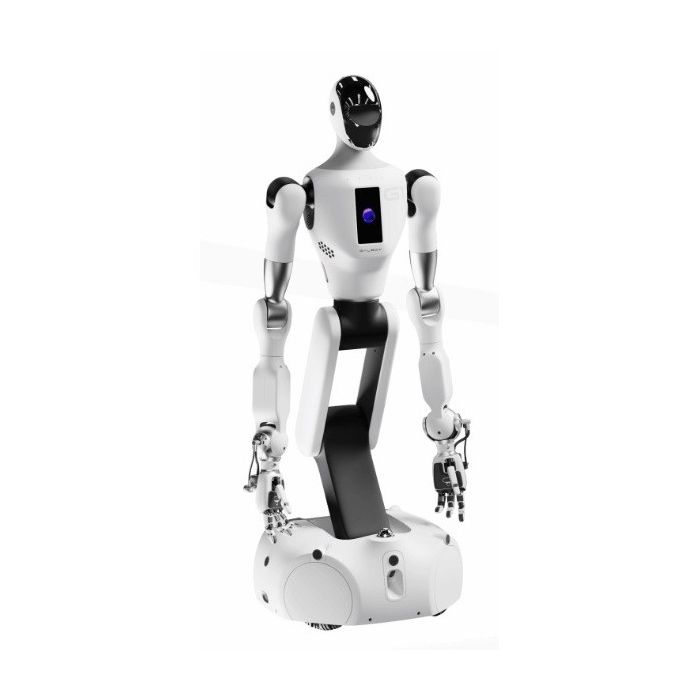
A robot is only as useful as whatever sits at the end of its arm. Bolt on a gripper and it grips. Fit a suction cup and it lifts flat, smooth goods. Mount a dexterous hand and it starts handling the awkward, everyday objects that people take for granted. The Galbot G1 Wheeled Humanoid Robot is built on that idea. Its end effector is interchangeable between a dexterous hand, a suction cup and a gripper, so one mobile platform can be set up for the job in front of it instead of being locked into a single motion. Under that changeable tooling sits a fixed foundation: a four-wheel omnidirectional base, a waist and neck that position the upper body, and two seven-joint arms guided by Galbot's own embodied multimodal large model.
Robots USA sells the Galbot G1 and supplies it to businesses, integrators and research teams across the United States. We prepare the quotation, coordinate import and delivery, and stay on as your point of contact for configuration questions and after-sales support once the robot is on your floor.
Background
Galbot and a record of real deployments
Galbot designs the G1 as a general-purpose robot for productivity, and the company backs that claim with field numbers rather than stage shows. In its Galbot Space Capsule scenario, the G1 has been deployed at more than 170 sites in over 40 Chinese cities. Galbot describes this as one of the first cases worldwide of humanoid robots running at city scale. That matters for a buyer: a robot that has worked across that many sites has been tested against changing layouts, different products and the steady wear of daily operation.
An embodied model on a practical base
The G1 runs Galbot's in-house embodied multimodal large model, which lets the robot take on a range of tasks instead of repeating one hard-coded routine. The company positions it for retail, industrial and healthcare scenarios. The standard G1 runs on an NVIDIA AGX Orin computing platform. The hardware is laid out to give that model good information to work with. Each wrist carries a depth camera and a six-axis force sensor, so the robot can see what it is reaching for and feel how firmly it is holding it. The chassis adds a 3D LiDAR, eight ultrasonic sensors and an IMU for navigation and awareness of its surroundings.
Technical Specifications
| Specification | Value |
|---|---|
| Compute (standard G1) | NVIDIA AGX Orin |
| Workspace (wrist center) | Vertical 0–2100 mm, horizontal 1900 mm |
| Payload (wrist center) | 5 kg per arm, 10 kg combined |
| Degrees of freedom (excluding chassis and end effector) | 21 in total: neck 2, arms 7×2, waist 3, leg 2 |
| Chassis | 4-wheel omnidirectional mobile base, 600 / 600 / 625 mm (length / width / projected circle diameter) |
| Battery capacity | 48 V 30 Ah |
| Charging specification | 54.6 V 10 A |
| Work time | 8 hours |
| Charging time (adapter) | 3.5 hours |
| Power supply method | Autonomous return-to-charge, wireless charging |
| Operating environment | 0–40 ℃, 0%–90%RH (non-condensing) |
| Wrist sensors (left and right combined) | Depth camera ×2, wrist six-axis force sensor ×2 |
| Chassis sensors | 3D LiDAR ×1, ultrasonic sensors ×8, IMU ×1 |
| Wireless networking | WiFi 2.4/5GHz, Bluetooth 5.2 |
| Expansion ports | USB 3.0 ×2, HDMI |
| End effector | Interchangeable between dexterous hand, suction cup and gripper |
| End effector model | Parallel Gripper / Electric Suction Cup |
Specifications as published by the manufacturer; confirmed against the datasheet at quotation.
Galbot has not published the total power consumption, the operating noise level, the list of included accessories, the exact box contents, the software and SDK license terms, or the wheel and hand configuration for each SKU; Robots USA confirms all of these with your quotation.
Why does the Galbot G1 roll instead of walk?
Plenty of humanoid programs put their effort into bipedal walking. The G1 puts its effort into the work. Its four-wheel omnidirectional base can move in any direction without turning first, which is what you want in a narrow aisle or behind a service counter. The base keeps the upper body stable while the arms reach, and that stability is what makes force-sensitive handling at the wrists useful in practice.
The degrees-of-freedom breakdown shows the same priority. Of the 21 joints counted outside the chassis and end effector, 14 are in the arms and 3 are in the waist, with 2 each at the neck and the leg. Movement is concentrated where the task happens. Together with a vertical wrist-center workspace that runs from floor level to 2100 mm, the result is a robot that can pick from a bottom shelf and place on a top one without a step stool.
The power system is sized for a working shift. The 48 V 30 Ah battery is rated for 8 hours of work time, adapter charging takes 3.5 hours, and the power supply method is listed as autonomous return-to-charge with wireless charging. In daily operation, the robot can head to its charger on its own instead of waiting for someone to plug it in.
How does one Galbot G1 cover different tasks?
The answer goes back to the end of the arm. Because the end effector can be changed between a dexterous hand, a suction cup and a gripper, the G1 can be configured for the products and motions a site actually deals with. The source lists the end effector model as a parallel gripper and an electric suction cup. Which tooling ships with your unit is part of the configuration Robots USA confirms in writing.
Sensing makes that flexibility work. A depth camera at each wrist gives close-range vision right where the grasp happens, and the six-axis force sensors report the forces and torques at the wrist, so contact can be controlled instead of guessed. The embodied multimodal model ties perception to action, letting the same robot handle a range of tasks. For integration, USB 3.0 ×2 and HDMI ports plus WiFi 2.4/5GHz and Bluetooth 5.2 give engineering teams a clear way to connect peripherals and networks.
Who is the Galbot G1 for?
The G1 fits operators who want a mobile manipulator in spaces built for people. Retailers running convenience formats and supermarket floors will recognize the scenario Galbot has deployed at scale, where products sit on shelves at many heights and the layout leaves no room for a fenced-off robot cell. Operators considering an automated retail kiosk can review the Galbot Galaxy Space Capsule, the setting in which the G1 runs across Galbot's city-scale deployments.
Industrial teams looking at light material handling, and healthcare organizations exploring item picking and delivery support, fall within the scenarios Galbot names for the robot. Universities, labs and integrators make up a third group. They value the expansion ports, the wireless connectivity and a sensor suite that covers both manipulation and navigation.
If your tasks call for a platform built for heavier work, compare the Galbot S1 Heavy Duty Wheeled Humanoid Robot. If your research centers on legged locomotion, the Galbot ET1 Galaxy Star Bipedal Humanoid Robot takes a different approach. Robots USA can help you weigh one against the other for your specific workload.
What is the Galbot G1 used for?
- Shelf replenishment: picking and placing goods across the full height of retail shelving.
- Unattended retail: running the store side of an automated kiosk, as in Galbot's Space Capsule deployments.
- Pharmacy and healthcare picking: retrieving packaged items in healthcare settings, one of the scenarios Galbot names.
- Light industrial handling: moving parts and components between stations within the arms' rated payload.
- Research and development: a sensor-rich, expandable platform for embodied AI and manipulation research.
- Integration pilots: testing mobile manipulation in a live facility before committing to a wider rollout.
Pricing and Availability
Robots USA sells the Galbot G1 on a quotation basis, so the configuration, end effector tooling and software terms are spelled out before you commit. Tell us about your site, your tasks and your timeline, and we will prepare an offer that matches them. Delivery, customs clearance and support are arranged together with the quotation. To start the process, a quotation request for the Galbot G1 Wheeled Humanoid Robot is available on this page.
Frequently Asked Questions
How long does the Galbot G1 run on one charge?
The G1 is rated for 8 hours of work time on its 48 V 30 Ah battery. Adapter charging takes 3.5 hours.
How much can each arm carry?
Payload at the wrist center is 5 kg per arm and 10 kg combined.
How high can the Galbot G1 reach?
The vertical workspace at the wrist center runs from 0 to 2100 mm, and the horizontal workspace is 1900 mm.
Can the end effector be changed?
Yes. The end effector can be swapped between a dexterous hand, a suction cup and a gripper. The tooling supplied with your unit is confirmed in the quotation.
Does the robot charge itself?
The power supply method is listed as autonomous return-to-charge with wireless charging, so the robot can return to its charger without an operator.
What environments can it operate in?
The G1 is specified for 0–40 ℃ and 0%–90%RH, non-condensing, which suits indoor commercial and light industrial spaces.
Where can I buy the Galbot G1 and what does it cost?
You can buy the Galbot G1 from Robots USA, which supplies it across the United States. Pricing depends on configuration, tooling and support, so request a quotation on this page and we will prepare an offer for your project.
Summary
The Galbot G1 starts from a simple premise: put a stable, omnidirectional base under a flexible upper body, then let the tooling at the end of the arm adapt to the job. Interchangeable end effectors, depth cameras and force sensors at each wrist, a floor-to-2100 mm reach, and an 8-hour work time all serve that premise. More than 170 deployed sites show it holds up in daily operation. If you are ready to see how a G1 configured for your tasks would fit your floor, this page is the starting point.