
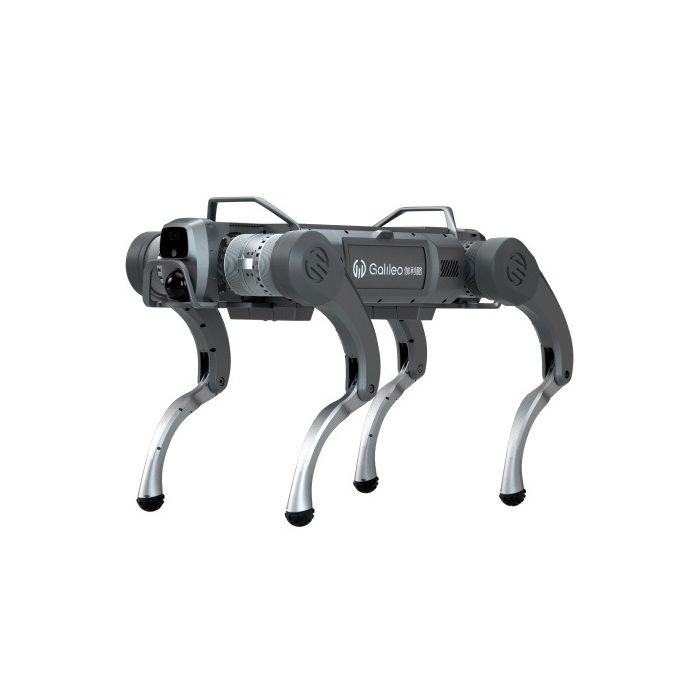
Galileo E1 Quadruped Robot Dog
In stock
- BRAND:
- GALILEO
- MODEL:
- E1
- ORIGIN:
- China
- Warranty:
- 12 MONTHS
- AVAILABILITY:
- SUBJECT TO AVAILABILITY
- SKU:
- GALILEO-E1
Buy now, pay later
Galileo E1 Quadruped Robot Dog
A legged robot is usually bought for its legs and kept for its brain. Legs get a machine across a ballast bed in a rail depot, up a ramp into a substation or along a gantry in a refinery. What it does once it arrives depends on the computing it carries and the work that computing can take on. The Galileo E1 Quadruped Robot Dog answers that second question head-on. It runs on an 8-core ARM processor and a separate 4-core X86 computer, housed in an aluminum alloy and high-strength industrial plastic body with IP66 ingress protection. The result is a medium industrial-grade quadruped that walks like a field robot and brings its own second computer to the job.
Robots USA sells the Galileo E1 and supplies it to industrial, utility, security and public-safety customers across the United States. Robots USA prepares each quotation, coordinates delivery to your site, and supports the robot once it is working on your routes. Our team can also help you match the E1 against the other platforms in the Galileo range before you commit.
Background
GalileoTime and the Galileo range
The Galileo E1 is developed by GalileoTime for practical field deployment in industrial inspection, security patrol and emergency response. GalileoTime organizes its quadrupeds into three tiers, and each tier comes as a legged model and a -W variant. The C1 and C1-W form the small industrial and consumer-grade range. The E1 and E1-W are the medium industrial-grade robots. The S1 and S1-W are the larger industrial platforms. The E1 sits in the middle of that lineup on purpose. It is built for operators who need more than a compact demonstrator and less than a full-size heavy platform.
That middle position shapes how the E1 should be evaluated. It is not a lab curiosity or a consumer robot pet. It is an operational machine meant to go into rail transit, power infrastructure, petrochemical and security environments, carry equipment and come back with useful data.
A dual-computer architecture with recognition built in
The E1's defining technical choice is its pairing of processors. The primary CPU is an 8-core ARM unit with 8 GB RAM and a 64 GB SSD. A secondary 4-core X86 computer adds 16 GB RAM and a 256 GB HDD. On top of that hardware, the E1 supports voiceprint recognition, gesture recognition, face anomaly recognition and multi-target recognition. It also supports cluster collaboration management for multi-robot deployments. Connectivity covers WiFi 6, Bluetooth 5.2, Ethernet, USB and Type-C, so the robot can join a site network and accept wired peripherals.
Power comes from a 30 Ah / 1440 Wh, 48 V battery. In low-power standby the E1 holds for at least 365 days with remote wake-up, which suits robots that are stationed on site rather than shipped in for each job.
Technical Specifications
| Specification | Value |
|---|---|
| Product class | Medium industrial-grade quadruped robot dog |
| Dimensions (L × W × H) | 100.0 × 45.2 × 55.0 cm |
| Body weight | 52 kg |
| Max standing load | 100 kg |
| Movement speed | Up to 3.5 m/s |
| Max slope | ≥30° |
| Forward platform height | 80 cm |
| Battery | 30 Ah / 1440 Wh, 48 V |
| Low-power standby | ≥365 days with remote wake-up |
| Primary CPU | 8-core ARM, 8 GB RAM, 64 GB SSD |
| Secondary CPU | 4-core X86, 16 GB RAM, 256 GB HDD |
| Connectivity | WiFi 6, Bluetooth 5.2, Ethernet, USB, Type-C |
| Ingress protection | IP66 |
| Recognition functions | Voiceprint, gesture, face anomaly and multi-target recognition; cluster collaboration management |
| Materials | Aluminum alloy and high-strength industrial plastic |
Specifications are as published by the manufacturer and are confirmed against the datasheet at quotation.
The manufacturer has not published the battery runtime, operating temperature range, sensor and camera package, charging time, control app and software, or the contents of the box; Robots USA confirms each of these at quotation.
Why does the Galileo E1 carry two computers?
Most buyers look at a quadruped's speed and payload first. On the E1, the computing deserves equal attention. The E1 carries an ARM processor and an X86 computer, each with its own memory and storage. Across legged robots in general, a split like this tends to keep real-time motion control apart from mission software. Navigation, analytics and integrator code can then run without competing with the gait for resources.
The X86 side matters to anyone who plans to bring their own software. Many industrial inspection and security tools are written for X86 environments. A robot that already carries an X86 computer with 16 GB RAM and a 256 GB HDD gives those tools a native home on board. The recognition functions point the same way. Voiceprint, gesture, face anomaly and multi-target recognition, together with cluster collaboration management, show a platform built to interpret its surroundings and coordinate with other robots, not just walk a line.
How does the Galileo E1 compare with the C1 and S1?
GalileoTime's own classification is the clearest guide. The Galileo C1 Small Quadruped Robot Dog covers the small industrial and consumer-grade end. It suits teaching, demonstrations and lighter tasks where a compact machine is the better fit. The Galileo S1 Large Industrial Grade Quadruped Robot Dog is the larger industrial platform for programs that have outgrown a medium-class robot. The E1 sits between them. At 52 kg, with a 100 kg maximum standing load, a ≥30° slope rating and a top speed of up to 3.5 m/s, it is sized to carry real inspection equipment while staying manageable for a field team.
Each tier also has a -W variant. If your routes and surfaces point toward the wheeled design, compare the Galileo E1-W Wheeled Quadruped Robot Dog before you decide. The figures on this page belong to the E1 only; the E1-W has its own page.
Who is the Galileo E1 for?
The E1 is aimed at organizations that run repeated inspection or patrol work in places that are awkward, exposed or hazardous for people. GalileoTime names four target sectors: rail transit, power infrastructure, petrochemical and security. Rail operators can use it in depots and tunnels. Utilities can send it on substation and power-facility rounds. Petrochemical sites can use it to cover plant areas on a fixed schedule. Security providers can use it to extend perimeter coverage between human patrols.
Emergency response teams are a second group. The IP66 body and the recognition functions suit reconnaissance work where a crew wants information before entering a scene. Agencies building out that capability can browse our Emergency Response category for related equipment. A third group is integrators and engineering teams who want a rugged legged base to carry their own sensors and software. For them, the X86 computer, the 100 kg standing load and the 80 cm forward platform height are the headline features. Buyers who need something smaller or more entry-level should look at the C1. Those who need a larger machine should look at the S1.
What is the Galileo E1 used for?
- Power infrastructure inspection — scheduled walk-throughs of substations and power facilities with mounted inspection equipment.
- Rail transit patrol — routine coverage of depots, platforms and track-side areas in rail transit networks.
- Petrochemical plant rounds — repeatable inspection routes through process areas where reducing human exposure is a priority.
- Security patrol — perimeter and facility patrols supported by face anomaly and multi-target recognition.
- Emergency response reconnaissance — sending a sealed, IP66-rated robot ahead of responders to assess a scene.
- Multi-robot fleet operations — coordinating several robots across a site with cluster collaboration management.
Pricing and Availability
Robots USA prices the Galileo E1 by quotation, because configuration, software and integration needs differ from one deployment to the next. Delivery, customs and support are arranged together with your quotation. Tell us about your site, your routes and the equipment you plan to mount, and we will tailor the quotation to your deployment. A quotation for the Galileo E1 Quadruped Robot Dog is available on this page.
Frequently Asked Questions
How much can the Galileo E1 carry?
The E1 has a maximum standing load of 100 kg. Robots USA can help you plan payloads around your specific equipment.
How fast does the Galileo E1 move?
The E1 reaches a movement speed of up to 3.5 m/s and handles slopes of ≥30°.
Is the Galileo E1 weather-resistant?
The E1 carries an IP66 ingress protection rating, and its body is built from aluminum alloy and high-strength industrial plastic.
What computers does the Galileo E1 use?
It pairs a primary 8-core ARM CPU with 8 GB RAM and a 64 GB SSD with a secondary 4-core X86 computer with 16 GB RAM and a 256 GB HDD.
What battery does the Galileo E1 use?
The battery is rated at 30 Ah / 1440 Wh, 48 V, and low-power standby lasts at least 365 days with remote wake-up.
Can several Galileo E1 robots work together?
Yes. The E1 supports cluster collaboration management for multi-robot deployments in rail transit, power infrastructure, petrochemical and security settings.
Where can I buy the Galileo E1 and what does it cost?
You can buy the Galileo E1 from Robots USA, which supplies it across the United States. Pricing is provided by individual quotation, which you can request on this page.
Summary
The Galileo E1 Quadruped Robot Dog earns its place on the strength of its computing as much as its legs. A 100 kg standing load, a top speed of up to 3.5 m/s and an IP66 aluminum alloy and industrial plastic body get it into rail depots, substations, plants and incident scenes. Its paired ARM and X86 computers, recognition functions and cluster collaboration management decide how much it can do once it is there. As GalileoTime's medium industrial-grade model, it sits between the compact C1 and the larger S1. For operators ready to put a thinking quadruped on their routes with Robots USA, this page is the starting point.