
Galileo C1 Small Quadruped Robot Dog
In stock
- BRAND:
- GALILEO
- MODEL:
- C1
- ORIGIN:
- China
- AVAILABILITY:
- SUBJECT TO AVAILABILITY
- SKU:
- GALILEO-C1
Buy now, pay later
Galileo C1 Small Quadruped Robot Dog
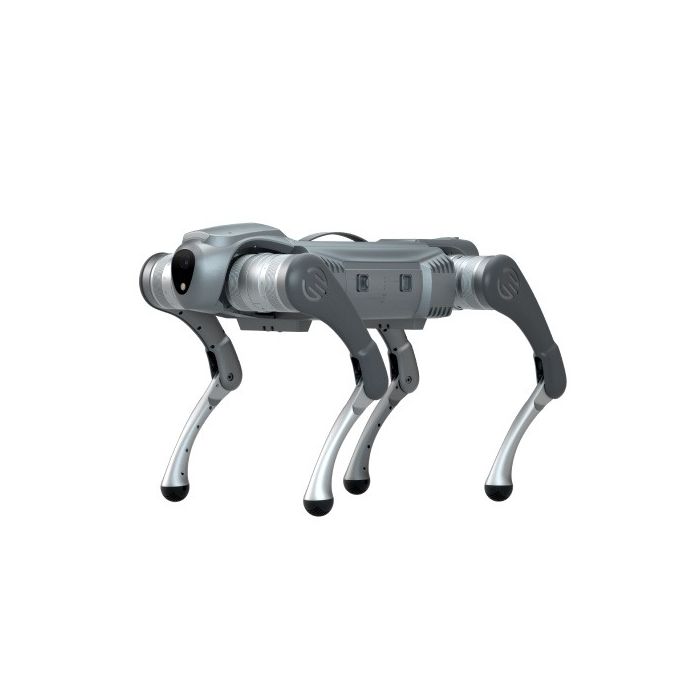
On a plant floor, the hardest assets to check are rarely the big ones. They are the pump skid behind a short run of steel steps, the switchgear room at the top of a ramp, the compressor tucked into a corner that no cart can reach. Wheels stop at the first step, and a skilled technician has better things to do than walk the same loop every shift. The Galileo C1 Small Quadruped Robot Dog closes that gap with four legs, a body compact enough to share a corridor with people, and a power system designed to keep it on the job. The same qualities make it a serious teaching and research platform for groups that want a legged robot they can program themselves.
Robots USA supplies the Galileo C1 to schools, universities, research groups and industrial maintenance teams across the United States. Robots USA prepares each quotation, coordinates delivery to your site, and supports the robot after it arrives, so you work with one team from the first technical question through commissioning and day-to-day operation.
Background
Galileo and the C1 Series
Galileo presents the C1 Series as an intelligent bionic quadruped line: a lightweight, versatile robot tailored for consumer-grade scenarios, scientific research and education, and inspection tasks for small industrial equipment. That three-way orientation matters. Many legged robots are built either as research kits or as heavy industrial machines; the C1 sits deliberately between those poles. The series names two versions, the legged C1 described on this page and the wheel-leg C1-W, and Galileo also builds larger platforms for heavier industrial work. Quadruped robots as a class have moved quickly from laboratory curiosities to working tools, because legs let a machine handle stairs, curbs and broken ground that defeat wheeled carts, while still carrying sensors and computing on board.
A platform built around its power system
What separates a working robot from a demonstrator is often the electrical design, and this is where the C1 is most deliberate. It runs on a 48V lithium battery rated at 20Ah(960Wh), with an endurance time of 3-5h. It supports autonomous charging, so it can be set up to return to its charger instead of waiting for someone to plug it in. A low power mode holds for ≥365 days and supports remote wake-up, which suits robots that sit ready for occasional patrols or seasonal experiments. External power outputs at 48V and 24V, expandable as needed, let you run add-on sensors and payloads straight from the robot's own battery.
Technical Specifications
| Specification | Value |
|---|---|
| Standing dimensions (L x W x H) | 765x410x475mm |
| Weight | 22kg |
| Battery type | Lithium Battery |
| Battery capacity | 20Ah(960Wh) |
| Battery rated voltage | 48V |
| Charger input | 100V~240V |
| External power interface | 48V;24V(Expandable as needed) |
| External communication interface | Ethernet; USB; RS485(Interface expandable as needed) |
| Low power mode | ≥365 days, supports remote wake-up |
| Autonomous charging | Supported |
| Movement speed | 0-3m/s(Adjustable) |
| Maximum climbable slope | ≥30° |
| Stair walking capability | ≥20cm high consecutive steps |
| Endurance time | 3-5h |
| Continuous load | 12kg |
| Maximum load | 15 kg |
| Control system CPU | Domestic ARM low-power high-performance CPU (8 cores 8 threads / 8GB RAM / 64GB SSD) |
| Secondary development | Supported |
| Wireless | WIFI6 Dual-band Wireless Supported |
| Front camera resolution | 1920*1080 |
| LiDAR | Optional |
| Remote control | Supplied with a remote-control handle |
| Joint IP rating | IP67 |
| Operating temperature | -20℃~55℃ |
Specifications as published by the manufacturer; confirmed against the datasheet at quotation.
Galileo has not published the charging time, the available gaits, the degrees of freedom per leg, the full list of included accessories, a companion app or the noise level; Robots USA confirms these with your quotation.
How does the Galileo C1 handle stairs, slopes and harsh conditions?
Mobility is the reason to choose legs, and the C1 backs that choice with concrete capability. It walks ≥20cm high consecutive steps, which covers typical stairs and the short steel flights common around industrial equipment, and it climbs slopes of ≥30°. Movement speed is adjustable across 0-3m/s, so you can run it slowly and steadily beside sensitive machinery or let it move briskly along a long corridor between checkpoints.
The environment is rarely kind to inspection hardware. The C1's joints carry an IP67 rating, and the robot operates from -20℃~55℃, a range that spans unheated outbuildings in winter and hot equipment rooms in summer. A front camera with 1920*1080 resolution gives operators a clear forward view, and LiDAR is available as an option for teams that need mapping and obstacle detection. With a continuous load of 12kg and a maximum load of 15 kg, the C1 can carry additional sensors, a small instrument package or research hardware without needing a larger, heavier platform.
Can the Galileo C1 be programmed for your own application?
Yes, and this is central to its value in education and research. Galileo supports secondary development on the C1, so it can serve as a base for your own navigation, perception or inspection software rather than a closed appliance. On board, an ARM low-power high-performance CPU with 8 cores and 8 threads, 8GB RAM and a 64GB SSD handles the computing load.
Connectivity is generous for a robot of this size. Ethernet, USB and RS485 are provided, with interfaces expandable as needed, so you can attach industrial sensors, gas detectors, thermal cameras or lab instruments. WIFI6 dual-band wireless keeps the robot connected to your network, and the supplied remote-control handle lets an operator drive it directly during setup, training sessions or manual inspections. Combined with the 48V and 24V external power outputs, these interfaces turn the C1 into a carrier for whatever tools your project requires.
Who is the Galileo C1 Small Quadruped Robot Dog for?
Universities and research institutes form the first group: robotics, controls and AI labs that want a real legged robot with open development support, standard interfaces and enough onboard computing to run their own experiments. Those comparing several platforms will find more options in our Research Robots category.
Schools, technical colleges and training centers are the second group. A compact, manageable quadruped with a supplied remote-control handle gives students hands-on experience with legged locomotion, perception and programming, and the long low power mode means the robot stays ready between semesters.
The third group is maintenance and reliability teams responsible for small industrial equipment: pump rooms, compressor stations, electrical rooms and utility corridors where stairs and ramps block wheeled carts. The C1's IP67 joints, temperature range and autonomous charging fit routine patrols in these spaces.
If your routes are mostly long, flat stretches where rolling efficiency matters more than stepping, look at the wheel-leg sibling, the Galileo C1-W Wheeled Quadruped Robot Dog. For heavy industrial sites that call for a bigger machine, the Galileo S1 Large Industrial Grade Quadruped Robot Dog is the better match. The full lineup is in our Standard Quadrupeds category.
What is the Galileo C1 used for?
- Small equipment inspection: routine visual checks of pumps, compressors and cabinets in rooms reached by stairs or ramps.
- Legged robotics research: a programmable platform for locomotion, control and perception experiments.
- STEM and university teaching: hands-on lessons in robotics, programming and autonomous systems.
- Sensor payload carrier: moving thermal, gas or acoustic instruments using the robot's power and communication interfaces.
- Mapping and navigation trials: testing navigation software with the optional LiDAR and the front camera.
- Scheduled facility patrols: repeated rounds supported by autonomous charging and remote wake-up.
Pricing and Availability
Robots USA prices the Galileo C1 by quotation, so the configuration you receive matches your application, whether that means adding the optional LiDAR or planning payloads for the external interfaces. Tell us about your site, your intended use and any software or sensor requirements, and we will confirm the details with you. Delivery, customs and support are arranged with the quotation. To begin, use the quotation request available on this page.
Frequently Asked Questions
Can the Galileo C1 climb stairs?
Yes. It walks ≥20cm high consecutive steps and climbs slopes of ≥30°.
How long does the Galileo C1 run on one charge?
Endurance time is 3-5h on its 20Ah(960Wh) lithium battery. It also supports autonomous charging, so it can recharge between tasks without manual handling.
Can it be used outdoors or in harsh environments?
Its joints are rated IP67, and the operating temperature range is -20℃~55℃, which covers many outdoor and unheated industrial settings.
How much can the Galileo C1 carry?
The continuous load is 12kg, with a maximum load of 15 kg. That leaves room for sensors and instrument packages.
Is LiDAR included?
LiDAR is optional on the C1. Robots USA confirms the configuration you need when preparing your quotation.
Can I develop my own software for the C1?
Yes. Secondary development is supported, and the robot provides Ethernet, USB and RS485 interfaces plus WIFI6 dual-band wireless for integration.
Where can I buy the Galileo C1 Small Quadruped Robot Dog and what does it cost?
You can buy it from Robots USA. Pricing is provided by quotation based on your configuration, and you can request one directly from this page.
Summary
The awkward corners of a facility, the stairs, the ramps, the cramped equipment rooms, are exactly where the Galileo C1 earns its place. Four legs carry it up steps and slopes, IP67 joints and a wide temperature range keep it working where conditions are rough, and autonomous charging with a year-long low power mode keeps it ready without constant attention. For labs and classrooms, open development support, standard interfaces and capable onboard computing turn the same machine into a platform for learning and research. Whether you need a patrol robot for small equipment or a legged robot your team can program, Robots USA will configure, quote and support it, and this page is the starting point.