
Fourier GR2 Humanoid Robot
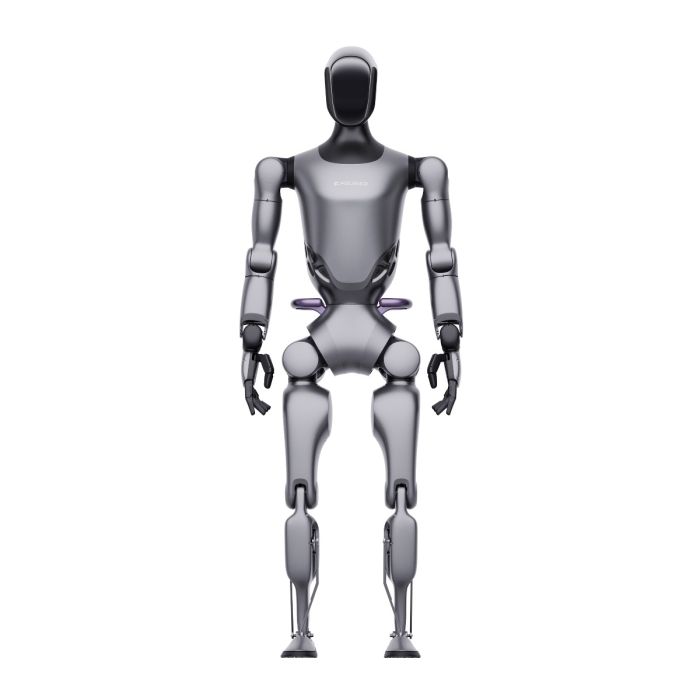
In stock
- BRAND:
- FOURIER
- MODEL:
- GR2
- ORIGIN:
- China
- AVAILABILITY:
- SUBJECT TO AVAILABILITY
- SKU:
- Fourier-GR2
Buy now, pay later
Fourier GR2 Humanoid Robot
The hardest part of building a second humanoid robot is deciding what the first one got wrong. Fourier answered that question at the joints, in the battery bay, along the wiring and at the fingertips. The Fourier GR2 Humanoid Robot is the result: a human-height machine whose upgrades read less like a marketing list and more like a set of lessons learned in the field. For a lab or development team, that history matters. A platform revised from real use tends to spend more of its life running experiments and less of it waiting on the bench for a fix.
Robots USA sells the Fourier GR2 Humanoid Robot to universities, research institutes and corporate R&D groups across the United States. We prepare your quotation, coordinate delivery to your facility and remain your point of contact for support after the robot arrives. One team handles your project from the first technical question through commissioning.
Background
Fourier and the GR-1 lineage
Fourier built its name in rehabilitation robotics before moving into general-purpose humanoids. Its first full-size humanoid, the Fourier GR1 Humanoid Robot (GR-1), is described by the company as the world's first mass-produced humanoid robot. The GR-2 builds directly on it. Few humanoid makers have had a production robot in customers' hands long enough to collect that kind of feedback, and the GR-2 is shaped by it. The GR-1 is now discontinued, so the GR-2 is where a team continues work on Fourier hardware.
A redesign from the joints outward
Instead of adding features to the GR-1 frame, Fourier reworked the fundamentals. The joint configuration moved from a parallel to a serial structure. The actuators moved to the FSA 2.0 series, which comes in seven different types so that each joint gets an actuator matched to its own torque demand. Power and communication now run through integrated cabling, so the wires are concealed and the packaging is more compact. The battery became detachable, and its capacity was doubled. Each change targets a familiar complaint about research humanoids: joints that are hard to model, exposed cables that snag and wear, and runtime that ends a session early.
Technical Specifications
| Specification | Value |
|---|---|
| Height | 175 cm |
| Weight | 63 kg |
| Degrees of freedom | 53 |
| Single-arm load capacity | 3 kg |
| Actuator series | FSA 2.0, seven different actuator types |
| Actuator peak torque | Exceeding 380 N.m |
| Encoders | Dual-encoder system, doubles control accuracy |
| Joint structure | Serial (redesigned from parallel) |
| Battery | Detachable; capacity doubled, runtime extended by an hour |
| Cabling | Integrated power and communication cabling, concealed wires |
| Hand options | Basic Dexterous Hand; Enhanced Dexterous Hand (12-DoF, optional) |
| Tactile sensing (Enhanced Dexterous Hand) | Six array-type tactile sensors |
| Upper-limb teaching modes | VR remote control, lead-through programming, direct command |
Specifications are as published by the manufacturer and are confirmed against the datasheet at quotation.
Fourier has not published the charge time, the IP rating, the Wi-Fi and Bluetooth details, the operating temperature range, the camera resolution, the operating system or the contents of the box; Robots USA confirms each of these with you at quotation.
What changed from the GR-1 to the GR-2?
The short answer is the hardware your engineers touch every day. The serial joint structure simplifies how each joint behaves, and a predictable joint is easier to model, tune and control. The FSA 2.0 actuators deliver peak torques exceeding 380 N.m. Because the series includes seven actuator types, Fourier did not have to force one actuator design onto every joint. A hip and a wrist ask for very different things, and the GR-2 treats them differently.
Control precision moved as well. The dual-encoder system doubles control accuracy, which matters most in exactly the place research teams care about: fine, repeatable motion during manipulation and data collection. A controller can only be as precise as the position data it receives, and a second encoder gives it a better picture of where each joint really is.
Then there is uptime. The detachable battery has double the capacity and extends runtime by an hour. Because it comes out of the robot, a team can swap packs and keep a session going instead of parking the robot to recharge. The integrated cabling supports the same goal: with power and communication lines concealed inside the structure, there are fewer exposed wires to catch, chafe or disconnect during long test days.
What does the Enhanced Dexterous Hand add?
The GR-2 is offered with a Basic Dexterous Hand or with the optional Enhanced Dexterous Hand, a 12-DoF design. The difference is touch. The Enhanced Dexterous Hand carries six array-type tactile sensors, so the robot can sense force, identify the shapes and materials of objects and adjust its grip in real time. That turns grasping from a position problem into a feedback problem: the hand responds to what it feels, not only to where it was told to go.
The tactile hand pays off most when combined with the GR-2's upper-limb teaching modes. Through VR remote control, lead-through programming or direct command, the robot records a comprehensive set of operational data, from motion paths to tactile responses. For a team building manipulation datasets or training learned policies, those recordings are the raw material. A hand that feels contact makes that data far richer than joint trajectories alone. If your work centers on locomotion, whole-body control or supervised demonstrations, the Basic Dexterous Hand keeps the configuration simpler. If grip and contact are the subject of your research, the Enhanced Dexterous Hand is the version to quote.
Who is the Fourier GR2 Humanoid Robot for?
The first group is embodied AI and robot-learning labs. These teams need a human-scale body that can be taught by demonstration and that logs what happened during each demonstration. The three teaching modes and the recorded motion and tactile data fit that workflow directly, and the Enhanced Dexterous Hand is the natural choice here.
The second group is university departments that teach robotics, controls and mechatronics. A 175 cm, 63 kg platform with 53 degrees of freedom gives students a realistic subject for kinematics, control design and human-robot interaction work, while the detachable battery keeps lab sessions on schedule.
The third group is corporate R&D and innovation teams evaluating humanoids for future tasks in manufacturing, logistics or service settings. For them the GR-2 is a platform for proving out concepts and collecting data before any wider deployment decision. The single-arm load capacity of 3 kg sets realistic expectations for the objects a pilot can involve.
Teams that still need to decide between form factors can compare the GR-2 with other platforms in our Humanoids and Bipedal Humanoids categories. Robots USA can walk you through the differences before you commit to a configuration.
What is the Fourier GR2 Humanoid Robot used for?
- Manipulation research: studying grasp, release and in-hand adjustment with a tactile, real-time responsive hand.
- Demonstration data collection: recording motion paths and tactile responses through VR remote control or lead-through programming.
- Robot-learning and policy training: feeding recorded operational data into imitation learning and embodied AI models.
- Control and actuator studies: testing controllers on a serial joint structure with dual encoders and FSA 2.0 actuators.
- Robotics education: giving students a human-scale platform for kinematics, programming and human-robot interaction coursework.
- Pilot programs for future applications: exploring how a humanoid could take on tasks in factories, warehouses or service environments.
Pricing and Availability
Robots USA prices the Fourier GR2 Humanoid Robot by quotation, because the hand configuration and your project requirements shape the final offer. Tell us which hand you need, how you plan to use the robot and where it will be installed, and we will prepare a quotation that matches your project. Delivery, customs and support are arranged together with your quotation, so there are no loose ends once you approve it. To start the process, request your quotation using the form available on this page.
Frequently Asked Questions
How tall is the Fourier GR2 Humanoid Robot and how much does it weigh?
The GR-2 stands 175 cm tall and weighs 63 kg. It offers 53 degrees of freedom and a single-arm load capacity of 3 kg.
Which hand options are available?
The GR-2 is available with a Basic Dexterous Hand or with the optional Enhanced Dexterous Hand, a 12-DoF design. The Enhanced Dexterous Hand adds six array-type tactile sensors.
What can the tactile sensors do?
On the Enhanced Dexterous Hand, the six array-type tactile sensors let the GR-2 sense force, identify object shapes and materials and adjust its grip in real time.
How is the GR-2 taught new tasks?
It supports three upper-limb teaching modes: VR remote control, lead-through programming and direct command. During teaching it records operational data from motion paths to tactile responses.
Can the battery be swapped?
Yes. The battery is detachable, its capacity has been doubled and it extends runtime by an hour.
How does the GR-2 relate to the GR-1?
The GR-2 builds on the GR-1, which Fourier describes as the world's first mass-produced humanoid robot. It adds a serial joint structure, FSA 2.0 actuators, dual encoders, integrated cabling and a detachable battery.
Where can I buy the Fourier GR2 Humanoid Robot and what does it cost?
You can buy the GR-2 from Robots USA, which supplies it across the United States. Pricing depends on the hand configuration and your project, so request a quotation and we will prepare an offer that includes delivery, customs and support.
Summary
A second-generation robot is only as good as the lessons it absorbs, and the Fourier GR2 Humanoid Robot shows those lessons in hardware. A serial joint structure, seven types of FSA 2.0 actuators with peak torques exceeding 380 N.m, dual encoders, concealed cabling and a detachable battery all address the practical friction that slows research humanoids down. The optional 12-DoF Enhanced Dexterous Hand with tactile sensing, together with three teaching modes that record motion and touch, makes the GR-2 a serious tool for manipulation and robot-learning work. Robots USA supplies, delivers and supports it nationwide. For your team's next humanoid project, this page is the starting point.