
AgiBot D1 Ultra Security Inspection Kit Quadruped Robot Dog
In stock
- BRAND:
- AGIBOT
- MODEL:
- D1 ULTRA SECURITY INSPECTION KIT
- ORIGIN:
- China
- AVAILABILITY:
- USUALLY SHIPS IN 7-14 BUSINESS DAYS
- SKU:
- AgiBot-D1-Ultra-SI
Buy now, pay later
AgiBot D1 Ultra Security Inspection Kit Quadruped Robot Dog
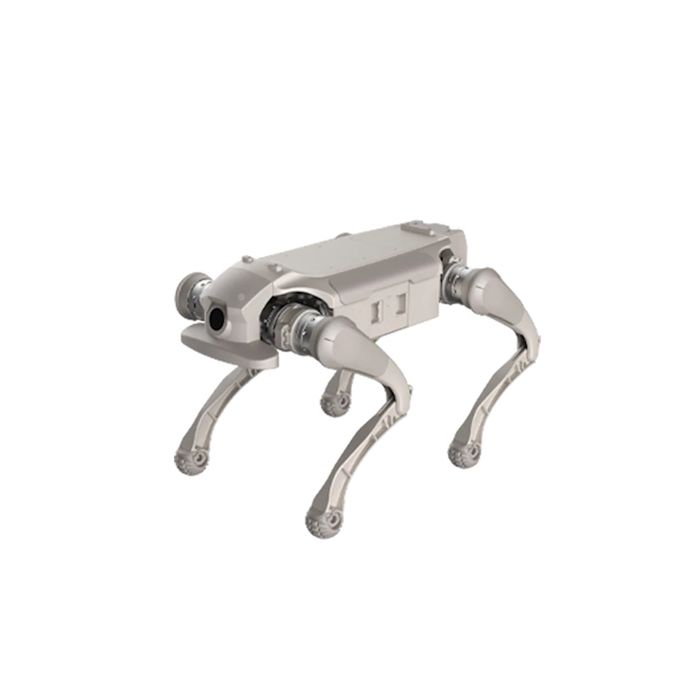
When an alarm trips at two in the morning, the minutes that matter are the ones before anyone reaches the scene. A response robot that first needs a calibration routine, a technician and a level floor is already behind. The AgiBot D1 Ultra Security Inspection Kit Quadruped Robot Dog is built on the opposite principle. It is a compact, industry-grade quadruped whose dual-encoder joint controller needs no zero-position calibration, so it is ready to move the moment it powers up. From there it carries its sensing hardware over stairs, slopes and broken ground on a self-balancing gait trained with reinforcement learning.
Robots USA sells the D1 Ultra Security Inspection Kit to security integrators, facility operators, public-safety teams and research groups across the United States. Robots USA prepares your quotation, coordinates delivery to your site and remains your point of contact once the robot is in service, including questions about expansion hardware, payload mounting and SDK development.
Background
AgiBot and the D1 Series
AGIBOT builds the D1 as a family rather than a single robot. The sources name four versions: the D1 Pro/Edu, the D1 Ultra, the D1 Max and the D1 MaxPro. The D1 Ultra is positioned as "Compact yet Powerful — Industry Grade", a description that sums up its role in the series. It is small enough to fold down for transport in a vehicle and robust enough to work outdoors and in industrial spaces. The Security Inspection Kit configuration points that platform at a specific mission: patrol and inspection work where a legged robot can reach places a fixed camera cannot see and a wheeled robot cannot drive.
Each version in the series has its own figures, and the specifications on this page belong to the D1 Ultra alone. If you are weighing the Ultra against a sibling, compare each model on its own specifications rather than assuming that one version's numbers carry over to another.
Reinforcement-learning gait and dual-encoder joints
Two technologies define how the D1 Ultra behaves in the field. The first is its gait. Instead of relying only on hand-tuned walking patterns, the D1 Ultra uses reinforcement-learning-based gait control that adapts to complex terrain and provides self-balancing, anti-tipping and disturbance rejection. In practice, this is what lets a patrol robot keep its footing when it steps off a curb, meets loose gravel or takes a bump from an obstacle.
The second is its joint architecture. Every joint runs in dual-encoding control mode, and the dual-encoder controller removes the need for zero-position calibration at startup. For a security team, that turns the robot from a lab instrument into a tool that can be unpacked, switched on and sent out. Joint motors deliver a peak torque of about 48N·m, which supports the dynamic movements listed below, including jumps and continuous stair climbing.
Technical Specifications
| Specification | Value |
|---|---|
| Product positioning | Compact yet Powerful — Industry Grade |
| Application scenarios | Emergency rescue, security, inspection, education, entertainment |
| Standing dimensions | 630mm × 360mm × 420mm |
| Folded dimensions | 670mm × 435mm × 145mm |
| Maximum running speed | 3.7m/s |
| Maximum slope angle | 40° |
| Effective payload | 5kg |
| Range/Mileage | 6 ± 1 km |
| Protection level | IP54 |
| Stable operating time in extreme environments | 200h |
| Joint motor peak torque | About 48N·m |
| Joint control mode | Dual encoding |
| Startup calibration | Dual-encoder controller requires no zero-position calibration; ready to use upon startup |
| Jump height | Forward/upward jumping up to 35cm above the ground |
| Stair climbing | Continuous climbing of stairs up to 16cm high |
| Gait control | RL (reinforcement learning) based, with self-balancing, anti-tipping and disturbance rejection |
| Expansion interfaces | Ethernet port, USB port, power port, SBUS port, UART port |
| Supported expansion | 3D radar, depth camera, RTK, 4G module, image transmission module, follow-up module, application layer loading, etc. |
| Software / simulation | Open SDK for secondary development and payload mounting; URDF modeling for Isaac Sim and Mujoco |
Specifications are as published by the manufacturer and are confirmed against the datasheet at quotation.
The manufacturer has not published the weight, battery capacity, charging time, operating temperature range, the contents of the security inspection kit, the camera and sensor package or the degrees of freedom; Robots USA confirms these details with you at quotation.
Why choose a legged robot over a wheeled patrol robot?
Wheeled security robots do well on smooth, continuous floors: parking decks, lobbies, long warehouse aisles. Real patrol routes are rarely that tidy. A perimeter walk crosses curbs, drainage channels and grass. A building check means stairwells. A plant inspection runs past ramps, cable trays and uneven concrete. The D1 Ultra is built for exactly that mix. It climbs stairs continuously up to 16cm high, handles slopes up to 40° and can jump forward or upward up to 35cm, so a single obstacle does not end the patrol.
Legs also change what happens when something goes wrong. The reinforcement-learning gait is designed to reject disturbances and resist tipping, which matters when a robot is working unattended on terrain no one mapped in advance. And because the robot carries an IP54 protection level and is rated for 200h of stable operation in extreme environments, it is a credible tool for outdoor and industrial routes, not just a showroom demonstrator.
None of this makes wheels obsolete. Where a route is long and mostly flat, a wheeled-leg design can be the better match, and AgiBot offers that approach in the AgiBot D1 Ultra-W Wheeled Quadruped Robot Dog. The right answer depends on how much of your route is stairs and rough ground versus open pavement.
How much sensing hardware can the D1 Ultra carry on patrol?
An inspection robot is only as useful as what it carries. The D1 Ultra takes an effective payload of 5kg and offers Ethernet, USB, power, SBUS and UART ports for connecting it. It supports expansion options including 3D radar, a depth camera, RTK positioning, a 4G module, an image transmission module and a follow-up module, along with application layer loading for your own software.
That combination gives integrators real freedom. A site that needs long-range video can prioritize image transmission and 4G; a site that needs precise outdoor positioning can add RTK; a site that needs mapping can add 3D radar. The open SDK supports secondary development and payload mounting, and URDF models let your team test behaviors in Isaac Sim or Mujoco before the robot ever walks your route. Robots USA will work through these choices with you so the configuration you receive matches the mission you are planning.
Who is the AgiBot D1 Ultra Security Inspection Kit for?
The primary buyer is the security integrator or in-house security team that wants a mobile sensor platform for routes that include stairs, slopes and outdoor ground. Corporate campuses, industrial plants, utilities, logistics yards and critical infrastructure sites fit this profile, especially where recurring patrols are predictable and a robot can take the repetitive rounds off human staff.
Inspection teams are a close second. Facility and maintenance groups that walk the same equipment rounds every shift can use the D1 Ultra as a carrier for depth cameras, radar or other sensors, with the open SDK connecting the robot to their own software. Public-safety and emergency response organizations are a third segment: emergency rescue is one of the published application scenarios, and a compact, foldable robot that is ready on power-up suits teams that need to deploy quickly. Related platforms are collected in our Emergency Response category.
Not every buyer needs the kit configuration. If you plan to build your own payload from the ground up, the AgiBot D1 Ultra Industrial Grade Quadruped Robot Dog is the base platform to review. Universities and schools focused on teaching and curriculum work should look at the AgiBot D1 Edu Quadruped Robot Dog, the education-oriented member of the series. Teams comparing across the full D1 family can also review the AgiBot D1 MaxPro Quadruped Robot Dog and weigh each version on its own specifications.
What is the AgiBot D1 Ultra Security Inspection Kit used for?
- Security patrol: Recurring rounds of perimeters, parking areas and building interiors, including routes with stairs and curbs.
- Facility inspection: Carrying depth cameras, 3D radar or other sensors past equipment on scheduled inspection walks.
- Emergency rescue reconnaissance: Sending a compact robot ahead of responders to look at ground that is hard or unsafe to reach.
- Remote monitoring: Streaming observations from the field through image transmission and 4G expansion modules.
- Research and simulation: Developing and testing behaviors with the open SDK and URDF models in Isaac Sim or Mujoco.
- Education and demonstration: Teaching legged locomotion and robotics integration, and presenting the platform at events and in showrooms.
Pricing and Availability
Robots USA quotes the AgiBot D1 Ultra Security Inspection Kit to match your configuration, including the kit contents, expansion modules and any software support your project requires. Delivery, customs and support are all arranged together with the quotation, so you know exactly what reaches your site and who supports it afterward. To start the process, request a quotation from Robots USA, available on this page.
Frequently Asked Questions
Does the D1 Ultra need calibration before each use?
No. Its dual-encoder controller requires no zero-position calibration, so the robot is ready to use upon startup.
Can the D1 Ultra climb stairs?
Yes. It supports continuous climbing of stairs up to 16cm high and handles slopes up to a maximum angle of 40°.
Is the D1 Ultra suitable for outdoor work?
It carries an IP54 protection level and is rated for 200h of stable operating time in extreme environments.
How fast and how far can the D1 Ultra travel?
It reaches a maximum running speed of 3.7m/s, and its range is 6 ± 1 km.
How much can the D1 Ultra carry?
The effective payload is 5kg. Sensors and modules connect through Ethernet, USB, power, SBUS and UART ports.
Can my team develop its own software for the robot?
Yes. An open SDK supports secondary development and payload mounting, and URDF modeling lets you test the robot in simulation platforms such as Isaac Sim and Mujoco.
Where can I buy the AgiBot D1 Ultra Security Inspection Kit and what does it cost?
You can buy it from Robots USA, which supplies customers across the United States. Pricing depends on the configuration you choose, so request a quotation on this page and Robots USA will prepare it for your project.
Summary
Security work is a race against the first few minutes, and the AgiBot D1 Ultra Security Inspection Kit is designed not to lose them. It starts without calibration, then moves at up to 3.7m/s on a reinforcement-learning gait that keeps it balanced across stairs, slopes and rough ground. Along the way it carries up to 5kg of the sensing hardware your mission calls for, with an IP54 protection level and an open SDK for integration. Robots USA builds the configuration around your route and stays with you after delivery. If your patrol routes have outgrown fixed cameras and wheeled robots, this page is the starting point.