
DISCONTINUED - Agibot X1 Full-Stack Open Source Humanoid Robot
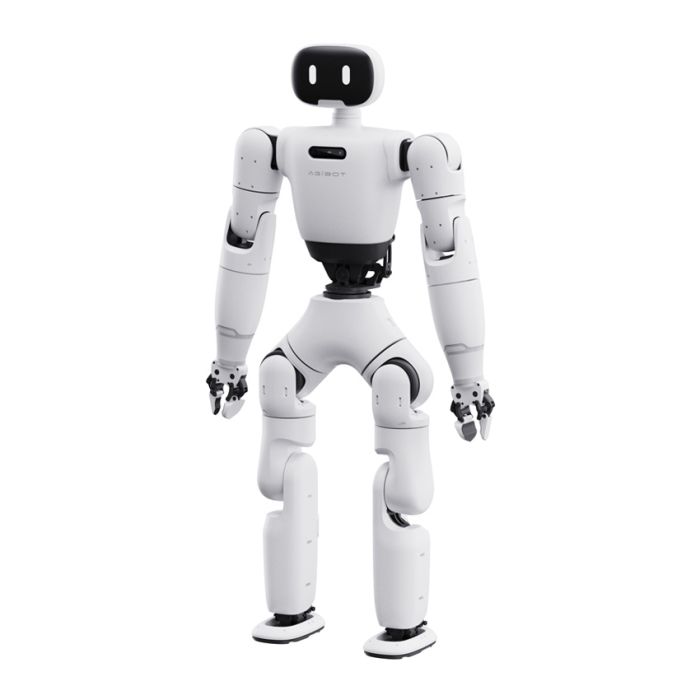
Out of stock
- BRAND:
- AGIBOT
- PART #:
- X1
- ORIGIN:
- China
- AVAILABILITY:
- DISCONTINUED
- SKU:
- AgiBot-X1
DISCONTINUED - Agibot X1 Full-Stack Open Source Humanoid Robot
In electronics, nobody learns a new processor from a finished laptop. Engineers learn it from the reference board, where every pin is exposed and every interface is documented. DISCONTINUED - Agibot X1 Full-Stack Open Source Humanoid Robot plays that role for bipedal robotics. It stands 130 cm tall, weighs 33kg and offers 34DoF of active motion. Its joint actuators, its domain controller and its gripper are each described as separate modules. A research team can study the platform one layer at a time and change any of them, instead of working around a closed box. AgiBot has since discontinued the line. For a buyer, the question is therefore not whether the X1 is new, but whether an open, modular humanoid still fits the project at hand.
Robots USA sells the Agibot X1 to universities, research institutes and engineering teams across the United States. Robots USA prepares the quotation, coordinates import and delivery to your lab, and stays your point of contact for technical support once the robot is on the bench. Because the X1 is listed as discontinued, every quotation from Robots USA lays out what is still on offer, both complete robots and individual modules.
Background
AgiBot and its humanoid lineage
AgiBot is a Chinese robotics company that builds humanoid robots for several markets, from interactive service machines to research platforms. Its current portfolio centers on full-size service humanoids such as the A2 and A3 families, which are built for public-facing work and deployment. The X1 came from a different idea within the same company. It was a smaller, lighter humanoid released as a full-stack open-source project, aimed at developers rather than end customers. AgiBot describes it with four ideas: modular design, a high degree of freedom, safe and lightweight construction, and high scalability. Together they read as a design brief for a robot that is meant to be modified.
Open modules: PowerFlow actuators, DCU and OmniPicker
The X1 is assembled from component modules that AgiBot documents individually. The PowerFlow actuator family covers the joints. The R86-3 is the strongest rotary unit, with a peak torque of 200N·m at a weight of 1.28 kg. The R86-2 delivers a peak torque of 80N·m, and the compact R52 is rated at 19N·m. A linear actuator, the PowerFlow L28, provides a maximum thrust of 110N. These modules are coordinated by the DCU domain controller, a 90g unit that converts EtherCAT to 3-way FDCAN at 5Mbps. It handles real-time communication forwarding at 1kHz with a 100Mbps communication rate and comes with a secondary development SDK for Linux. At the end of the arm, the OmniPicker gripper offers a maximum clamping force of 30N and a maximum stroke of 120mm. It communicates over CAN, CANFD, RS485 or a serial port. Because each module has its own documented figures, a team can read the robot like a bill of materials rather than a mystery.
Technical Specifications
| Specification | Value |
|---|---|
| Active degrees of freedom | 34DoF |
| Height | 130 cm |
| Weight | 33kg |
| Runtime | 2h |
| Maximum walking speed | 1m/s |
| Single arm load capacity | 0.5kg |
| PowerFlow R86-3 peak torque | 200N·m |
| PowerFlow R86-3 weight | 1.28 kg |
| PowerFlow R86-2 peak torque | 80N·m |
| PowerFlow R52 peak torque | 19N·m |
| PowerFlow L28 maximum thrust | 110N |
| DCU domain controller weight | 90g |
| DCU communication | 1kHz real-time communication forwarding, 100Mbps communication rate |
| DCU bus | EtherCAT to 3-way FDCAN (5Mbps) |
| DCU software | Secondary development SDK for Linux |
| OmniPicker maximum clamping force | 30N |
| OmniPicker maximum stroke | 120mm |
| OmniPicker communication protocol | CAN, CANFD, RS485, serial port |
These specifications are as published by the manufacturer and are confirmed against the datasheet at quotation.
The manufacturer has not published the battery capacity, the charging time, the IP rating, the onboard compute, the sensors and cameras, the box contents or the packaged dimensions, so Robots USA confirms these details at quotation.
What does full-stack open source mean on the Agibot X1?
Many robots called open stop at the application layer. You get an API, but the motor control, the bus and the hardware remain sealed. The X1 goes further down the stack. Its actuators are documented as individual PowerFlow units with their own torque and thrust figures, and its domain controller is specified down to the bus conversion. The DCU translates EtherCAT into 3-way FDCAN at 5Mbps and forwards real-time communication at 1kHz. AgiBot also supplies a secondary development SDK for Linux, so your code talks to that controller from an environment your team already knows.
This matters for real research work. A team developing a new walking controller can see exactly which actuator drives which joint and what its torque ceiling is. A team building a new end effector can see that the OmniPicker speaks CAN, CANFD, RS485 or serial, and design a replacement that uses the same interfaces. Modular design and high scalability, the two ideas AgiBot puts at the center of the X1, describe a platform that is built to be taken apart and extended.
Does a discontinued humanoid still make sense for a research project?
It depends on what the project needs. If your goal is a commercial deployment, you will want a robot that is still in production. If your goal is understanding how a humanoid works, the case is different. With the X1, the value lies largely in the openness of its design and its documentation, and those do not expire when production ends. The platform still offers 34DoF in a 130 cm, 33kg body, a maximum walking speed of 1m/s and a runtime of 2h. That is enough to run locomotion experiments, collect data and test control software in a real lab.
A smaller, lighter humanoid is also easier to handle, transport and protect during early experiments than a full-size machine. The honest limits are part of the decision. The arms carry a single arm load capacity of 0.5kg, which places the X1 in research and teaching rather than material handling. Robots USA goes through these points, along with the availability of units and modules, before you commit.
Who is the Agibot X1 for?
The X1 suits university labs that teach or research legged locomotion and need a platform students can open, modify and rebuild. It suits robotics researchers working on control and learning methods who want direct access to actuator-level behavior through a Linux SDK. It also suits hardware developers who want to benchmark or replace individual modules, such as an actuator or an end effector, against documented interfaces. Engineering teams at companies exploring humanoid technology can use it as a reference design before they commit to a larger platform.
The X1 is not the right choice for buyers who need a robot for public-facing service work or for a production deployment. For those projects, the range of AgiBot humanoids still in production is the better place to look, including the Agibot A2 Interactive Service Humanoid Robot. The wider Bipedal Humanoids category gives an overview of walking platforms from other manufacturers. Robots USA can compare the options with you as part of a quotation.
What is the Agibot X1 used for?
- Locomotion research: developing and testing walking controllers on a real bipedal body with 34DoF.
- Learning-based control: moving policies trained in simulation onto physical hardware and studying where they break.
- Robotics education: teaching mechatronics, control and embedded software on a platform students can take apart.
- Actuator benchmarking: characterizing the PowerFlow joint modules and comparing them with alternative designs.
- Manipulation experiments: exploring light grasping tasks with the OmniPicker gripper and its documented interfaces.
- Software stack development: building middleware and tooling on the Linux SDK and the EtherCAT-to-FDCAN architecture of the DCU.
Pricing and Availability
The Agibot X1 is sold by quotation, and Robots USA does not publish prices on this page. Each quotation reflects what is still on offer for this discontinued model and the configuration your project needs, whether that is a complete robot or individual modules. Delivery, customs and support are arranged with the quotation, so you know exactly what to expect before you order. To start the process, request a quotation using the form available on this page.
Frequently Asked Questions
Is the Agibot X1 still in production?
No. The X1 is listed as discontinued. Your quotation from Robots USA states whether complete units or component modules are still on offer.
How tall and heavy is the Agibot X1?
The X1 is 130 cm tall and weighs 33kg, a compact size for a walking research humanoid.
How long does the Agibot X1 run on a charge?
The X1 has a runtime of 2h between charges.
What can the arms and gripper handle?
Each arm has a single arm load capacity of 0.5kg. The OmniPicker gripper reaches a maximum clamping force of 30N and a maximum stroke of 120mm.
What software support does the Agibot X1 offer?
The DCU domain controller comes with a secondary development SDK for Linux. Developers can build their own control and application software directly against the hardware.
Which communication buses does the platform use?
The DCU converts EtherCAT to 3-way FDCAN at 5Mbps, with 1kHz real-time forwarding and a 100Mbps communication rate. The OmniPicker gripper supports CAN, CANFD, RS485 and a serial port.
Where can I buy the Agibot X1 and what does it cost?
You can buy the Agibot X1 from Robots USA by requesting a quotation on this page. The quotation covers availability, configuration, delivery, customs and support for your project.
Summary
Like a reference board for a new chip, the Agibot X1 is valuable because it shows its workings. Its PowerFlow actuators, its DCU domain controller and its OmniPicker gripper are documented as separate modules. They are tied together by a Linux SDK and an EtherCAT-to-FDCAN architecture, in a 130 cm, 33kg body with 34DoF. The line is discontinued and its light arms are built for experiments, not handling work. For a lab that wants to understand a humanoid from the joint upward, it remains a candid platform. If that is the work ahead of you, Robots USA will walk you through availability, configuration and support, and this page is the starting point.