
Noetix HOBBS W1 Wheeled Humanoid Bionic Robot
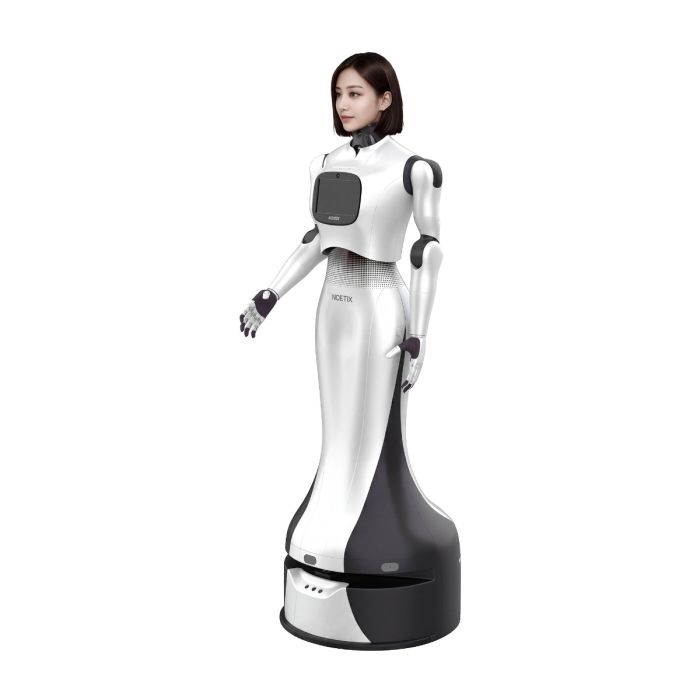
The Noetix Hobbs W1 (officially marketed as the "Guidance Expert Hobbs W1") is a wheeled humanoid bionic service robot engineered by Beijing Noetix Robotics Technology Co., Ltd. First unveiled at the 2025 World Robot Conference in Beijing and formally introduced to the market in December 2025, the Hobbs W1 represents a landmark product in the commercial service robotics category. It is the first wheeled bionic robot documented to feature 54 active degrees of freedom across its full body, a specification that distinguishes it sharply from conventional service platforms that rely on rigid, limited-motion bodies mounted on wheeled bases.
In stock
- Brand:
- NOETIX
- Model:
- HOBBS W1
- Part #:
- HOBBS
- ORIGIN:
- China
- AVAILABILITY:
- SUBJECT TO AVAILABILITY
- SKU:
- Noetix-HOBBS
Noetix Hobbs W1: The Wheeled Humanoid Bionic Robot Redefining Professional Service
Noetix describes the Hobbs W1 as having achieved "a landmark leap from static interaction to dynamic execution of bionic humanoid robot" technology. The platform evolved from an earlier internal prototype designated the Hobbs W0, which was the company's first fully functional wheeled bionic robot and proved the concept of combining the Hobbs bionic head with a mobile base, dexterous hands, and robotic arms. The W1 refines and commercializes that foundation for deployment in real-world professional environments.
The robot's most defining technical feature is its bionic head, which carries 32 active degrees of freedom and 8 passive degrees of freedom. The facial skin is fabricated from specially designed platinum silicone selected for its texture, elasticity, and visual resemblance to human skin. This head, combined with a metallic silver body shaped in an ankle-length skirt silhouette, an interactive chest-mounted screen, two five-degree-of-freedom robotic arms, and two six-degree-of-freedom dexterous hands, creates a platform capable of both nuanced physical interaction and emotionally resonant human-facing communication.
The Hobbs W1 generated strong early market interest. A presale listing on JD.com attracted more than 500 unit bookings in the first days of availability. As of its announcement, Noetix had not publicly disclosed the final retail price, though the company invited direct inquiries for enterprise and institutional buyers.
Noetix Robotics and the Hobbs Lineage
Noetix Robotics, legally registered as Songyan Dynamics (Beijing) Technology Co., Ltd., was founded in September 2023 by Jiang Zheyuan, a former doctoral candidate in motion control for legged robots at Tsinghua University. The founding team included engineers from Tsinghua University, Zhejiang University, and the University of Southern California.
The Hobbs product family traces its origins to Noetix's early research into bionic head technology. The company first developed a standalone bionic human head as a proof of concept, demonstrating that high-fidelity facial expression and low-latency AI-driven interaction could be achieved within a standard head-sized form factor. This initial development was described by the company as filling a technological gap in the industry. The Hobbs 1 followed as a bipedal platform incorporating that bionic head. The Hobbs 3, also called "A Bosom Friend," extended the series into a half-body platform with a highly realistic head and became the template for the W-series development.
The Hobbs W0 was released as the first-generation fully functional wheeled bionic robot in the series, integrating the Hobbs bionic head with a robotic arm, dexterous hand, and wheeled mobile platform for the first time. Noetix described the W0 as achieving the milestone transition from static interaction, in which the robot could only engage users in a fixed position, to dynamic execution, in which the robot could navigate through a space while simultaneously engaging users expressively and physically. The W1 followed as the production-ready commercial iteration of that concept.
Funding and Company Trajectory
By the time the Hobbs W1 launched, Noetix had completed five funding rounds within approximately one year, including a Pre-B round of nearly 300 million RMB led by Fangguang Capital and a Pre-B+ round of nearly 200 million RMB led by CICC Capital, bringing combined Pre-B financing to approximately 500 million RMB (roughly USD $68 million). In February 2026, the company announced a Series B round of approximately 1 billion RMB, signaling continued investor confidence in its product direction. The Beijing city government has also engaged directly with Noetix, with Beijing Mayor Yin Yong visiting the company to promote the commercial scaling of humanoid robots.
Design and Physical Characteristics
Overall Form Factor
The Hobbs W1's physical design is deliberate in its approach to human-facing environments. The robot's upper body, which includes the bionic head, neck, torso, arms, and hands, is designed to communicate visually and expressively at a height and proportion that humans find natural for conversation. The metallic silver body beneath the head is shaped in a style that has been described in industry coverage as an ankle-length skirt silhouette, giving the robot a visually distinctive and non-threatening profile appropriate for reception and service contexts.
An interactive touch screen is mounted on the robot's chest, providing a supplementary display channel for information, directions, schedules, and other content that can be presented visually in parallel with the robot's spoken output. This dual-channel approach, combining expressive face and informational screen, makes the W1 more versatile than either a screen kiosk or a face-only social robot.
The wheeled mobile base provides stable, quiet locomotion across flat indoor surfaces and is designed for the sustained operational demands of a working day in a professional environment. The wheeled configuration is a deliberate engineering choice: it provides more reliable indoor navigation and greater energy efficiency for sustained operation than bipedal locomotion, at the cost of stair-climbing ability.
Bionic Head
The bionic head is the technical and commercial centerpiece of the Hobbs W1. Its 32 active degrees of freedom enable precise, fine-grained control of facial muscles, producing subtle micro-expressions that viewers interpret through the same perceptual channels they use to read human faces. The 8 passive degrees of freedom add further realism by allowing the face to respond naturally to movement and gravity in ways that pure mechanical actuation cannot fully replicate.
The platinum silicone used for the facial skin was specifically selected for its combination of material properties: high elasticity that allows natural deformation during expression changes, a surface texture and pattern that closely approximates human skin at typical conversational distances, and durability sufficient for sustained daily deployment. Noetix describes the realism achieved as reaching "wax-figure level" appearance quality, meaning the head can pass casual visual inspection as a human face before a viewer looks more closely.
The neck provides three axes of motion: pitch (nodding up and down), roll (tilting from side to side), and yaw (rotating left and right). Published motion ranges include a neck pitch of 35 degrees, a neck roll of 25 degrees, and a neck yaw of 90 degrees. These ranges are sufficient for the robot to make and maintain eye contact with users across a reception desk or lobby space, nod in acknowledgment, and turn to face approaching visitors without repositioning its entire body.
The face's lip movements are synchronized in real time with speech output, meaning the robot's mouth shapes match the phonemes of the words it speaks. This synchronization is computed dynamically rather than from pre-recorded animation clips, allowing natural-looking speech regardless of the content being spoken.
Technology and Specifications
Degrees of Freedom
The Hobbs W1 is described by Noetix as the first wheeled bionic robot with 54 active degrees of freedom across its complete body. Of these, 32 are located in the bionic head and neck system, enabling the expressive facial and postural motion described above. The remaining degrees of freedom are distributed across the two robotic arms (five DOF each) and two dexterous hands (six DOF each), accounting for 22 more joints dedicated to upper-body manipulation. The wheeled mobile base and torso contribute the remaining articulated motion axes.
This total is substantially higher than most wheeled service robots, which typically have minimal upper-body articulation, if any. The combination of a highly articulated expressive face and functional manipulation hands in a single mobile platform is technically distinctive in the service robotics market.
Robotic Arms and Dexterous Hands
Each of the W1's two robotic arms has five degrees of freedom. Combined with the six-degree-of-freedom hands, the arm and hand system enables a range of light physical tasks that screen-and-speech-only service robots cannot perform. Documented capabilities include handing objects to visitors, pressing buttons, opening certain door types, and basic pick-and-place operations. The hand's joint articulation and torque control enable accurate grip modulation, meaning the robot can adjust the force and configuration of its grip in response to the shape and weight of the object being handled.
This level of dexterity is deliberately positioned by Noetix as sufficient for practical service tasks rather than aiming for the higher degree-of-freedom count of specialized industrial end effectors. The design philosophy prioritizes reliable, useful manipulation in human-facing environments over maximum theoretical dexterity.
Onboard Computing
The Hobbs W1 processes all of its core AI workloads on dual onboard GPUs. This dual-GPU architecture handles the simultaneous computational demands of real-time facial expression generation, natural language processing, emotion recognition, and autonomous navigation without requiring cloud connectivity for any of these functions. The ability to operate fully offline for core interaction tasks is an important practical consideration for deployment in environments with variable or restricted network access, such as secure government buildings, healthcare facilities, and exhibition venues.
The underlying control environment is Linux-based, providing a familiar software foundation for system integrators and developers who need to customize or extend the robot's capabilities for specific deployment scenarios.
Perception and Sensing
The Hobbs W1's perception system includes dual RGB cameras positioned to approximate the placement of human eyes, enabling stereoscopic visual sensing that supports gaze behavior, face tracking, and distance estimation during conversation. A microphone array provides multi-directional audio capture, allowing the robot to pick up speech from users approaching from different angles without requiring them to stand in a specific position.
Emotion recognition is integrated into the perception stack. The system uses frame-level analysis of facial expressions captured from users to identify emotional states and update the robot's interaction approach in real time. This allows the robot to detect when a visitor appears confused, frustrated, or pleased and adjust its tone, pacing, and conversational content accordingly.
The autonomous navigation system uses the robot's sensor array to map indoor environments and plan movement paths through them. The W1 can navigate around obstacles, including people moving through its path, and perform guided escort duties by leading a visitor from one location to another while maintaining conversation.
Natural Language and Multimodal AI
The W1's conversational system is built on a natural language processing stack that supports intent recognition, semantic parsing, and dialogue management. This architecture allows the robot to handle both transactional queries, such as directions and appointment verification, and more open-ended conversations in a coherent and contextually appropriate way. The system supports multilingual operation, making the W1 suitable for international environments where visitors may speak different languages.
All three of the robot's primary output channels, spoken language, facial expression, and body gesture, are coordinated by the multimodal AI system. The result is that the robot's words, face, and posture respond as a unified, simultaneous whole rather than as separate sequential outputs. This coherence is considered important for achieving natural-feeling interaction, since humans are highly sensitive to mismatches between what a person says and what their face and body communicate.
Applications and Use Cases
Reception and Visitor Management
The Hobbs W1 is suited for front-of-house reception in corporate offices, government buildings, hotels, hospitals, and other facilities where visitors arrive and need to be greeted, verified, directed, and assisted. The robot's combination of human-like appearance, emotional AI, and functional hands allows it to manage visitor flows, provide directions, hand out printed materials or passes, and create a welcoming first impression around the clock without staffing constraints.
Current deployments noted in public coverage include museums, government halls, and office buildings, where the W1 has served as both guide and receptionist.
Guided Tours and Cultural Institutions
Museums, exhibition halls, national parks visitor centers, and government facilities are natural deployment environments for the W1's guided tour capability. The robot can deliver prepared content about exhibits, respond to visitor questions, lead groups through a route, and maintain an expressive, engaging presence throughout. The robot's visual distinctiveness also makes it an attraction in its own right, encouraging visitor engagement with the institution's technology profile.
Hospitality and Customer Service
Hotels, retail outlets, and entertainment venues represent strong applications for the W1's multilingual interaction capability, wayfinding functionality, and ability to hand objects to guests. In hotel lobbies, the robot can handle check-in information queries, hand key packets to guests, and escort visitors to elevators. In retail environments, it can greet customers, provide product information, and direct shoppers to specific departments.
Corporate and Institutional Environments
Corporate lobbies and conference centers benefit from the W1's ability to verify visitor identities, provide directions, manage registration for events, and maintain a professional and consistent presence. The robot's 24-hour operational capability is particularly valuable in facilities that receive international visitors across multiple time zones or that operate extended hours.
Elder Care and Companionship
Noetix identifies elder care as a target application for the Hobbs family. The W1's lifelike appearance, emotionally responsive interaction, and ability to navigate through living spaces to accompany and engage older adults make it better suited for this role than abstract or screen-faced alternatives. The emotion recognition system allows the robot to detect and respond to signs of distress, boredom, or engagement in ways that support meaningful companionship.
Psychological Therapy Support
The Hobbs product introduction lists psychological therapy support as a target use case, reflecting the growing body of research into social robots as therapeutic tools. The W1's capacity for empathetic-seeming interaction, emotional state detection, and sustained patient engagement may support certain therapeutic protocols under the supervision of qualified professionals, particularly in settings where human therapist time is limited.
Comparison with Related Platforms
Noetix Hobbs 3
The Hobbs 3, also known as "A Bosom Friend," is the companion platform to the W1 within the Noetix Hobbs family. It is a half-body, non-mobile platform designed for the highest fidelity emotional interaction. Its bionic head features the same 32 active degrees of freedom as the W1's head but is integrated into a seated or display-mounted upper-body configuration rather than a mobile wheeled base. The Hobbs 3 is oriented toward companionship, research into human-robot emotional interaction, and elder care contexts where the robot operates from a fixed position. The W1 is the mobile, service-deployment member of the family, able to navigate through a space while performing the same expressive interaction.
Noetix E1
The E1 is Noetix's bipedal embodied intelligence platform, standing 1.36 meters tall with 21 degrees of freedom in its baseline configuration. It uses a modular approach with optional dexterous hands and LiDAR, and its multimodal AI emphasizes speech, gesture, and whole-body coordination for research and education. Compared to the W1, the E1 has fewer total degrees of freedom and a less realistic facial system, but offers the full bipedal locomotion that the wheeled W1 lacks. The E1 is the better choice for researchers studying bipedal gait, embodied AI locomotion, and manipulation tasks; the W1 is better suited for sustained professional service deployment where facial realism and manipulation capability matter more than bipedal mobility.
SoftBank Pepper
SoftBank's Pepper robot, discontinued in 2021, was a wheeled social robot with an abstract, stylized appearance and no physical manipulation capability. It relied entirely on a touchscreen and speech-based interaction, with no bionic skin, no realistic facial expression, and no dexterous hands. The Hobbs W1 represents a significant generational advance in every dimension relevant to service robotics: visual realism, emotional interaction, physical capability, and onboard AI processing power. For businesses that deployed Pepper and are evaluating modern alternatives, the W1 offers a substantially richer interaction experience.
Advantages and Benefits
Industry-leading facial DOF: With 32 active degrees of freedom in the bionic head alone, the W1 produces facial expressions with a subtlety and breadth that no other commercially available service robot matches. This level of facial fidelity creates interactions that human visitors process through natural social perception channels rather than as obviously robotic behavior.
Platinum silicone skin: The material choice for the facial covering is technically significant. Platinum silicone provides the elasticity needed for natural expression deformation, the surface texture expected from human skin, and the durability required for daily operational deployment. This is a higher-specification skin material than flexible polymers used in less demanding applications.
54 active degrees of freedom: The total DOF count across the full body represents a landmark in wheeled service robotics, enabling the W1 to coordinate expressive face, natural gesture, and functional hand movements simultaneously in a way that creates a coherent, human-like interaction presence.
Functional dexterous hands: The six-DOF hands extend the robot's operational value beyond conversation into light physical task execution, covering real-world service needs such as object handover, button interaction, and basic pick-and-place.
Cloud-independent AI processing: The dual onboard GPU architecture ensures that the robot's core interaction, emotion recognition, and navigation capabilities function reliably even in network-restricted or bandwidth-limited environments.
Demonstrated real-world deployment: The W1 has already been documented in active service in museums, government halls, and offices, providing evidence of operational readiness beyond laboratory demonstration.
Strong financial backing: Noetix's five funding rounds totaling hundreds of millions of dollars, combined with direct government engagement at the mayoral level, provide buyers with confidence in the company's longevity and capacity for ongoing product support.
Summary
The Noetix Hobbs W1 Wheeled Humanoid Bionic Robot stands as one of the most technically sophisticated service robots to reach commercial deployment anywhere in the world. Its 54 active degrees of freedom, 32-DOF bionic head with platinum silicone skin, dual GPU onboard AI processing, autonomous navigation, and dexterous six-degree-of-freedom hands collectively represent a combination of capabilities that no other wheeled service robot in its class has yet matched. Built on a foundation of proven bionic head technology developed through the Hobbs series, deployed in real-world settings including museums, government halls, and corporate offices, and backed by a company that has demonstrated consistent execution across multiple product launches and substantial financing, the Hobbs W1 is a credible and compelling option for US organizations seeking a next-generation service robot for public-facing professional environments. For those evaluating wheeled humanoid bionic robots in the United States market, the Noetix Hobbs W1 warrants serious consideration as a benchmark platform in its category.
Frequently Asked Questions (FAQ)
What is the Noetix Hobbs W1 Wheeled Humanoid Bionic Robot?
The Noetix Hobbs W1 is a wheeled humanoid bionic service robot developed by Beijing Noetix Robotics Technology Co., Ltd. It is distinguished by its bionic head with 32 active degrees of freedom and platinum silicone facial skin, giving it a lifelike appearance capable of reproducing human micro-expressions. Mounted on a wheeled mobile base, the robot also features an interactive chest screen, two five-DOF robotic arms, two six-DOF dexterous hands, and onboard dual GPU computing, for a total of 54 active degrees of freedom across its full body. It is designed for professional service environments including reception, hospitality, retail, corporate offices, museums, and elder care.
How does the Noetix Hobbs W1 work?
The W1 integrates several parallel systems operating simultaneously. Its autonomous navigation module maps and traverses indoor environments using onboard sensors, allowing the robot to escort visitors and move between service positions without human guidance. The dual onboard GPUs run natural language processing, emotion recognition, and facial expression generation in real time without cloud dependency. Dual RGB cameras and a microphone array capture visual and audio input from users, and the emotion recognition system analyzes this input to detect users' emotional states and adapt the robot's conversational approach accordingly. The six-DOF dexterous hands respond to task commands for object handover and light manipulation, and all output channels including speech, facial expression, and body gesture are coordinated by a multimodal AI system.
Why is the Noetix Hobbs W1 important for the professional service robot industry?
The W1 is significant because it combines, for the first time in a commercially deployed wheeled service robot, a 32-DOF bionic head with platinum silicone skin, functional dexterous hands, autonomous navigation, and onboard AI emotion recognition in a single platform. Previous wheeled service robots either used stylized, non-realistic faces with no manipulation capability, or had manipulation capability with no expressive facial system. The W1's technical integration of these capabilities in one product sets a new benchmark for what a service robot can realistically offer in customer-facing professional environments.
What are the benefits of the Noetix Hobbs W1 for businesses?
For organizations deploying the W1, the primary benefits include a lifelike, emotionally responsive presence that engages visitors more effectively than screen-based or abstract-faced robots; physical manipulation capability that allows light service tasks such as handing objects and pressing buttons; 24-hour availability without staffing costs; multilingual operation suitable for international visitor populations; cloud-independent AI that functions reliably in network-restricted environments; and a distinctive visual profile that differentiates the deployment environment. The robot's ability to detect and respond to users' emotional states also enables a level of personalized service adaptation that static interfaces cannot provide.
How many degrees of freedom does the Noetix Hobbs W1 have?
The Noetix Hobbs W1 has 54 active degrees of freedom across its full body. Of these, 32 active degrees of freedom plus 8 passive degrees of freedom are in the bionic head and neck system, enabling precise facial expression control with published neck motion ranges of 35 degrees pitch, 25 degrees roll, and 90 degrees yaw. Each of the two robotic arms has five degrees of freedom, and each dexterous hand has six degrees of freedom, accounting for the remaining 22 active DOF in the manipulation system.
How does the Noetix Hobbs W1 compare to SoftBank Pepper?
SoftBank's Pepper robot, discontinued in 2021, was a wheeled social robot with a stylized, non-realistic appearance, no bionic skin, limited facial expression capability, and no dexterous hands or physical manipulation ability. The Hobbs W1 surpasses Pepper across every relevant dimension: its 32-DOF bionic head with platinum silicone skin produces lifelike facial expressions that Pepper's fixed face cannot replicate; its six-DOF dexterous hands enable physical task execution that Pepper entirely lacks; and its dual onboard GPU architecture provides substantially greater AI processing capability than Pepper's aging compute hardware. For organizations currently evaluating replacements for Pepper or similar legacy service robots, the W1 represents a generational advance in both interaction quality and functional capability.