
BrainCo Revo 3-21 Basic Robot Hand
In stock
- MARCA:
- BRAINCO
- MODELO:
- REVO 3-21 BASIC
- ORIGIN:
- China
- Warranty:
- 12 MONTHS
- AVAILABILITY:
- SUBJECT TO AVAILABILITY
- SKU:
- BrainCo-Revo-3
BrainCo Revo 3-21 Basic Robot Hand
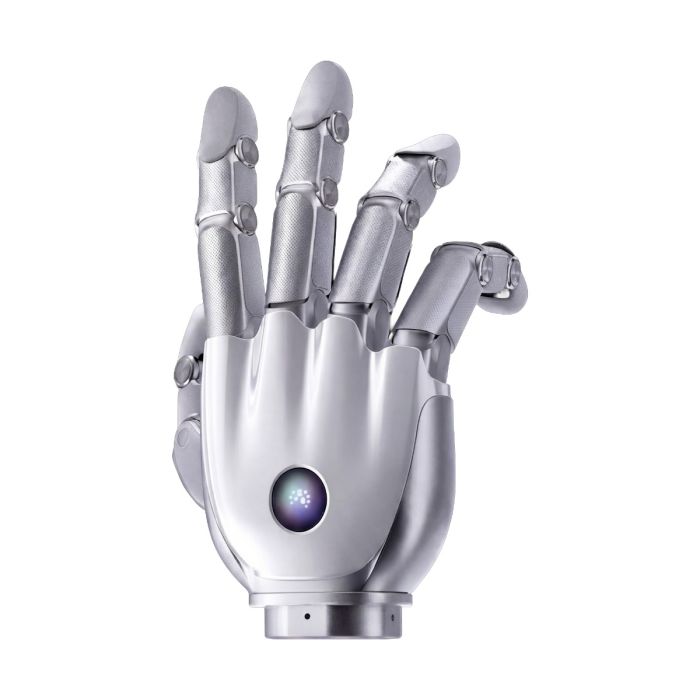
A grasp is only the beginning: the harder engineering question is what happens when an object must change position within the fingers. BrainCo Revo 3-21 Basic Robot Hand puts that manipulation problem at the center of the buying decision. Published Revo 3 descriptions report independently driven finger joints intended for industrial automation, scientific research, and advanced robotics manipulation. For a project team, the priority is matching that reported architecture to the actual configuration, control requirements, and working environment—not treating dexterity as a guarantee of task success.
Robots USA sells BrainCo Revo 3-21 Basic Robot Hand for projects in the United States. Robots USA handles the quotation discussion, including the exact hand configuration and the documentation needed to assess integration. The Basic label is a reseller name rather than a separately documented manufacturer configuration in the supplied research, so the quotation should identify the corresponding manufacturer model before procurement.
Background
BrainCo and the Revo lineage
Published reporting identifies BrainCo as a Hangzhou-based company founded in 2015 and dates the launch of its third-generation Revo 3 robot dexterous hand to 10 April 2026. That lineage provides context, but it does not establish interchangeability with earlier hands. Mounting, software behavior, accessories, and control arrangements should be assessed for the selected configuration rather than inferred from the Revo name.
The source material names Revo 3 U21, Revo 3 U21F, Revo 3 U21T, and Revo 3 U21VT, alongside reseller labels Basic, Touch, and Vision. It does not establish a complete correspondence between those naming systems. Buyers comparing the BrainCo Revo 3 family should therefore keep manufacturer identifiers separate from storefront descriptions until the quotation resolves them.
Active joints as the positioning principle
Per the published family specification, Revo 3 uses 21 independently driven motors for 21 fully active degrees of freedom. The reported distribution is five in the thumb and four in each of the index, middle, ring, and pinky fingers. Published descriptions also identify direct-driven and backdrivable joints. These are architectural details, not evidence that a particular object-handling routine will work without development.
For dexterous-hand projects generally, independently controlled joints give engineers more motion variables to coordinate than a fixed gripping mechanism. They also make control design, collision avoidance, and repeatable evaluation important parts of integration. Assess the hand together with the application software and test procedure, rather than as an isolated mechanical component.
Technical Specifications
| Specification | Value |
|---|---|
| Specification scope | Published Revo 3 family specifications; Basic configuration mapping requires confirmation at quotation |
| Active degrees of freedom | Reported: 21 fully active degrees of freedom across all Revo 3 models |
| Motors | Reported: 21 independently driven motors across all Revo 3 models |
| Finger distribution | Reported: five in the thumb; four in each of the index, middle, ring, and pinky fingers |
| Joint drive | Reported: direct-driven and backdrivable joints |
| Joint durability | Reported rating: over 1,000,000 joint flex cycles |
| SDK languages | Reported: C/C++ and Python |
| SDK operating systems | Reported compatibility: Linux and Windows |
| Recommended power supply | Published recommendation: stable 24V DC power supply with a power rating of at least 100W |
| Default RS485 identifiers | Reported: Left Hand ID 126; Right Hand ID 127; Broadcast ID 0 |
| Power-on behavior | Reported: physical position calibration, with all fingers opening during this period |
| Weight | Unpublished in the available sources; confirmed at quotation |
| Operating temperature | Unpublished in the available sources; confirmed at quotation |
| IP rating | Unpublished in the available sources; confirmed at quotation |
| Operating noise | Unpublished in the available sources; confirmed at quotation |
| What is in the box | Unpublished in the available sources; confirmed at quotation |
Specifications are as published for the Revo 3 family and are confirmed against the datasheet for the quoted Basic configuration at quotation.
What should you verify before integrating BrainCo Revo 3-21 Basic Robot Hand?
Start with the startup sequence, not just the commanded motion. Published guidance says the hand performs physical position calibration at power-on and opens all fingers during that process. An integration plan should leave room for that motion and define when objects may enter the workspace. Do not assume that powering the system preserves a previous grasp or leaves the fingers stationary.
Electrical and communications planning also deserve early attention. The published recommendation calls for a stable 24V DC supply rated at least 100W to reduce voltage-drop risk. Published RS485 guidance gives default identifiers for left and right hands and a broadcast identifier. Confirm the supplied hand's identity and network settings before incorporating it into a shared bus; defaults are not a substitute for a documented commissioning procedure.
Published SDK information reports C/C++ and Python support on Linux and Windows. That provides a starting point for software evaluation, but the supplied research does not describe command timing, example coverage, or a complete integration package. Ask Robots USA to clarify the available development documentation, connection requirements, and scope of support when preparing the quotation.
Who is BrainCo Revo 3-21 Basic Robot Hand for?
Research laboratories, robotics developers, and automation engineering teams are the relevant buyer groups: published descriptions position Revo 3 for scientific research, industrial automation, and advanced manipulation. A suitable evaluation begins with an object set, a defined manipulation objective, and acceptance criteria. Buyers seeking a complete application should distinguish the hand itself from the programming, perception, and surrounding equipment needed to make a robotic task work.
Teams comparing sensing-oriented options can also review BrainCo Revo 3-21 Touch Robot Hand and BrainCo Revo 3-21 V-Touch Robot Hand. However, the available fact sheet does not establish their sensing specifications or prove which version suits a particular application better. Request a documented comparison instead of interpreting Touch or V-Touch as a confirmed feature set.
What is BrainCo Revo 3-21 Basic Robot Hand used for?
- Manipulation research: Evaluate finger coordination through application-specific experiments rather than assuming predefined task performance.
- Grasp-planning development: Explore how object geometry and planned finger motion affect a robotic grasp.
- Automation feasibility studies: Assess whether a dexterous-hand approach fits a proposed handling process.
- Control-software prototyping: Investigate coordinated motion using the SDK options reported in the published specification.
- Startup and integration testing: Develop procedures around the reported calibration motion, power recommendation, and bus identifiers.
- Comparative robotics evaluation: Compare hand architectures using consistent objects, procedures, and acceptance criteria.
Pricing and Availability
Request a project-specific quotation from Robots USA with your intended task, host system, preferred hand configuration, and documentation requirements. Ask the quotation to identify the manufacturer model behind the Basic name and distinguish the hand from any separately required integration equipment. Package contents are unpublished in the available sources and must be confirmed at quotation.
Robots USA arranges delivery, customs, and support with the quotation. Submit your requirements through the quotation option available on this page.
Frequently Asked Questions
Is Basic the same as Revo 3 U21?
The supplied research names both but does not establish that they are equivalent. No manufacturer page for the Basic name is published in the available sources; the corresponding manufacturer model is confirmed at quotation.
How many degrees of freedom does the hand have?
The published Revo 3 family specification reports 21 fully active degrees of freedom driven by 21 independent motors. Applicability to the quoted Basic configuration should be verified against its datasheet.
Does the hand move when it powers on?
Published guidance reports physical position calibration at power-on, during which all fingers open. Plan workspace clearance and commissioning procedures around that reported behavior.
Which programming languages and operating systems are supported?
Published specifications report C/C++ and Python SDKs compatible with Linux and Windows. Confirm the actual software package and documentation supplied for your configuration at quotation.
Can it be selected for a demanding operating environment?
The available sources do not publish operating temperature or an IP rating; both are confirmed at quotation. A reported rating of over 1,000,000 joint flex cycles does not establish suitability for a particular environment.
What comes in the box, and how much does it weigh?
Package contents and weight are unpublished in the available sources and are confirmed at quotation. Operating noise is also unpublished and should be confirmed at quotation if it affects your installation.
Where can I buy BrainCo Revo 3-21 Basic Robot Hand and what does it cost?
Buy through Robots USA by requesting a quotation for your project. Robots USA confirms the configuration, package scope, delivery, customs, and support through that quotation rather than presenting an assumed package cost.
Summary
The central question remains what happens after the initial grasp. Revo 3's reported active-joint architecture gives buyers a reason to investigate coordinated manipulation, while the Basic naming gap and unpublished installation details make configuration verification essential. Bring Robots USA a clear task description and a list of integration requirements so the quotation can connect the published family specifications to the exact hand being supplied. For a documented evaluation rather than a name-based assumption, this page is the starting point.