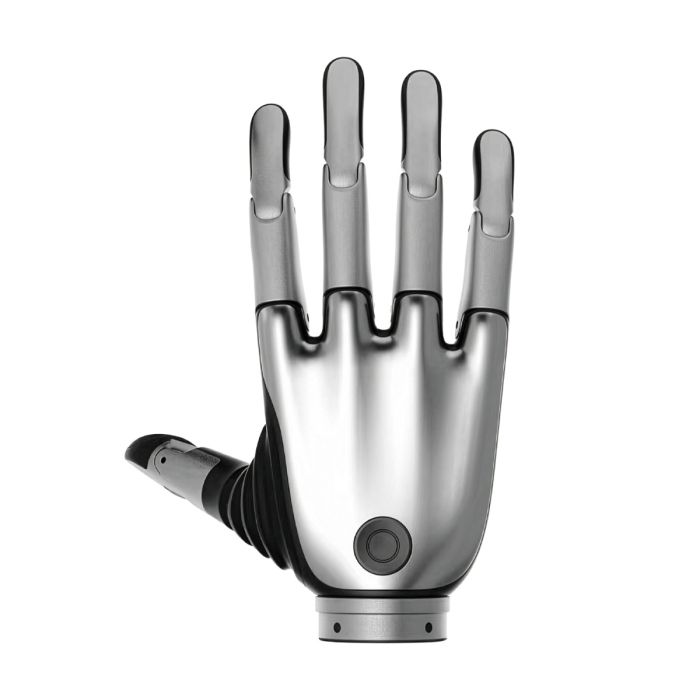
Brainco Revo 2 Touch Biomimetic Dexterous Right Hand (XTR)
In stock
- MARCA:
- BRAINCO
- MODELO:
- REVO 2 TOUCH
- NÚMERO DE PIEZA #:
- XTR
- ORIGIN:
- China
- AVAILABILITY:
- SUBJECT TO AVAILABILITY
- SKU:
- BrainCo-Revo-2-Touch
Brainco Revo 2 Touch Biomimetic Dexterous Right Hand (XTR)
A successful manipulation experiment starts before the robot touches an object: at the interface between the hand, the controller, and the test plan. Brainco Revo 2 Touch Biomimetic Dexterous Right Hand (XTR) deserves evaluation from that perspective. The published specification describes the Revo 2 as a bionic dexterous hand for robot integration and research. For buyers, the practical question is whether the documented control options fit the intended system—and which details still need confirmation before committing to an integration.
Robots USA sells this right-hand configuration for supply to customers in the United States. Robots USA handles quotation inquiries and coordinates the delivery and support arrangements associated with the order. A useful inquiry identifies the required hand orientation, host control environment, intended manipulation tasks, and any documentation needed for acceptance.
Background
BRAINCO and the Revo family
According to the published company background, BRAINCO was founded in 2015 and incubated by the Harvard Innovation Lab (i-Lab). The supplied product information names BASIC (XRL/XRR), PRO (XEL/XER), and TOUCH (XTL/XTR) configurations in the Revo 2 family. Those identifiers matter when requesting technical documents: a family-level statement does not automatically establish every version-specific feature.
This page concerns TOUCH (XTR), the right-hand configuration. Buyers should carry that designation into their requirements, quotation request, and acceptance checklist. Doing so helps keep the mechanical orientation and version-specific electrical requirements attached to the correct product throughout an engineering review.
Positioning around integration and control
Per the published specification, the Revo 2 platform combines closed-loop servo control with custom gesture definitions. It also supports RS485, CAN FD, and EtherCAT communication interfaces, with SDK support for Linux, Windows, and ROS workflows. These are relevant starting points for teams deciding how a hand will connect to a larger robot or laboratory controller.
The supplied evidence is less complete on sensing. Although TOUCH is the named configuration, the available fact sheet does not establish its detailed tactile capabilities. The manufacturer has not published tactile sensor resolution in the supplied source coverage; it is confirmed at quotation. Buyers should therefore evaluate sensing requirements separately rather than treating the version name as a complete sensor specification.
Technical Specifications
| Specification | Value |
|---|---|
| Configuration | TOUCH (XTR), right hand |
| Product type | Reported bionic dexterous hand for robot integration and research |
| Active joints | Reported: 6 |
| Degrees of freedom | Reported: 11 |
| Communication interfaces | Reported: RS485, CAN FD, and EtherCAT |
| SDK support | Reported: Linux, Windows, and ROS workflows |
| Control | Reported closed-loop servo control and custom gesture definitions |
| Protection conditions | Reported: current, stall, high temperature, and collision |
| Default device ID, right hand | Reported: 127 |
| Pinch force | Reported: ≥15N |
| Control precision | Reported: 0.1° |
| Supply voltage, TOUCH | Reported: 12-64V |
| Ingress protection rating | Not published by the manufacturer; confirmed at quotation |
| Contents of the box | Not published by the manufacturer; confirmed at quotation |
| Operating temperature, TOUCH | Not published by the manufacturer; confirmed at quotation |
| Tactile sensor resolution | Not published by the manufacturer; confirmed at quotation |
Specifications are as published and are confirmed against the datasheet at quotation.
How does the Revo 2 fit a robot control workflow?
The reported communication interfaces give buyers several possible routes to investigate, but an interface name alone does not complete an integration plan. Engineers still need to establish the relevant protocol documentation, available commands, host-side requirements, and behavior under communication loss. These details should be requested for the intended configuration rather than assumed from the presence of a familiar bus.
The published SDK support for Linux, Windows, and ROS workflows is similarly useful as a screening criterion. A development team can compare those environments with its existing software stack before asking for the applicable SDK documentation. Exact software versions, examples, licensing terms, and installation requirements are not established by the supplied facts.
Reported custom gesture definitions may be relevant when organizing repeatable experiments. However, gesture support does not establish a finished application or an autonomous manipulation capability. Buyers should distinguish the hand's documented control functions from the perception, planning, and validation work their wider system must provide.
What should buyers verify before choosing TOUCH (XTR)?
The published joint description distinguishes active joints from total degrees of freedom. Those terms should not be treated as interchangeable when planning commands or evaluating motion. A detailed articulation diagram and command reference would help a team understand how the reported mechanism maps to its intended movements.
The reported pinch force is also different from a supported whole-hand payload claim. No payload value is established by the supplied fact sheet, so lifting requirements need separate confirmation. Likewise, the published control precision is an angular specification, not a stated linear positioning accuracy. Neither figure should be repurposed into a different performance claim.
Per the published specification, the device includes protections for current, stall, high temperature, and collision conditions. These reported functions do not establish a safety certification or make the surrounding robot system safe by themselves. A project still needs its own risk assessment, operating limits, and test procedures appropriate to the application.
Who is Brainco Revo 2 Touch Biomimetic Dexterous Right Hand (XTR) for?
This configuration is a candidate for robotics laboratories, university research groups, and integration teams investigating hand-based manipulation. It is most sensible to evaluate it against a defined experiment or system requirement, particularly where the reported control interfaces and supported software workflows align with the team's development environment.
Orientation is a clear selection criterion. A project requiring a left hand should instead review the Brainco Revo 2 Touch Biomimetic Dexterous Left Hand (XTL). The fact sheet names BASIC and PRO alternatives but does not provide enough comparative capability information to recommend them as better choices for a particular task. Teams still defining their end-effector approach can also review the Hands category.
What is Brainco Revo 2 Touch Biomimetic Dexterous Right Hand (XTR) used for?
- Robot integration studies: Evaluate a hand-based end effector within a proposed controller and communication architecture.
- Manipulation research: Investigate grasping tasks with experiment-specific objects, procedures, and acceptance criteria.
- Gesture development: Explore the reported custom gesture functionality against documented command behavior.
- Software workflow evaluation: Assess the reported SDK support against the laboratory's chosen development environment.
- Control experiments: Study commanded hand behavior within an appropriately instrumented research setup.
- System requirements development: Establish what mechanical, electrical, and sensing documentation a future application needs.
Pricing and Availability
Request a quotation from Robots USA for TOUCH (XTR), specifying the intended integration and any required accessories or documentation. Because box contents are unpublished and confirmed at quotation, do not assume that cables, adapters, or mounting components are included.
Robots USA arranges delivery, customs, and support with the quotation. Include the destination and acceptance requirements so the proposed scope can be reviewed before ordering. Begin with the quotation inquiry available on this page.
Frequently Asked Questions
Is XTR the right-hand version?
Yes. XTR identifies the TOUCH right-hand configuration; XTL identifies the TOUCH left-hand configuration.
How many joints and degrees of freedom are reported?
The published specification reports 6 active joints and 11 degrees of freedom. These are distinct descriptions of the mechanism, not interchangeable counts of independently commanded motion.
Which interfaces and software workflows are listed?
Per the published specification, communication interfaces are RS485, CAN FD, and EtherCAT, with SDK support for Linux, Windows, and ROS workflows. Confirm the relevant protocol and SDK documentation for your integration at quotation.
What supply voltage applies to TOUCH?
The published specification reports 12-64V for TOUCH. Keep that range attached to the TOUCH configuration rather than applying another version's electrical requirements.
What tactile sensor resolution is specified?
The manufacturer has not published tactile sensor resolution in the available sources; it is confirmed at quotation. Detailed tactile functions should also be verified before defining a sensing-dependent experiment.
What comes in the box, and what environmental limits apply?
The manufacturer has not published box contents, the ingress protection rating, or the operating temperature for TOUCH in the available sources; these are confirmed at quotation. Request those details before selecting accessories or approving the operating environment.
Where can I buy Brainco Revo 2 Touch Biomimetic Dexterous Right Hand (XTR) and what does it cost?
Request a quotation from Robots USA through this page. Robots USA will quote the required configuration and arrange the associated delivery, customs, and support scope without relying on an assumed package.
Summary
The hand-controller-test-plan relationship is the right place to begin this evaluation. The published specification provides a starting point for reviewing articulation, communication, and control, while sensing details, environmental limits, and package contents require further confirmation. Match TOUCH (XTR) to a documented requirement rather than an unsupported performance expectation. For a configuration-specific quotation and that technical review with Robots USA, this page is the starting point.
Specifications
General
Physical
Mobility
Performance
Connectivity
Software
Hand
Shipping
What's included
Videos