
Dexrobot 021S High-Function Three-Fingered Dexterous Hand
In stock
- MARCA:
- DEXROBOT
- NÚMERO DE PIEZA #:
- 021S
- ORIGIN:
- China
- Warranty:
- 12 MONTHS
- AVAILABILITY:
- USUALLY SHIPS IN 7-14 BUSINESS DAYS
- SKU:
- DexRobot-021S
Dexrobot 021S High-Function Three-Fingered Dexterous Hand
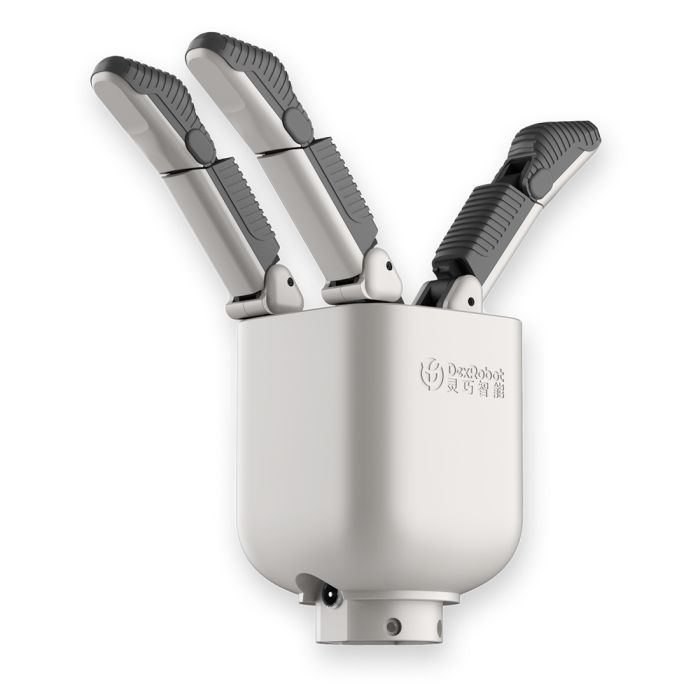
Open any well-used toolbox and the pattern is always the same: a handful of tools do most of the work, and the rest wait in the drawer for the rare job. Robotic hands follow the same logic. The Dexrobot 021S High-Function Three-Fingered Dexterous Hand is built around that handful. It is a three-finger hand that achieves 80% of core hand functions at a lower cost, and it carries vision, touch and adaptive torque control on board, so a robot arm can pick, pinch and place with more adaptability than a simple parallel gripper typically offers.
Robots USA sells the 021S, also designated DexHand021 S, and supplies it to research labs, system integrators and manufacturers across the United States. Every project starts with a quotation from Robots USA, and the same team handles delivery of the hand and its optional accessories, along with technical support once the hand is mounted and running on your arm.
Background
DEXROBOT and the DexHand021 family
The 021S belongs to DEXROBOT's DexHand021 line. On May 30, 2025, at the 2025 Lingqiao Intelligent New Product Launch Conference, the company released three products together: the DexHand021 Pro dexterous hand, the DexHand021 S three-fingered dexterous hand and the DexCap data collection system. At the same event, DEXROBOT proposed a “dexterity index quantification system,” a framework for expressing how dexterous a robotic hand is in measurable terms. For buyers, that launch context is useful: the 021S was introduced as the three-fingered member of a family, not as a stand-alone experiment.
The sources name two versions in this line, DexHand021 S and DexHand021 S-T. The figures on this page are published for the DexHand021 S; the differences of the S-T version have not been detailed and are clarified with your quotation.
Vision, touch and torque in one end-effector
What sets the 021S apart from a basic gripper is the sensing it brings to the wrist. A 5 MP auto-focus RGB camera is mounted in the palm as standard, giving the hand its own view of the object it is about to grasp. Tactile sensing resolves forces down to 0.1 N, so contact is detected early and light. Adaptive torque control provides 0 - 1 A stepless torque adjustment with dynamic adaptation, letting the hand modulate how firmly it closes rather than simply switching between open and shut.
Mechanically, the hand combines three transmission principles: gear, tendon rope and linkage. That mix is common in dexterous hands because each method handles a different part of the job, from driving joints compactly to coupling finger segments into natural curling motions. The result is a hand that weighs just 0.6kg yet offers a 22N grip force and 8 DOFs for flexible industrial manipulation.
Technical Specifications
| Specification | Value |
|---|---|
| Finger count | 3 |
| Degrees of freedom | 8 DOFs |
| Weight | 0.6kg |
| Grip force | 22N |
| Dimensions | 208mm * 80mm * 82.8mm |
| Transmission | Gear + Tendon rope + Linkage |
| Repeatability | ± 0.5 mm |
| Min grasp diameter | ≤ 30 mm |
| Voltage | DC 24 V |
| Communication | CAN FD / RS485 |
| Lifespan | 200,000 cycles |
| Vision | 5 MP auto-focus RGB camera, standard palm-mount |
| Tactile sensing | 0.1 N ultra-sensitive tactile |
| Adaptive torque control | 0 - 1 A stepless torque adjustment with dynamic adaptation |
| Software | Open-source SDK + Multi-protocol |
| Optional accessories | Power Adapter 24V / 3A; USB-to-CAN ZLG 100U-mini (both shipped separately) |
Specifications are as published by the manufacturer and are confirmed against the datasheet at quotation.
DEXROBOT has not published the operating temperature range, the IP rating, the supported software platforms or the materials used; these are confirmed at quotation.
How does a three-finger hand cover most core hand functions?
Most grasps a robot performs in a lab or a work cell fall into a small set of patterns: a fingertip pinch for small parts, a tripod grip for round or irregular objects, and a wrapping grasp for handles and cylinders. A well-designed three-finger hand can form all of these. The 021S spreads 8 DOFs across its three fingers, which gives each finger enough independent motion to adapt its pose to the object rather than closing along a single fixed path.
Precision is where the design earns its keep. With ± 0.5 mm repeatability, the hand supports the precision picking of micro-objects, and its minimum grasp diameter of ≤ 30 mm defines the small end of the parts it is built to hold. Combined with tactile sensing at 0.1 N, the hand can approach fragile or lightweight items without crushing them, then raise torque smoothly when the object calls for a firmer hold.
The trade-off is deliberate. Fewer fingers mean fewer actuators, less wiring and less calibration, which is how the 021S achieves 80% of core hand functions at a lower cost. At 0.6kg, it also leaves more of the arm's payload available for the object itself, a practical advantage on collaborative arms and mobile manipulators where every gram at the wrist counts.
What does it take to integrate the 021S with a robot arm?
The electrical side is straightforward. The hand runs on DC 24 V, a supply level that is standard in industrial automation, and communicates over CAN FD or RS485. DEXROBOT states that the hand seamlessly adapts to mainstream robotic arms via multiple communication protocols, so in most cells the integration work centers on mounting and control logic rather than custom electronics.
On the software side, the hand ships with an open-source SDK and multi-protocol support. An open SDK matters to research and integration teams because it lets them inspect, adapt and extend the control code to fit their own motion planning, vision pipelines or learning frameworks.
Two accessories are offered as options and are shipped separately: a Power Adapter 24V / 3A for bench or lab setups, and a ZLG 100U-mini USB-to-CAN interface for connecting the hand directly to a PC. If your arm controller or host environment has particular requirements, Robots USA reviews them with you before the quotation is finalized.
Who is the 021S for?
The first group is research labs working on embodied AI, grasp learning and manipulation. For them, the combination of a palm camera, fingertip-level tactile sensing and an open-source SDK provides rich data and full control at a cost that makes running more than one hand realistic.
The second group is system integrators and automation engineers who need more adaptability than a parallel gripper offers but do not want the complexity of a full humanoid hand. The CAN FD / RS485 interfaces and DC 24 V supply fit the way industrial cells are already built.
The third group is manufacturers piloting flexible handling of small or delicate parts, where repeatable precision and controlled force matter more than human-like appearance. Universities and training centers form a fourth group, using the hand to teach grasping, sensing and robot control on real hardware.
Buyers who want to compare form factors across the family can review the Dexrobot 021PRO Wrist-Hand Integrated Dexterous Hand (021PRO), the Dexrobot 021MP High-DOF,Multi-Modal,Perceptive Intelligent General-Purpose Dexterous Hand (021MP) and the Dexrobot 021 Concept Version Intelligent General-Purpose Dexterous Hand (021 Concept), or browse the full DexRobot range and the wider Robot Hands category. Robots USA can help you match the right model to your task.
What is the 021S used for?
- Precision picking: Handling small components and micro-objects where repeatable finger placement is essential.
- Vision-guided grasping: Using the palm-mounted camera to locate and approach objects without an external camera rig.
- Delicate handling: Detecting light contact through tactile sensing to hold fragile items without damage.
- Embodied AI research: Collecting grasp data and training manipulation policies on hardware with an open-source SDK.
- Flexible assembly and machine tending: Picking varied parts in cells where a fixed gripper would need frequent changeovers.
- Education and training: Teaching students and engineers how sensing, torque control and grasp planning work together.
Pricing and Availability
Robots USA supplies the 021S by quotation, so the offer reflects your configuration, the optional accessories you need and your integration requirements. Delivery, customs and technical support are arranged together with the quotation. To start the process for the Dexrobot 021S High-Function Three-Fingered Dexterous Hand , use the quotation request available on this page.
Frequently Asked Questions
How much does the 021S weigh and how strong is its grip?
The hand weighs 0.6kg and offers a 22N grip force. That low weight leaves more of the arm's payload free for the object being handled.
How many fingers and degrees of freedom does it have?
The 021S has 3 fingers and 8 DOFs, driven through a combination of gear, tendon rope and linkage transmission.
Which communication interfaces and supply voltage does it use?
It communicates over CAN FD / RS485 and runs on DC 24 V. It adapts to mainstream robotic arms via multiple communication protocols.
Is a power adapter included?
The Power Adapter 24V / 3A is an optional accessory and is shipped separately, as is the ZLG 100U-mini USB-to-CAN interface. Robots USA includes both in your quotation on request.
Does the hand have built-in vision and touch sensing?
Yes. A 5 MP auto-focus RGB camera is mounted in the palm as standard, and the tactile sensing resolves forces down to 0.1 N.
How long is the hand rated to last?
The rated lifespan is 200,000 cycles.
Where can I buy the 021S and what does it cost?
You can buy the 021S from Robots USA, which quotes each project individually based on configuration, accessories and delivery. Request a quotation on this page to receive an offer.
Summary
Like the few tools that come out of the toolbox every day, the 021S focuses on the grasps that matter most and does them well. Three fingers with 8 DOFs, a 22N grip force at just 0.6kg, ± 0.5 mm repeatability, a palm-mounted camera, 0.1 N tactile sensing and stepless torque control give a robot arm real dexterity without the cost and complexity of a full humanoid hand. With CAN FD / RS485, DC 24 V and an open-source SDK, it fits into existing cells and research setups with little friction. Robots USA quotes, delivers and supports the hand across the United States, and for any team ready to move beyond a simple gripper, this page is the starting point.