
DISCONTINUED - Agibot X1 Full-Stack Open Source Humanoid Robot
Out of stock
- MARCA:
- AGIBOT
- NÚMERO DE PIEZA #:
- X1
- ORIGIN:
- China
- AVAILABILITY:
- DISCONTINUED
- SKU:
- AgiBot-X1
DISCONTINUED - Agibot X1 Full-Stack Open Source Humanoid Robot
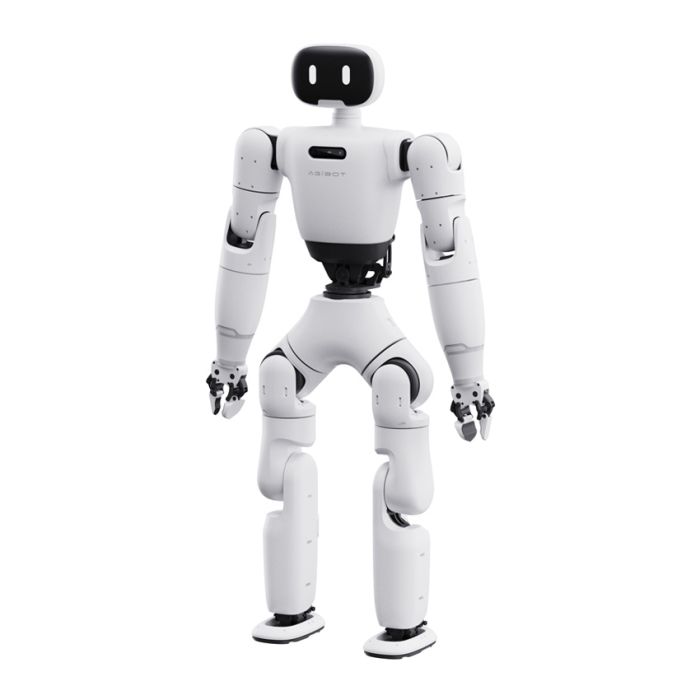
Software developers take it for granted that they can fork a project, read every line and rebuild it their own way. Robot builders have rarely had that freedom. The joints arrive sealed, the controller is a black box, and the most interesting engineering decisions were made by someone else. The DISCONTINUED - Agibot X1 Full-Stack Open Source Humanoid Robot was AGIBOT's answer to that imbalance. It is a walking humanoid built as a modular platform with a high degree of freedom, and its actuators, domain controller and gripper are each documented as building blocks of their own. This is a robot meant to be studied, modified and extended, not just switched on.
Robots USA supplies the Agibot X1 to universities, research labs and engineering teams across the United States and handles the quotation, delivery and after-sales support directly. Because the model is listed as discontinued, every request starts with a check on whether a unit can still be supplied and in what configuration. You know exactly what you are getting before you commit.
Background
AGIBOT and its humanoid lineup
AGIBOT is a humanoid robotics developer whose catalog includes interactive service humanoids built to work in front of people: receptionists, guides and demonstrators in public spaces. The X1 took a different path within the same family. It was positioned as a development platform rather than a finished service robot, aimed at the people who build robots rather than the people who deploy them. That makes it the most engineering-oriented entry in the brand's history, and the reason it still draws interest from research groups. The complete brand range is organized on the AgiBot category page.
Full-stack and open source as a design choice
AGIBOT sums up the X1 in four ideas: modular design, high degree of freedom, safe and lightweight, and highly scalable. All four point at the same goal. Modularity means the robot is made of components a team can understand one at a time. The PowerFlow joint actuators, the DCU domain controller and the OmniPicker gripper each carry their own specification. A high degree of freedom gives researchers enough joints to explore whole-body control instead of a simplified subset of it. A light build keeps the robot manageable on a lab floor. Scalability leaves room to swap or add modules as a project matures, so the platform can follow the research instead of limiting it.
Technical Specifications
| Specification | Value |
|---|---|
| Active degrees of freedom | 34DoF |
| Height | 130 cm |
| Weight | 33kg |
| Runtime | 2h |
| Maximum walking speed | 1m/s |
| Single arm load capacity | 0.5kg |
| PowerFlow R86-3 peak torque | 200N·m |
| PowerFlow R86-3 weight | 1.28 kg |
| PowerFlow R86-2 peak torque | 80N·m |
| PowerFlow R52 peak torque | 19N·m |
| PowerFlow L28 maximum thrust | 110N |
| DCU domain controller weight | 90g |
| DCU communication | 1kHz real-time communication forwarding, 100Mbps communication rate |
| DCU bus | EtherCAT to 3-way FDCAN (5Mbps) |
| DCU software | Secondary development SDK for Linux |
| OmniPicker maximum clamping force | 30N |
| OmniPicker maximum stroke | 120mm |
| OmniPicker communication protocol | CAN, CANFD, RS485, serial port |
Specifications are as published by the manufacturer and are confirmed against the datasheet at quotation.
AGIBOT has not published the battery capacity, the IP rating, the sensor and camera set, the box contents, the packaged dimensions, the onboard compute or the charging time; Robots USA confirms these at quotation.
What does full-stack open source mean on the Agibot X1?
On most humanoids, "open" stops at an application interface. You can send commands, but the layers underneath stay out of reach. The X1 is built on the opposite principle. The stack runs from the actuator in each joint, through the domain controller that relays commands across the robot's buses, up to the software a team writes on Linux. Each of those layers is a documented component with its own specification, so a researcher can work at whichever level the project demands.
This matters because humanoid research rarely lives in a single layer. A locomotion study may need to change how joint torque is commanded. A manipulation project may need to talk to the gripper over its own protocol. A controls course may need students to trace a command from code to motion. A platform that exposes the whole chain supports all three. With 34DoF of active joints in a 130 cm, 33kg body, the X1 gives that open stack a full humanoid to drive rather than a single arm or a pair of legs.
What do the PowerFlow actuators and DCU controller give a development team?
The PowerFlow family spans a wide torque range. The PowerFlow R86-3 delivers a peak torque of 200N·m at a weight of 1.28 kg, the PowerFlow R86-2 delivers 80N·m, and the compact PowerFlow R52 delivers 19N·m. The PowerFlow L28 is a linear unit with a maximum thrust of 110N. Having high-torque, mid-range and compact actuators within one documented family lets a team match joint performance to the load each joint carries and understand that choice in detail.
The DCU domain controller ties those actuators together. It weighs 90g, forwards real-time communication at 1kHz with a 100Mbps communication rate, and bridges EtherCAT to 3-way FDCAN at 5Mbps. A secondary development SDK for Linux sits on top. For a development team, that combination means a high-frequency, deterministic control loop in a familiar software environment. The OmniPicker gripper extends the same thinking to the hand: 30N of maximum clamping force, 120mm of maximum stroke, and a choice of CAN, CANFD, RS485 or serial port communication, so it can be integrated into almost any test bench.
Who is the Agibot X1 for?
The X1 fits best with university robotics departments that want students to work on a real walking humanoid instead of a simulation. Its open architecture turns the robot into a teaching instrument for kinematics, control and embedded software. Research laboratories studying bipedal locomotion, whole-body control or learning-based motion will find the documented actuator and controller layers especially useful, because they can change behavior at the level where their research lives.
Engineering teams at robotics startups and corporate innovation groups form a third segment. They can use the X1 to prototype control software, evaluate actuator strategies or build in-house expertise before committing to a custom design. Developers working on manipulation will value the OmniPicker gripper and its range of communication protocols.
The X1 is the wrong choice for organizations that want a finished robot to greet visitors or present products. Those buyers are better served by an interactive service humanoid such as the Agibot A2 Interactive Service Humanoid Robot or the Agibot A3 Dual-Battery Interactive Service Humanoid Robot. More walking platforms are listed under Bipedal Humanoids.
What is the Agibot X1 used for?
- Locomotion research – developing and testing walking controllers on a full-size bipedal body.
- Whole-body control – coordinating many active joints to study balance, posture and motion planning.
- Robotics education – giving students hands-on access to every layer, from joint actuator to Linux software.
- Actuator evaluation – comparing how the PowerFlow units behave across joints with different loads.
- Manipulation experiments – integrating the OmniPicker gripper into grasping and pick-and-place studies.
- Software prototyping – building and validating control stacks on the DCU SDK before moving to custom hardware.
Pricing and Availability
The Agibot X1 is supplied by quotation. Send Robots USA your request with a short description of your project, and the team will reply on whether a unit can still be supplied and in which configuration. Delivery, customs and support are all arranged with the quotation, so there is one point of contact from first question to commissioning. A quotation request is available on this page.
Frequently Asked Questions
Is the Agibot X1 still in production?
The model is listed as discontinued. Robots USA checks with every request whether a unit can still be supplied and in which configuration.
How tall and heavy is the Agibot X1?
The X1 stands 130 cm tall and weighs 33kg, which keeps it manageable in a lab or classroom.
How long does the Agibot X1 run?
The X1 has a runtime of 2h. Plan longer experiments around breaks for recharging.
What software does the Agibot X1 support?
The DCU domain controller comes with a secondary development SDK for Linux. It sits on a controller that forwards real-time communication at 1kHz.
How much can the arms carry?
Each arm has a load capacity of 0.5kg. That suits light manipulation and research tasks rather than heavy handling.
Which bus does the DCU domain controller use?
The DCU bridges EtherCAT to 3-way FDCAN at 5Mbps, with a 100Mbps communication rate. That gives the joint actuators a fast, deterministic link to the control software.
Where can I buy the Agibot X1 and what does it cost?
You can buy the Agibot X1 from Robots USA, which quotes each request individually. Submit a quotation request and the team will reply with the cost for your configuration, including delivery and support.
Summary
The Agibot X1 brings to humanoid robotics what developers have long expected from software: the right to open the stack, read it and rebuild it. Its documented PowerFlow actuators, DCU domain controller with a Linux SDK, and OmniPicker gripper turn a 34DoF walking robot into a platform for research, teaching and prototyping, not a sealed appliance. The model is discontinued, so availability is checked case by case, and Robots USA handles the quotation, delivery and support. For teams that want a humanoid they can truly take apart and rebuild, this page is the starting point.